
Author: Kim Scheidt
Published in Communities Magazine Issue #152
I received a phone call from my mother in the spring of 2009. A high-school teacher in her late 50s, she was overjoyed to tell me that she had just finished her last full day of work for the rest of her life. I congratulated her on her semi-retirement, and in my head a voice said, “I did that five years ago.”
Quite a while ago I realized that if I kept a modest cost of living I would not need to work a 40-50 hour a week job for the rest of my life. Instead, I could work part-time and earn enough money to cover my costs. Since then I’ve found that the more I simplify my life, the less time I need to work to earn money. By reducing my economic impact I believe that I also directly reduce my ecological footprint on the earth, which is important to me too.
This line of thought is slightly different from what mainstream society often tells us. A consumptive lifestyle is still seen as affluent. And a 40-plus hour week is standard. Many people would find it hard to believe that someone could have a happier life by giving up certain creature comforts. But in my experience and those of my community-mates around me, simpler living has led to an increased quality of life.
If you would like to simplify your lifestyle, a good first step is to reanalyze what is perceived as necessary, be it travel, good restaurant meals, movies and theater, or whatever, and put your resources toward what you care most about. Then look to see if there are any “necessities” you pay for that you personally could do without. I recommend spending some period of time living in a third-world country. Learn that everyone in the world does not necessarily have a vehicle, a refrigerator, running water, flush toilets, a washing machine, a telephone, air conditioning…the list goes on.
I spent about four months living in Costa Rica, where the sole fact that I was from the United States traveling for leisure made me seem supremely rich to the locals. The people I was traveling with gave me encouragement to go outside my comfort zone and work on simple living closer to nature using limited resources. Unfortunately, it seems that a great many people in third-world countries, whose ancestors have excelled at simple living, would do just about anything to live the perceived richness portrayed in Hollywood movies.
When I came back to the United States I was able to figure out for myself what is really important to me. Over time I’ve realized that I can do without a refrigerator, running water, a flush toilet, a shower, and a washing machine. What I do find necessary are electric lights, high-speed internet, good food, fresh air, strong social connections, and control over my own time.
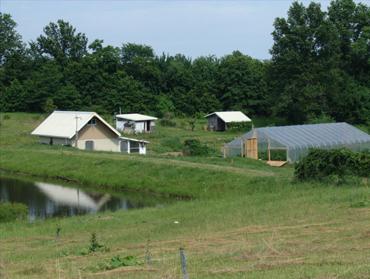
I live in an intentional community that has a strong focus on permaculture and sustainable living. We aim to have a very small ecological footprint and to be self-sufficient in all the ways we can. We utilize human power for most applications and keep track of the times when we do use fossil fuels, vehicles, and heavy machinery. Our community exists within a larger network of intentional communities in the area that are exploring different approaches toward right livelihood.
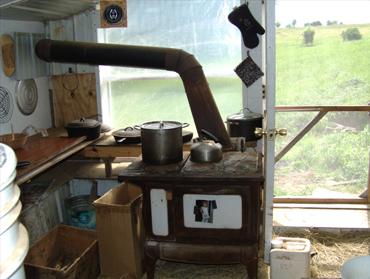
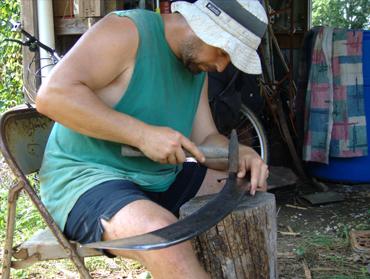
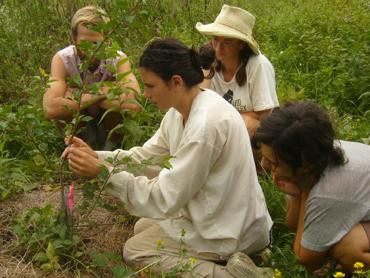
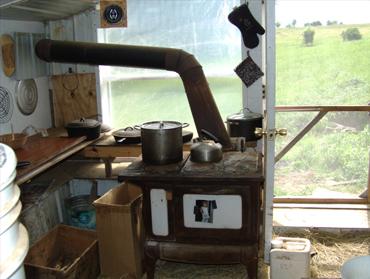
Our primary dwelling that I live in is a small passive-solar house with an attached greenhouse space, and this design vastly reduces the amount of fuel we need to provide heat in the winter. We do all our cooking and heating with the sun or with wood, a renewable resource that we harvest from our land using hand tools. To be honest, we have borrowed a chainsaw a couple of times in order to fell some larger trees. But for the most part we keep to our ideals of doing it all by hand.
We are not connected to grid electricity. The power draw of the electric appliances we use is what determines how many thousands of dollars we spend on purchase and upkeep of our power system. For the time being, we have chosen to limit our power load to running very low wattage electric light bulbs, computers, and stereo. The refrigerator-freezer, ubiquitous in households across the U.S., is a power-hog appliance that we’ve chosen to live without.
It has been over seven years since I’ve had a refrigerator. In order to do without, I’ve learned to change the way I cook and eat. During the warmer months the cook is careful to make only so much leftovers that can be eaten up the next day at lunch. And in our climate we have refrigeration roughly half the year just by putting things outside our door. Spoiled food is fed to our animals or composted. Many items commonly kept in a refrigerator actually store just fine at room temperature, and a diet that includes little or no meat makes this easier too. We have plans to build an ice house one day in the future. At that point we will have the luxury of refrigeration, but it will be a very low-tech version.
Our drinking water comes straight from the sky. We collect rain off the metal roof of our main building into a cistern. We use a hand pump to draw water up from the cistern and it goes through a filter before consumption. It is some of the tastiest water on the planet. For other uses such as doing dishes or washing up we use non-potable water that we haul in buckets either from our pond or from a rain catchment barrel. We do not have running water (although we joke that we have “walking water”). Our system is one that requires some physical labor but very little money or infrastructure.
And what about the flush toilet? We are fortunate to live in a part of the country with few zoning laws or building codes and thus have been able to build and use an outhouse that is a mouldering toilet. Human wastes, to which we occasionally add soil and mown grass, decompose over time giving off little odor. Eventually this compost can be spread around trees in our orchard, closing the loop in the fertility cycle.
Cleanliness is an interesting topic. I certainly do not live in a sterile environment, and that makes my life so much richer. My routine used to involve daily hot showers that would dry out my skin, and I frequently shampooed my hair. I would then slather my body in lotion to restore lost moisture and put styling goop in my hair. I was happy to find that when I changed my routine to scrubbing up with just a washcloth and warm water my skin felt pretty amazing. Another interesting discovery is that pond water does wonderful things to my hair that I can’t quite get with gel or hair spray.
We wash laundry by hand using water from our pond. When I take our clothes down from the line they always smell nice and clean; however, there are often stains that just don’t come out the way they would with a power washer. My solution is that I maintain a set of clothes for when I need to look “nice” and I have another set that is for everyday use. I’m fortunate to live in an environment where appearance is not so important, though I do admit I enjoy fashion. Community-mates often gift clothing that doesn’t suit them, and once or twice a year I go to a thrift store to add new items to my wardrobe.
Okay, so what else do people spend money on? One particularly controversial thing that I go without is health insurance. My philosophy is that my right livelihood is my health insurance. If I live in alignment with the universe then I will be taken care of. I understand that this way of thinking does not satisfy all people. I take full responsibility for my health. I hope to embrace death when that time comes. (And living on a low income helps me to qualify for sliding scale rates available from some health practitioners.)
I say that I only work one day a week because that is the amount of time I spend outside my home earning money. However, all my days are filled with physical and mental labor, but those are things I do for myself and for my community, so in many ways I do not consider them work. For the most part I get to choose how I spend my time and only have to do any particular task for as long as feels good to me. I find it really inspiring when there is an obvious connection between the energy I put into a project and the results I get to enjoy, be it in the garden or orchard or in the development of my child.
One of the major roles I play in my life right now is that of being a parent to a youngster. My daughter is being raised in what I consider an almost ideal environment for her. She has both her mother and her father around most of the time. Although she is an only child she is well socialized with peers and has relationships with adults other than her biological parents. She lives rurally but is not isolated. We have clean air for her to breathe, healthy food for her to eat, and pure water for her to drink. She gets plenty of exercise and loves to be outside.
There is a pretty good support network for being a parent around here. I certainly believe that parenting is one of the most challenging things I have taken on in my life. It is so valuable when others make an effort to be an ally to myself and to my child. I believe that in an ideal world there would always be at least three parents to any one child. I don’t currently have that situation, but it certainly would be possible to do so within a community setting.
Pioneering a community is another huge project I’ve taken part in. There are benefits—mainly that my personal vision is incorporated in the shape our community takes. Starting from scratch on raw land is certainly not easy and it is not something I would have ever undertaken alone. A great benefit of settling our community where we did is that members of the other established local intentional communities gave support to us in many and varied ways. So much of our time in the beginning was taken up with satisfying the most basic of our physical needs—a place to sleep, a place to cook, water to drink, etc. All this was done on a pretty tight budget using primarily human power. Phew.
There are certainly ways in which we have fallen short of our ideals. Sometimes we make the choice to spend money on an item rather than taking the extra time and energy to make do with resources we already have at our disposal. When we first moved onto the land six years ago we made choices to build structures that placed values such as speed of construction, comfort, durability, and function over aesthetic beauty and the use of completely local or sustainably harvested building materials.
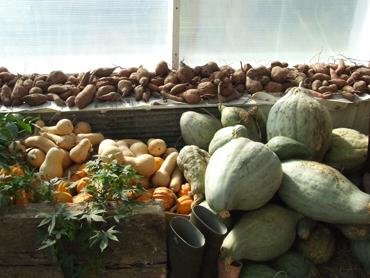
We also still buy most of the food we eat. However, each year we get closer to being self-reliant in that area. Our fruit and nut orchards will begin bearing soon, and the output from our annual garden continues to increase. It is helpful to keep in mind the long-term goals and vision—the way it is today is not the way it’s always going to be. I do finally feel that we are out of the pioneering stage. We have working systems in place and so now we can focus on simply improving our surroundings and quality of life.
I never thought I would be an activist, but I am. I’m proactive in that I am living the change I want to see. I’m demonstrating that there is another way. I never thought I would live in a fishbowl, but I do. Hundreds of people come by each year and we say, “here is our greenhouse, here is our garden, this is how we live.” I tend to forget how extreme my life is until I go somewhere out in the mainstream world. Now that’s a freaky place.
Keep the conversation going with these pieces
There are no available blogs
Subscribe to our newsletter for fresh stories and community updates delivered to your inbox.
Get unlimited access to courses, exclusive member events, and a supportive network of community builders
Access all courses, books, and premium content
Member-only workshops and community builders
Member-only workshops and gatherings
We use cookies to improve your experience on our site. By using our site, you consent to cookies.
Manage your cookie preferences below:
Essential cookies enable basic functions and are necessary for the proper function of the website.
These cookies are needed for adding comments on this website.
Statistics cookies collect information anonymously. This information helps us understand how visitors use our website.
Service URL: policies.google.com (opens in a new window)
A residential project: people live here as their primary home.
An institution, business, network, or project that isn’t a residence (e.g. a learning center, farm, or network with no one living there full-time).

{{ item.label }}
{{ item.value ? item.value : currencyFormat( item.amount ) }}
Subtotal
{{ currencyFormat( pricing_summary.total_amount ) }}
There are no results matching your search