Author: Rebecca Dale
Published in Communities Magazine Issue #149
Growing older was not sitting well with me. At 65, I was having an identity crisis worthy of adolescence, moodiness and all. Who was I now that I was retired, no longer able to answer the question “What do you do?” with a job title? Who was this person in the mirror with gray hair and wrinkles, with aches and pains and other intimations of mortality? When people my age got their names in the paper, they were usually labeled as “elderly,” a term that sounds like “has-been” to my ears. Although we sometimes refer to older people who have great influence and responsibility as “elder statesmen” or “elders” in our churches, we don’t seem to have a respected role for “elders” in everyday life, so I didn’t know how to be one. All the messages I had received up to that point told me there was no honor in growing older, only a gradual shuffling out of the category of adulthood into a separate world of retirement communities, senior centers, and the patronizing smiles or thinly veiled impatience of people who think you no longer have a brain. No wonder I was depressed.
I had been widowed for a decade. My children and grandchildren lived at opposite ends of the continent. I tried to fill the identity gap with volunteer work: nature education, garden writing, agitating for a farmers market. But these things held little value in a place where shopping malls and suburban sprawl were bulldozing their way across the family farms and small towns I had once known, and which now seemed as obsolete as I felt. My old way of life was gone, my sense of place, my human connections. Then I learned about intentional communities through the internet, which led me not only to a new home but a new life partner as well.
Currents is a small community in rural southeastern Ohio, founded nearly 30 years ago, along with several other small communities, in the beautiful foothills of the Appalachians. Five original members remained at Currents, all 60-ish and beyond, all community elders with much community wisdom to share. I would be joining them as an elder in community with much to learn. Since my joining, two mid-life couples with young families have become members also, and so I’ve become something of a bridge. Like the younger ones, I’m a newcomer to community life, but I’m also an older person growing into a new role of…elder? What can this mean?
That summer of 65, the summer of my discontent, I went to a week-long study gathering with Joanna Macy called “The Great Turning.” I was sharing some of my feelings about aging with another woman of my generation, when she smiled brightly and said, “Why, don’t you know? We’re the hope of the future!” Surprised, I answered, “I always thought children were the hope of the future.” “Oh no,” she replied, “Children ARE the future. But we’re the HOPE of the future because we hold the wisdom.”
We hold the wisdom. That sounded so right, yet the more I turned that statement around in my mind, the more it seemed as if I had been handed a gift that needed to be unwrapped. And each layer of wrapping was like a provocative question, and my search for answers became like a little treasure hunt through my own life.
Is it wisdom, then, that makes one an elder rather than merely old? What is this wisdom? And where does it come from? Obviously age alone doesn’t automatically make one wise. No more than simply reaching 18 or 21 automatically makes one an adult! One can be childish and self-involved at any age, but I’ve noticed that those we call elders are those who have done their inner growth work, who have successfully navigated the developmental stages of life.
I looked again at the human development theories of Abraham Maslow, Erik Erikson, Jane Loevinger, and others, and was struck by how much our society functions like an adolescent, competitive and concerned with appearance and social conformity, things that I stopped caring about long ago. I’m much more inner-directed now, while probably more idealistic and outwardly focused than ever. Mainstream society looks at me and says I’m past my prime; developmental theories suggest I’m just now getting there. This is definitely good news! Aging doesn’t have to mean drying up. On the contrary, it appears that when people open to inner growth, including its ethical dimensions, “they still bring forth fruit in old age, they are ever full of sap and green.” (Psalms 92:14 RSV)
OK, so we’re flexible (green), draw on juicy, nourishing resources (sappy!), and continue to be fruitful. But what is the shape of this new fruit? And how is it to be shared? In traditional societies, the elders assimilated and passed on their culture’s skills and values. But in our adolescent culture, educational institutions and mass media assume that role, teaching the values of wealth and the skills of competition. Such “conventional wisdom” tends to drown out the voices of our true elders who could call us to a saner way of being human. We have a culture that marginalizes our elders, so many of us have no models for elderhood. Who will show us how to access our own wisdom and share it?
Recently I read about some studies reported in the New York Times indicating that our brains actually learn a new trick as they age.[www.drweil.com/u/QAA400422/My-Aging-Brain-Whats-Your-Name-Again.html] They are better able to take in seemingly irrelevant bits of information often overlooked by younger brains. And in spite of occasional memory glitches, our older brains, while a bit slower, actually get more creative in drawing on our storehouse of these many bits of knowledge and experience and integrating them into helpful forms. What this suggests to me is that if wisdom is experience grounded in maturity, I actually have an inner elder ready to kick in and put together some wisdom when I need it. And so do my mature and ripened friends, who have different knowledge and experiences. What if we let our inner elders out to play more often, maybe in circles of elders, maybe together with others of all ages? Could we conjure up some wisdom magic? How cool would that be?
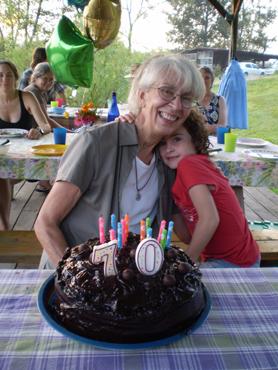
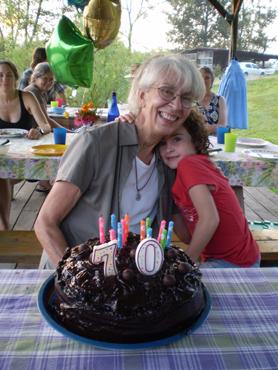
Actually, I’ve just described what I’ve seen happen on those occasions when community works well, especially multi-generational communities like mine. Younger people can develop nurturing, non-parental relationships with older ones; our presence can help to anchor their lives in a deeper historical context. I think this is part of what “holding” the wisdom means. Older people get to see the world anew through younger eyes. This keeps us on our toes, gives our wisdom-generating apparatus material to work on.
But there is a particular form of wisdom that our community elders are in a unique position to share: the values and the skills of creating and maintaining community. This is not my personal wisdom because I came to community late in life. It is something that I am learning from those who have been here for many years, who know something (however imperfect our actual practice may be) about organizing, resolving conflicts, cooperation and communication, and just plain thinking well about what community really means—and what it can mean for a world that sorely needs more of it.
What is MY wisdom? What can I pass on to a generation that is inheriting a dramatically changing world? Knowledge of ecology and restoring the land, yes. Knowledge for re-skilling in food growing and processing, of course…but knowledge isn’t wisdom.
I used to think that my ability to navigate change was my particular gift. I once lost a farm and a way of life that I loved. I moved on and found other good ways to live and love. But “moving on” is not the same as thriving unless one becomes anchored again in a place and with a people. Just changing careers is not enough. People who have lost their way of life as so many did in the wake of Katrina, and now in the Gulf disaster, cannot simply be re-trained and “move on.” One needs a sense of place, and connection to a people and a way of life that matters, and that continues. The many young people and families who are finding their way to Currents (and other communities) these days to experience these things are longing for them.
This kind of placemaking is the wisdom that our community elders hold. I trust they know how very valuable and wise this way of life is, this way that they have struggled for, this way into a future with hope. This is the wisdom that I am learning, the wisdom that is turning me into an elder, instead of merely elderly.
Keep the conversation going with these pieces
There are no available blogs
Subscribe to our newsletter for fresh stories and community updates delivered to your inbox.
Get unlimited access to courses, exclusive member events, and a supportive network of community builders
Access all courses, books, and premium content
Member-only workshops and community builders
Member-only workshops and gatherings
We use cookies to improve your experience on our site. By using our site, you consent to cookies.
Manage your cookie preferences below:
Essential cookies enable basic functions and are necessary for the proper function of the website.
These cookies are needed for adding comments on this website.
Statistics cookies collect information anonymously. This information helps us understand how visitors use our website.
Service URL: policies.google.com (opens in a new window)
A residential project: people live here as their primary home.
An institution, business, network, or project that isn’t a residence (e.g. a learning center, farm, or network with no one living there full-time).

{{ item.label }}
{{ item.value ? item.value : currencyFormat( item.amount ) }}
Subtotal
{{ currencyFormat( pricing_summary.total_amount ) }}
There are no results matching your search