
Author: Carol Pimentel
Published in Communities Magazine Issue #144
Why would anyone voluntarily give up having a place of her own? “I could never do it,” say my more traditional friends, shaking their heads in wonder. “I could never handle other people in my home. I can’t even take house guests for more than three days! I need to have my own space.”
Having one’s own house (and washer, dryer, garden, lawn mower, stuff) may be the American Dream, but some of us have a different dream: a dream of learning to live more cooperatively with others and sharing resources rather than each needing to have our own. And as it happens, the skills it takes to live closely with others and low on the food chain are extremely useful when the economic systems of the larger culture hit the skids.
I’ve lived in shared households all my adult life. Shared living has always been my chosen lifestyle, both for the companionship and the sharing of resources. When other young women were dreaming of becoming brides, my dream was to find my tribe. I was part of several start-up groups exploring intentional community, but none of them got off the ground. However, at age 35, I joined with three other women to buy a large house on an acre of land in San Luis Obispo, California as an experiment in community living on a small scale.
None of us could have afforded to buy property alone, and none of us wanted to dedicate our lives to earning enough to do so. We reasoned that if we shared living expenses we could all be free from the rat race. We called the place Caballeros House, and buying it jointly was a splendid decision. There was lots of turnover in the household as people’s lives changed, but for 20 years there was always a houseful of folks living and growing together.
Communication
Conflict was inevitable, and we had to learn how to manage it. One day a few months after we had moved in, Maxine came home to find a new piece of wall art mounted at the end of the hall. “Who put that there?” she demanded. “I did,” replied Elizabeth mildly, “I think the colorful herb and flowers in the poster look nice there.” “Well I don’t like it,” grumbled Maxine, slamming her door. Elizabeth’s feelings were hurt, and we all tiptoed around on eggshells for a day or two. Finally we called a house meeting to discuss what had happened and how we would handle such things in the future. The real issue was not the poster, of course, but territoriality. Max was sensitive to changes being made without consulting her, and Liz wanted the freedom to experiment without new additions being shot down. We came up with a simple policy that we called ”Try it for a week.” Anyone could bring anything into the house on a trial basis and the others would wait a week to pass final judgment. As it turned out, we discovered that an immediate negative reaction frequently dissipated after living with the change for a while. “Try it for a week” saved us innumerable arguments and much unpleasantness, and we often laughed remembering the stir caused by that inoffensive poster.
Living with others presents challenges. Relationship dynamics can get prickly and fantasies that the household will meet extended family needs or that everyone will pitch in equally may not pan out. Mutual adjustment is necessary. It takes a couple of months for a new resident to get into the flow of the household, and there’s a lingering emptiness when a much-loved person departs. It’s all part of the ebb and flow.
Communication is the key to making it work. Every new resident at Casa Caballeros had a long interview, in which we shared our values of recycling, composting, and conserving energy and resources, to determine whether s/he would be a good match for the household. We talked about mutual respect and the importance of communicating with one another about needs and irritations so that we could mutually adjust to prevent chronic complaints or resentments. There was no structure or expectation of how much we would interact; that was allowed to develop organically. Sometimes we shared meals, late night schmoozing, or celebrations. Always we respected one another’s privacy.
Alternative economy
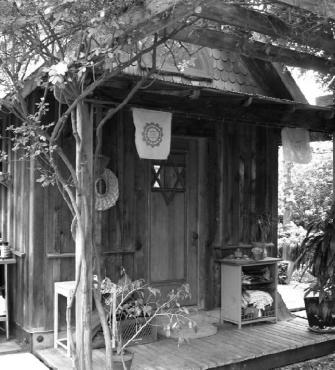
Eventually I married one of my housemates. When two of the original owners chose to move on, Don and I purchased their interests and Casa Caballeros entered a new phase as a shared home. Don was a remarkable artist/builder who transformed the yard with small outbuildings and tree plantings. Living in the outbuildings allowed us to include more people in the main house. The rental income covered most of our expenses, so we rode out the financial downturn of the ’80s without blinking an eye.
Valuing frugality, we all lived well on the cast-off treasures of others. We seldom paid retail price for anything since with patience anything could be found at swap meets or garage sales, everything from boots to vacuum cleaners to table saws to glittering sequined gowns.
Every Sunday at 6 a.m.—no kidding, every Sunday—Don was up and off, flashlight in hand, to what we called the “Church of the Holy Swap,” the weekly swap meet, to inspect the offerings of the day, coming home a few hours later to display his bounty. He had a great eye and the skills to repair and upgrade virtually anything. I remember when he brought home a plastic grocery bag of dirty looking sticks of wood and some rusty springs, which he assembled into a lovely Mission style rocker. Friends would place orders with Don, and sure enough, within a few weeks he could usually come up with the item.
Don was not alone in his dedication to reuse and recycling; we all held these values, and others in the household learned to be “bottom feeders” too. Sometimes we’d toodle around construction sites scavenging building materials. Those materials went into tidy resource piles to be used as needed for building projects on the property.
When the local university let out for the summer, we invited friends to join us with their trucks for the annual dumpster dive day. Armed with rubber gloves and dressed in garbage clothes and throwaway shoes, we went from dorm to dorm and behind student apartment buildings on a mission to rescue usable items students had predictably tossed into the trash. We loaded up on enough unopened sundries like dish soap, shampoo, and cleaning supplies to last for months. We scored so much—clothing, appliances, office supplies, furniture, and even jewelry—that we couldn’t use it all. Some items we sold second-hand for cash, but we’d donate much of it at the end of the day. Sometimes we’d take a few kids with us. It was a fun adventure for them to be allowed to get dirty and find so many cool things for free. We’d talk about the extravagant waste they’d seen and how they felt about donating to the homeless shelter. It was a great learning experience.
When a household is made up of people with a variety of skills, everyone is enriched. Physical skills, interpersonal skills, and creativity are all valuable contributions. Don was indisputably the swap meet king, our procurer of goods for very little cost. Allen was the consummate host and chef extraordinaire, often spontaneously firing up the grill and inviting anyone who was home to participate. I was the nurturer, communicator, and mediator, attending to relationships and dynamics in the group and willing to confront problems when they arose. Terry brought music. Kari was a gardener. Elizabeth, our elder, was the “ground. ” While the rest of us were busy with work, activities, and multi-tasking, her days were filled with reading, caring for the chickens, and deadheading the flowers. Her deep centeredness and quiet spirit permeated the atmosphere and brought peace to us all, while our activity enlivened her. Everyone pitching in with chores meant less burden an any one individual.
Beyond ourselves
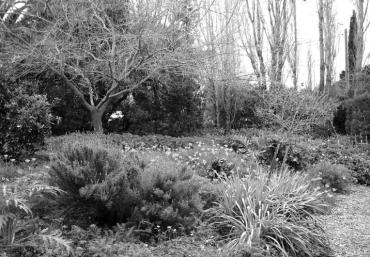
In anticipation of Y2K, several friends joined us to expand our gardens so we could all share the organic produce, fruits, and nuts. We developed the yard into a food forest, with a flock of chickens for fresh eggs. The security of knowing we were in it together prevented many a sleepless night, and though the crisis never happened, we all loved gardening together and sharing the bounty. And with so many of us involved, whatever tool we needed someone was bound to have.
Taking community and resource sharing beyond our own household, we formed an informal group with several couples and singles that we called The Barn Raisers. Anyone who had a big project could put out a call and those who were free would descend en masse and work miracles. Together we cleaned and painted houses, installed cabinets, cleared yards (lots of this!), and once we even installed a huge metal bridge over a creek. Our workdays always included wonderful meals and socializing together, sometimes into the wee hours. I wonder how much money we collectively saved over the years by helping each other in these ways?
We made the house and property available for any number of community events and groups. There were weddings, ceremonies, Cub Scout campouts, bonfires, meditation groups, workshop retreats, and big potlucks. A Mardi Gras float was built in the yard one year.
All good things come to an end
The community at Caballeros house lasted from 1985 through 2006, when sea changes in our lives dictated that Don and I sell the house and go our separate ways. We invited anyone who felt connected to the place to a huge “house closing” party to honor the many years of community sharing. About 150 people came to share stories, look at the photo wall, write in a memory book, hug, laugh, wipe away tears, and say farewell to an era. Three young people who had spent time with us as children were part of the celebration. One drove up with her daughter from Los Angeles, one drove down from college in Davis, and one flew in from Brussels, Belgium. All of them said they wouldn’t think of missing the event, Caballeros had been such an important part of their early lives, showing them an alternative way to live.
Not everyone has the temperament to share a house with other non-related adults, with all the comings and goings and the juggling of personalities and emotions involved. But for those who choose this lifestyle there is great wealth to be found in the realms of personal growth, shared resources, spontaneous celebration, and financial freedom even in economic downturns. Now, that’s MY kind of “social security!”
Keep the conversation going with these pieces
There are no available blogs
Subscribe to our newsletter for fresh stories and community updates delivered to your inbox.
Get unlimited access to courses, exclusive member events, and a supportive network of community builders
Access all courses, books, and premium content
Member-only workshops and community builders
Member-only workshops and gatherings
We use cookies to improve your experience on our site. By using our site, you consent to cookies.
Manage your cookie preferences below:
Essential cookies enable basic functions and are necessary for the proper function of the website.
These cookies are needed for adding comments on this website.
Statistics cookies collect information anonymously. This information helps us understand how visitors use our website.
Service URL: policies.google.com (opens in a new window)
A residential project: people live here as their primary home.
An institution, business, network, or project that isn’t a residence (e.g. a learning center, farm, or network with no one living there full-time).

{{ item.label }}
{{ item.value ? item.value : currencyFormat( item.amount ) }}
Subtotal
{{ currencyFormat( pricing_summary.total_amount ) }}
There are no results matching your search