

Deep breath in, deep breath out. I sit on one of the twin beds in our upstairs meeting room, leaning against the wall, with a steaming cup of freshly harvested and brewed turmeric ginger tea, mildly sweetened with honey from the bees on the farm. A small smile of contentment and anticipation plays across my lips as the drumming of the rain on the roof fills the room and individuals start appearing at the top of the staircase. A wet morning rewards the choice to spend time with chosen family, discussing important issues and fostering our common vision.
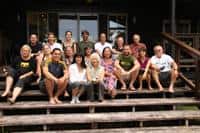
I am a founding member of La’akea Community (Big Island, Hawaii), which, formed 10 years ago, has 11 adult members, two kids, and one trial member. Our years of success stem from a shared belief that people must continuously connect with one another and the land to live sustainably. A primary way we connect is around food.
Business meetings at La’akea follow a format designed to encourage the honest sharing of minds and hearts. We begin with “check-ins,” then move on to “appreciations” and “withholds,” followed by “announcements,” “homework,” and then finally the “agenda.” Some of these processes I will describe further on.
At the meeting today, our facilitator starts by calling for check-ins. These are typically brief reports where individuals share their current emotional state and any plans for the day. One community member—a tall, dark-haired man, a strong presence on the land and loving father—speaks first. “I feel refreshed, well-rested, and happy the weather is complicit with our need to stay in this morning. I do not relish being soggy.”
As others take turns sharing, I appreciate the wisdom and intelligence of our most senior members, the patience and joy of several of the women, and the peaceful energy of several others. Our group is diverse and eclectic, ranging in age from 32 to 84, in education from high school to Ph.D., and in financial status from enough-to-get-by to established-retirement-fund. We are all fit and healthy within our varying body types. More than half of the group initially connected through the Network for a New Culture.
I take a turn at checking in. I begin by sharing an appreciation: “I am incredibly grateful for our daily experiment in how to live together. I appreciate every one of us for our commitment and dedication to each other and the land we steward.” I then share that I feel anxious that there are food-related items on the agenda. Food has been at the center of many energy-filled discussions throughout La’akea’s history. I am going to share several episodes from that history to provide an insight into our community processes.
Since our inception, we have been a partial income-sharing community. We take in money through collective endeavors (like events and guest fees) as well as through monthly membership dues. We use that money for a variety of group needs—for example, for our truck and tractor, tools, garden amendments and supplies, household and office goods. We use that money to buy food.
Early in our history, members used La’akea money to buy whatever food they wanted, with the exception of: foods deemed “luxury items” (coffee, chocolate), fruit over $2.50/lb., and any other items over $8/lb. This system was too vague and had to be changed within a year and a half. We devised a “food list”—a list of items we agreed were OK to buy. We made this list by starting with basic staples that were always in the kitchen, then added items we each liked to eat regularly. Faced with the daunting project of getting everyone to agree on every item on the list, we agreed (through consensus) to scratch consensus in this instance and use a voting system instead. If at least three people wanted an item on the list, we kept it. About two hours later, we had our first “food list.”
Moving forward in La’akea’s history, the dance around food came to include not just what we bought with La’akea money but also what we didn’t buy—what we chose to grow, harvest, prepare, and eat from the land.
“Did anyone harvest the cacao?” I heard this question within a year of the exultant cry, “The cacao is fruiting!” The answer: “Well, no. The last time I made a chocolate cake I used the cocoa powder from the store. It was sitting right there on the shelf and I chose what was easier.”
“For dinner tonight we have wild pig and taro stew, taro with pesto, heart of palm salad, and a kale salad.” Most of the items were grown on the farm, harvested and then prepared. This meal took most of a day to prepare, the reward being to eat food grown and harvested from the land.
“For dinner tonight we have tortillas, black beans, rice, grated cheese, avocado, and salsa.” One, maybe two, of these items is from the land: the avocados and the salsa (if freshly made). Everything else was purchased. This meal took only a few hours to prepare, the reward being ease.
The tension around the foods we bought and foods we grew and harvested eventually, about two years ago, led the topic back to the business meeting. If the general idea was to grow our own food and eat locally, why was our “food list” so big? Time had arrived for revision. We began by airing our concerns through a go-around. Each person in turn shared their thoughts and feelings around food in our community. This time we shared a strong desire to motivate change in our eating. We removed from the list (to name just some of the items) cocoa powder, dates, cashews, yogurt, cheese, and mayonnaise. A new list was born.
We now return to the present day. The rain continues to patter against the roof as I take another sip of sweet, nourishing tea. “Food list” has made it to the agenda yet again.
“Does anyone wish to share a withhold?” our facilitator asks. A withhold is a feeling or judgment that someone has kept to themselves—something that they are holding on to—that keeps them from being present. They share to be more present, to connect with the person or people to whom their withhold is directed.
“Yes,” hisses one of the members. She continues in an audibly irate tone, “this is for the whole group. Last night when I went to make dinner, I was disgusted by the mess on the counter. I went to put my collards down next to the sink and I saw a spattering of blood. I know a pig was slaughtered yesterday morning and to find this was beyond tolerable.” After hearing this withhold, we chose to make it a business item, to discuss raw meat and cleanliness in the kitchen at greater length.
Are you vegan? Vegetarian? Omnivore? Do you eat only raw food or prefer ayurvedically-prepared meals? La’akea’s mission statement welcomes such diversity: “We embrace processes which work to bring us into unity, while respecting each person’s autonomy.” Take a poll at La’akea and you’ll find one raw vegan, two vegetarians, four gluten-free, and several serious carnivores. Now let’s share a kitchen and make community meals together.
We decided to address the issue of the bloody counter by using an abbreviated version of the Hawaiian ho’oponopono. Each member shared their story:
“I assisted in the harvesting of the pig. We were very careful to do most of the work out in the slaughterhouse. We only did the final packaging for the freezer in the kitchen.”
“I remember wiping the counters very thoroughly.”
Then each shared how they were responsible for the blood on the counter.
“I could have gone over all the counters once again after everything was put away.”
“I could have been more careful to use only one area.”
“I could have wiped up the blood when I saw it.”
“I could have helped when I saw the process going on in the kitchen.”
After everyone, including the angry community member, took responsibility for their actions and feelings, the ho’oponopono was complete. We decided to move forward with a renewed consciousness around meat: to be more thorough in cleaning up, to use only the red cutting board, and to use the counter to the left of the first sink.
As we go on to address the topic of the food list, it’s obvious that food stirs our emotions. Culturally-influenced food choices, personal dietary needs, and sustainability ideals swirl together in a potential maelstrom. Every community, regardless of size, addresses these issues. Some communities come together around food. I’ve seen vegan communities, primal-diet communities, and 80-10-10 groups.
Sustainability is difficult to measure; there are many perspectives on what it is. From a land-based permaculture point of view, we could study the climate zone and research the crops historically grown in the area, especially those grown by the more indigenous cultures. Taro, breadfruit, turmeric, and sweet potato exist at the top of this list for Hawaii. Other tropically-oriented foods found here come from Central America, Brazil, Thailand, and the Philippines, such as cacao, palms, ginger, pumpkins, and spices. These plants grow well here and are easy to propagate; many are perennials that hardly ever succumb to insect or other plant pests; if you put them in the ground and walk away, these plants will do fine. Our need for ease will clearly be met by choosing these plants.
Yet there are other ways to view sustainability. Most of the members at La’akea did not grow up eating these foods, so…“What do we choose to eat?” “What do we choose to harvest?” This emotional angle asks, “Which foods bring us comfort? Which foods are linked to years of memories?” Our taste buds know these foods, as do our digestive systems. So we continue to grow the vegetables that need more care, more fertilizers, more protection from hungry insects, and require the purchase of seed shipped in from the continent. Balance, harmony, and sustainability are not just questions of physical reality.
I consider myself and many others at La’akea “opportunistic locavores.” As we open to the opportunity, we eat locally. We grow and purchase foods we know and love and foods we are learning to love.
The anxiety I felt earlier fades away as I realize it’s not all about the food list after all. It is about the connection that listening and understanding brings. Our community continues to thrive because we choose to take the time to connect with our chosen family. We choose to remember that to live sustainably we need to practice compassion, understanding, acceptance, and our consensus process.
Tracy Matfin is an educator turned farmer, mother, and permaculture instructor. Tracy cofounded La’akea Community (www.permaculture-hawaii.com). Sharing the community’s living experiment through tours and internship programs brings her great pleasure. She loves sitting with trees, communing with the “weeds” she is removing from the garden, and laughing with her daughter, friends, and family.
Keep the conversation going with these pieces
There are no available blogs
Subscribe to our newsletter for fresh stories and community updates delivered to your inbox.
Get unlimited access to courses, exclusive member events, and a supportive network of community builders
Access all courses, books, and premium content
Member-only workshops and community builders
Member-only workshops and gatherings
We use cookies to improve your experience on our site. By using our site, you consent to cookies.
Manage your cookie preferences below:
Essential cookies enable basic functions and are necessary for the proper function of the website.
These cookies are needed for adding comments on this website.
Statistics cookies collect information anonymously. This information helps us understand how visitors use our website.
Service URL: policies.google.com (opens in a new window)
A residential project: people live here as their primary home.
An institution, business, network, or project that isn’t a residence (e.g. a learning center, farm, or network with no one living there full-time).

{{ item.label }}
{{ item.value ? item.value : currencyFormat( item.amount ) }}
Subtotal
{{ currencyFormat( pricing_summary.total_amount ) }}
There are no results matching your search


