

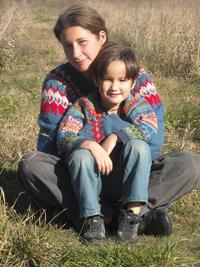
When I was a teenager and I spent my long and boring work days in the summer watching people walk by (that was my job) and dreaming of a better life in my adulthood, I was sure that if I had any children, they would not go to school as I knew it. No, it wasn’t that I believed the system is out to get us or that school is designed to keep the general population dumb and numb and under the control of some other class who want to control us. I just thought it could be done better and—with the hubris of a 14-year-old—figured I could make that happen, at least for my own kids.
There was another reason, too: The difference between what I believed was right and what I saw happening around me was heartbreaking and confusing to me. For a time, I wanted to shelter my hypothetical children from learning anything at all about the culture of greed and other kinds of violence that I couldn’t help being a part of, even in the somewhat sheltered environment I grew up in. I had a vision that I’m now embarrassed to say was strikingly similar to M. Night Shyamalan’s The Village.
Years went by, I became an adult, and I eventually did find myself the parent of a preschooler whose father has been out of the picture entirely since our child was less than a year old. Dancing Rabbit accepted me for residency when my son (let’s call him Kody) was four and I was still actively managing the online retail business that supported us. Less than a year later, I sent him to the county kindergarten and he’s thrived through three years of public school now. I’m considering whether to keep on sending him or take advantage of some of the co-home-schooling opportunities and resources that are appearing as Dancing Rabbit’s kid population grows.
It turns out that in real life we make compromises; running my business, participating in community obligations, and teaching a five-year-old to read, write, and count was really more than I felt it was reasonable to ask myself to handle alone. It was hard to send him off those first weeks of kindergarten. Kody and I are very attached to each other, and eight hours a day away from each other was a challenging stretch for both of us. We cried a lot. At that point, if the other demands on my life had been less, I think I would have pulled him out of school. As it was, we powered through, and eventually he started to become more comfortable with getting on the bus, would talk excitedly about the things he did at school each day, and seemed to be learning pretty well—better than I thought I could have managed at home, anyway.
In the beginning, I sent Kody with a lunch pail. Unfortunately for us both, I did a terrible job of packing a wholesome lunch for him that fit with the ethics I hoped to instill, that was also appealing enough to Kody that he’d eat it. I’m vegan, and out in the world of grocery stores and well-equipped kitchens Kody was too. At Dancing Rabbit in general it was harder to come up with food that he’d enjoy (or even eat at all) and when it came to his school lunches, I struggled particularly to find something practical, packable, ethical, affordable, and appealing. Compounding the difficulties, almost all of the other kids in the cafeteria ate the federally subsidized hot school lunches, and my kid, like many, possesses a strong desire to fit in.
The school lunches in our county are full of what I would call crap food: overcooked, chemically grown, GMO laden, factory farmed, and loaded with sugar, refined oils and grains, and artificial colors and flavors. Mostly it was the meat and other animal products that were hard for me to accept, but eventually, after months of having him come home ravenous, and after much contemplation and conversation, I stopped trying to pack a lunch. I made some overtures to the person in charge of the cafeteria food, offering to help find more agreeable choices, and offering information about why I felt it important to put effort into that. Eventually, the person stopped responding to my messages.
Once Kody started eating crap food for lunch, it became even harder to feed him at home. It’s been a few years and we still struggle with the gap between his tastes and my ethics, but we’re learning to find ways to satisfy us both.
As it turns out, most of the struggles we’ve had around the difference in culture between school and home have been around food. The cafeteria food is one thing, and then there’s also the tendency of teachers and other staff to use junk food as a reward. Besides that, there’s enough difference between the kid culture at school and the kid culture at home that Kody notices. I notice, too, when his language includes violent allusions, pop culture references, and racism. These things are shocking to me when they come up, but really it’s not too hard to conversationally clue him in that they’re inappropriate and why. It’s my hope that those conversations serve not just him, but the other kids at school, should he someday choose to share what he’s learned with his friends “out there.”
Sometimes Kody brings behaviors home from school that are upsetting to others in the community. Just because I’ve made the choice to include influences from the wider culture in the upbringing of my child doesn’t mean that everyone here wants their children to experience or even witness those influences. It can cause tension between the children, and more so between myself and other parents when ungroovy bits of the wider culture creep into Kody’s play at home. Dancing Rabbit is tolerant and even encouraging of diversity, though, and the public vs. home education is not the only division among the children here. We have lots of practice working out how to handle different parenting styles and lifestyle choices that overlap when our kids play together.
I think public school has had an overall positive effect on Kody’s development. I think his life will be richer, for example, for having lived through the process of experiencing the school foods and feeling compelled to ask questions about the different choices people make around food. Maybe he has a deeper understanding of the diversity of values and relative merits of various choices than he would if he didn’t experience those differences firsthand, within our household. Maybe it will make whatever actions he chooses as an adult be more firm and well considered than they would be were he to have not witnessed such a diversity and understood so personally how different values can lead us down different paths. I can help him shape his understanding to include challenging modern concepts like the coexistence of diverse codes of ethics within a single geographical space.
So, the child I once was so proud was made entirely of vegetables is now enthusiastically and undiscriminatingly omnivorous. The baby I almost never put down now spends 40 hours per week away at school, one of 20 kids under one teacher’s care. My dream of creating a brand new culture, uncontaminated by outside influences, in which to bring up a pure being to whom the troubles of the wider US culture would be unknown, has evolved to include moral relativism, humility, and compassion for those whose actions we disagree with. Now that he’s a rising third grader, he’s mastered basic reading and math skills, for which I feel very grateful to our county school system, his wonderful teachers and other staff, and the taxpayers who pay for his public education. We’re considering home schooling next year, and Kody is not so sure that he wants to leave the classmates he’s come to feel close to, and the the supportive environment of the public school classroom. I’m OK with that.
Keep the conversation going with these pieces
There are no available blogs
Subscribe to our newsletter for fresh stories and community updates delivered to your inbox.
Get unlimited access to courses, exclusive member events, and a supportive network of community builders
Access all courses, books, and premium content
Member-only workshops and community builders
Member-only workshops and gatherings
We use cookies to improve your experience on our site. By using our site, you consent to cookies.
Manage your cookie preferences below:
Essential cookies enable basic functions and are necessary for the proper function of the website.
These cookies are needed for adding comments on this website.
Statistics cookies collect information anonymously. This information helps us understand how visitors use our website.
Service URL: policies.google.com (opens in a new window)
A residential project: people live here as their primary home.
An institution, business, network, or project that isn’t a residence (e.g. a learning center, farm, or network with no one living there full-time).

{{ item.label }}
{{ item.value ? item.value : currencyFormat( item.amount ) }}
Subtotal
{{ currencyFormat( pricing_summary.total_amount ) }}
There are no results matching your search


