

Author: Ma’ikwe Schaub Ludwig
Published in Communities Magazine Issue #158
My story is boringly typical of a chronic lyme disease patient. Originally infected in 1997 while my family was living at East Wind in southern Missouri, I was given 10 days of antibiotics, which halted most of the symptoms. The lingering arthritis, I was told, was simply a matter of damage that had been done in my joints, and not evidence of any lasting infection. The worst of this first brush with lyme was that the doctor said they didn’t know if it could be passed through breast milk, so he advised (and we followed) stopping nursing my three-month-old son, Jibran.
Over the next eight years, the arthritis persisted and my health complaints were almost too vague to even have checked out. I remember talking to a nurse friend at Abundant Dawn Community in Virginia about whether it was possible (at 32) that I was starting perimenopause so early, but I can’t even tell you the details of why that thought had occurred to me; I just remember that something seemed off.
After a long and emotional birth with my second child, things got more marked—and more bizarre. I never really recovered from Ananda’s birth. After that, I was always dragging a little, and my lower back pain has been almost constant since. But that wasn’t the weird stuff. The strangest was that I’d be walking down the sidewalk, and my knees would suddenly just give out. The first time it happened, my potluck dish went sprawling along with me, and I sat for a full 10 minutes thinking, “What the hell just happened?”
It would become a more common thought as my illness progressed.
Living with Lyme
I’ll spare you all the details, but what passes for a normal day for me these days includes headaches, stiffness, general malaise, easy exhaustion, aches, and a wild array of neurological symptoms: buzzes, tingles, seemingly random shooting pains, parts of my body going numb, and an ability to lose thoughts that just about rivals my old ability to lose my keys in a 10′ x 12′ room.
For a woman accustomed to being mentally sharp and energetic enough to keep up with my notoriously workaholic husband, being couch- and house-bound has been—to say the least—an unwelcome change. My own work (which involves travel—the worst offender of all in terms of my symptoms flaring) has come to a screeching halt, my family has plummeted into debt, and I’ve gotten the unlooked-for opportunity to reinvent myself at the age of 42.
Lyme is my mid-life crisis.
In fact, I’m writing this opening sequence from the couch at 2:27 in the morning: sleep disturbances have also become commonplace. Hardly anything in my life looks the same as it did five or 10 years ago. The main commonalities, in fact, are family and community.
And community has been my saving grace in all of this.
Ticked Off
Chronic Lyme Disease is the most controversial disease in North America. And if I’d hoped that controversy would somehow stay outside of the permeable boundaries of my home community (Dancing Rabbit Ecovillage, Rutledge, Missouri), I’ve been brought up short on numerous occasions. It has been hard to navigate in dynamics where (with the same people who would have no problems with the idea that the EPA’s data or policies or perspective might be incomplete and politically motivated) some couldn’t understand why “Because the CDC says so” is an inadequate response to someone with an illness whose realities have been categorically denied by the Centers for Disease Control and Prevention for three decades.
Whether the CDC buys the existence, seriousness and prevalence of chronic lyme or not, I—and thousands of others—still have to live with it on a daily basis.
Dealing with insurance companies, doctors, and even family members who deny the reality of their illness is painful and life-impacting for most chronic lyme patients, but there has been an added feeling of betrayal for me here. These are people who know me, whom I’ve chosen as my tribe, and I know care about me. I simply didn’t expect to have to fight this fight at home and with friends (who are also decision-makers in my life, including in my mutual insurance association).
While it is certainly better for me than most patients (at least I can talk to, reason with, and try to educate the people who are making those decisions, whereas most patients get the implacably anonymous insurance industry, and very little recourse outside of the court system), the doubts, questions, and occasional outright attacks have been the worst wounds for me in my battle with lyme. During a time of low energy and emotional turmoil, what I really want to do is focus on healing. Instead, I’m battling with culture-wide ignorance in my own home.
That issue aside, I can’t imagine a better place to get horribly, persistently ill than in my community.
Support and Connection
I have afflicted friends who have been abandoned by family, literally being told to go find a homeless shelter. I have friends whose spouses have left. I have friends who haven’t had a friend come visit in six months, and who have had to drive themselves to the emergency room after a seizure. I have friends who are dying, their only human connection flowing through an internet cable while they fade. Being part of the lyme community in the ’10s is not so different from being an HIV patient in the ’80s. I am deeply blessed to have had a strong community before I got sick, who have rallied around me. I’m equally blessed with a supportive family who are science-oriented enough to be able to cut through the propaganda and back me up with their faith in my sound thinking.
I haven’t been abandoned or treated like I am crazy. Alyssa comes by almost every day just to connect. Mac comes five mornings a week to help with breakfast, juicing, and dishes. Amanda organized a juicing crew earlier this fall of folks who’d volunteer their time, and who always had a minute of kindness to offer. Friends have done laundry, swept my floor, hauled water for us, and filled my prescriptions and made bank deposits in town. People listen, even if my check-ins are almost identical from day to day…yes, I still hurt, yes I’m still falling apart, yes I’m worried about my son, no I don’t know when it will shift.
And for the most part, I am believed. This is huge. Lyme is considered to be an “invisible disease”—we don’t look sick, in spite of being debilitated and in constant pain. Some of this I credit to the efforts and past pain of Tereza, who lived here at Dancing Rabbit through seven years of fibromyalgia. We are always benefiting from the past work of someone it seems. And now as others have gotten this same diagnosis, I’m laying a foundation of a better educated and realistic populace to support them in their journey.
Community is keeping me healthier. Fresh air, a lifestyle of natural and organic foods, and social support have all been huge factors, and a healthy balance between trust and questioning have kept me finding the resources I need.
Exposure to alternative culture and self-reliance ethics over the years means that I am making some of my own medicine, and willing to get out of the narrow box of long-term antibiotics to find alternatives that won’t leave me with more organ damage from the treatment itself. I’ve been shocked at how matter-of-fact I am in looking at other options compared to most patients, and I’m sure being steeped in do-it-yourself culture for so long is the biggest factor in that contrast. Years of community have affected how I relate to everything, and those dividends are paying off now when I need them most.
Giving Back
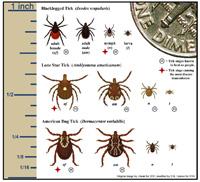
I’ve received a lot of help, and it’s important to me to give back. This has taken the form of encouraging people to get tested—for it turns out there are currently three confirmed “lyme positives” at DR, and more that I suspect. It means saying the uncomfortable, nosy things to neighbors because I care, and not getting caught in the trap of biting my tongue because it is none of my business. In community, it is my business if someone may have a debilitating and potentially fatal illness. And I’ve become the local tick bite expert (an uncomfortable position to be in, but an essential role).
I’ve also taken what I’ve learned out into the lyme community. I’ve brought my skills at facilitation to bear creating a safe space in online lyme groups, and am an administrator for one of the Facebook support groups.
I also created the Lyme Voices Project (www.lymevoices.blogspot.com). When I found myself frustrated last spring at a lack of collected information on patient experiences with lyme, I created a patient survey that got 450 responses in two weeks. Blogging about those results has both given me a way to feel like I’m still productive (since I can blog from my couch, being couch-bound doesn’t mean being useless) as well as help other new patients feel like their experiences are shared.
I don’t buy into the idea that we can’t have a voice in the politics of lyme; in fact, I think I’m capable of being a force in that. I have the curiosity and connection-making ability of a consensus trainer, and the articulation skills of a facilitator and writer. All of these skills came from community, and are being put to work to help “create community where I am”—doing what I can, in this semi-functional physical body, to help a large group of people in desperate need for hope and help. This aligns well with the FIC’s mission of helping people create community wherever they are, and in diverse forms, rather than just in intentional community.
Here in community, DRMIA (the Dancing Rabbit Mutual Insurance Association) and PEACH (Preservation of Equity Accessible for Community Health) have helped us insure ourselves affordably in a time of madness in the insurance industry. (See www.dancingrabbit.org/about-dancing-rabbit-ecovillage/social-change/economy/co-ops and thefec.org/projects/PEACH.) In this and other ways, living in community has greatly reduced my medical expenses.
Chronic lyme has become one of my ongoing opportunities for learning and service. For better or worse, it has helped shape my life in community in recent years, and I hope that not only I, but others, are growing from the experience. It’s not easy, and it raises difficult questions (see sidebars), but it’s the reality I am facing. If you have any questions or want to share stories of your own, please be in touch.
Keep the conversation going with these pieces
There are no available blogs
Subscribe to our newsletter for fresh stories and community updates delivered to your inbox.
Get unlimited access to courses, exclusive member events, and a supportive network of community builders
Access all courses, books, and premium content
Member-only workshops and community builders
Member-only workshops and gatherings
We use cookies to improve your experience on our site. By using our site, you consent to cookies.
Manage your cookie preferences below:
Essential cookies enable basic functions and are necessary for the proper function of the website.
These cookies are needed for adding comments on this website.
Statistics cookies collect information anonymously. This information helps us understand how visitors use our website.
Service URL: policies.google.com (opens in a new window)
A residential project: people live here as their primary home.
An institution, business, network, or project that isn’t a residence (e.g. a learning center, farm, or network with no one living there full-time).

{{ item.label }}
{{ item.value ? item.value : currencyFormat( item.amount ) }}
Subtotal
{{ currencyFormat( pricing_summary.total_amount ) }}
There are no results matching your search