

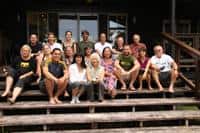
Your disability income will be the same almost anywhere you go. In community, you may find it can go a lot farther and take you to a lot more interesting places.
There are groovy, interesting, creative communities out there of every imaginable size, shape, and flavor. Many people find that intentional communities are a way to be less isolated, have a higher quality of life, and live in a more meaningful way.
In the quest for your new home, here are a few things to watch for, and a few things to watch out for:
The Quest for Community
Living in community can bring a great deal more friendship, warmth, and purposefulness into your life. The Foundation for Intentional Community website includes a list of over 1,000 intentional communities: communes, ecovillages, community farms, land trusts, artist communities, cooperative houses, spiritual communities, cohousing, and bunches more.
There is also a Communities Classifieds section with a list of dreamers and seekers looking to start their own communities or find their “people.” You can post your own dreams here or read through to see what others have posted.
Many people find that living in community can mean a much higher quality of life on much less income. However, if you’re simply looking for cheap housing, intentional communities will not be a good match for you. Most communities are seeking people who are like-minded and genuinely wish to be part of their community life.
Finding Your People
When you contact a new community, you may discover that no one else living there right now is on disability. You may also discover that no one else who has ever lived there since the beginning of time has ever been on disability. Someone has to be the groundbreaker. You can pave the way for others.
Even able-bodied people don’t find the perfect match right out of the gate. Be persistent. Contact as many communities as you can. And be patient. Folks may need a little time to get to know you and your situation. With time, you will find somewhere that is a good match.
Most people visit more than one community before finding one they click with. For a person with disabilities, this is easier said than done. If you are able, though, it’s nice to be able to explore.
When you arrive at a new community, don’t be shocked if it seems very different than what you read on the website. Some people are “aspirational” when writing these descriptions. The person who wrote that website may have had big dreams. They also may be long gone by now.
Work Contributions
Some communities ask for work contributions and others do not. If you are too ill to work, it is still possible to find a community that may be a great match for you.
In some places, the work contribution is small—for example, one day per month. If you cannot build buildings or dig ditches, there are usually some gentler, more sedentary ways in which you can contribute.
If you have physical disabilities, some newly-forming communities may not be the best match. These communities are often looking for people who can construct buildings and cultivate the land. Keep an eye out for more established communities where the buildings are already built.
Don’t be scared off if you feel you don’t have enough to contribute. If you are a nice person, and you get along well with the people living there, and you have a stable income from your disability check, and you wish to be part of the community life, there are many communities that may be happy to have you.
Financial Contributions
Some communities are quite pricey and others are dirt cheap. In my experience, cohousing communities in particular tend to be on the pricey, middle class side. If you are poor, this may not be a good match. Then again, if you see somewhere you just love, it does not hurt to contact them and ask. Someone in the community may have a room or space available for rent.
Some communities require a buy-in, join fee, or land purchase. For a new or forming community, it may be hard to join if you don’t have the financial means.
Please don’t be scared off by all join fees. In an older, more established community, you may find the join-in fees to be a bit more flexible. If the community is large and located in an isolated area, there are more than likely a few houses or rooms sitting empty by now. Someone might be quite pleased to rent you one of these places, and you might be quite pleased with the amount of rent they charge.
Some years back, I visited a land trust community. The website mentioned nothing about being able to rent, but when I got there, there were several empty rooms and houses, and plenty of options.
Income-Sharing Communities
In some communities, all finances are separate and each person has their own largely independent life. Other communities are “income-sharing” or “egalitarian” and resources and/or money are shared. Income-sharing is a very different lifestyle than most of us are used to. Some people find they really love it.
I was initially under the mistaken impression that all income-sharing communities would be looking for full-time work contributions to the community. Apparently, not so!
The nice folks from the Foundation for Intentional Community were kind enough to set me straight: “Some income-sharing communities may have a full-time work week, but others have a more flexible approach. Some may actually be ideal for people with disabilities.”
Community and Disability Benefits
If you are on Social Security, Medicaid, or other benefits, there are a few special considerations you may wish to think about before moving to community (or before moving anywhere, really). For that matter, you might want to think about some of these things even if you are just staying still.
It is especially helpful to learn a little more about how your benefits may be affected before joining in a community business, shared income, shared property, shared cars, shared food, or a community that gives you a place to live but does not charge “rent.” All of these things are possible, but if you know the disability regulations, it will make your life a whole lot easier.
It is also worth noting that there are different home care and Medicaid programs in different states. (If you are going to move anyway, you might as well move somewhere with good services!) You can read about all this and much more in this Guide to Disability Benefits and Intentional Community: howtogeton.wordpress.com/community.
Caregiving and Caretaking
If you are unable to care for yourself and need assistance, you may find it difficult or impossible to find a community that can accommodate this.
You may wish to look into state homecare programs that can provide you with a caregiver. This can give you more options for communities to join. Most people with disabilities do not know that all 50 states offer caregiving programs to help low-income people with disabilities in their homes. The type of care, ways to qualify, and hours available vary wildly from state to state. See howtogeton.wordpress.com for more information on finding homecare in your area.
The way you approach a community may have a big impact on the kind of response you get. It is wonderful if you can let people know who you are and why you are interested in their community. If you feel you will need special assistance, you might see if it is possible to bring a friend or caregiver with you when you visit.
Not all who wander are lost. Keep wandering and keep questing. You may not find your perfect community overnight, but if you keep an open mind and an open heart, there is a new life out there waiting for you. I hope you find your people, and the community of your dreams.
Lily Silver is disabled and primarily homebound with CFS/ME. Luckily, she lives in an informal community of like-minded, kind-hearted friends and familiars who brighten her days. Lily is assembling a free online guide to Disability, Medicaid, and Home Care. Come by and visit at howtogeton.wordpress.com.
Keep the conversation going with these pieces
There are no available blogs
Subscribe to our newsletter for fresh stories and community updates delivered to your inbox.
Get unlimited access to courses, exclusive member events, and a supportive network of community builders
Access all courses, books, and premium content
Member-only workshops and community builders
Member-only workshops and gatherings
We use cookies to improve your experience on our site. By using our site, you consent to cookies.
Manage your cookie preferences below:
Essential cookies enable basic functions and are necessary for the proper function of the website.
These cookies are needed for adding comments on this website.
Statistics cookies collect information anonymously. This information helps us understand how visitors use our website.
Service URL: policies.google.com (opens in a new window)
A residential project: people live here as their primary home.
An institution, business, network, or project that isn’t a residence (e.g. a learning center, farm, or network with no one living there full-time).

{{ item.label }}
{{ item.value ? item.value : currencyFormat( item.amount ) }}
Subtotal
{{ currencyFormat( pricing_summary.total_amount ) }}
There are no results matching your search


