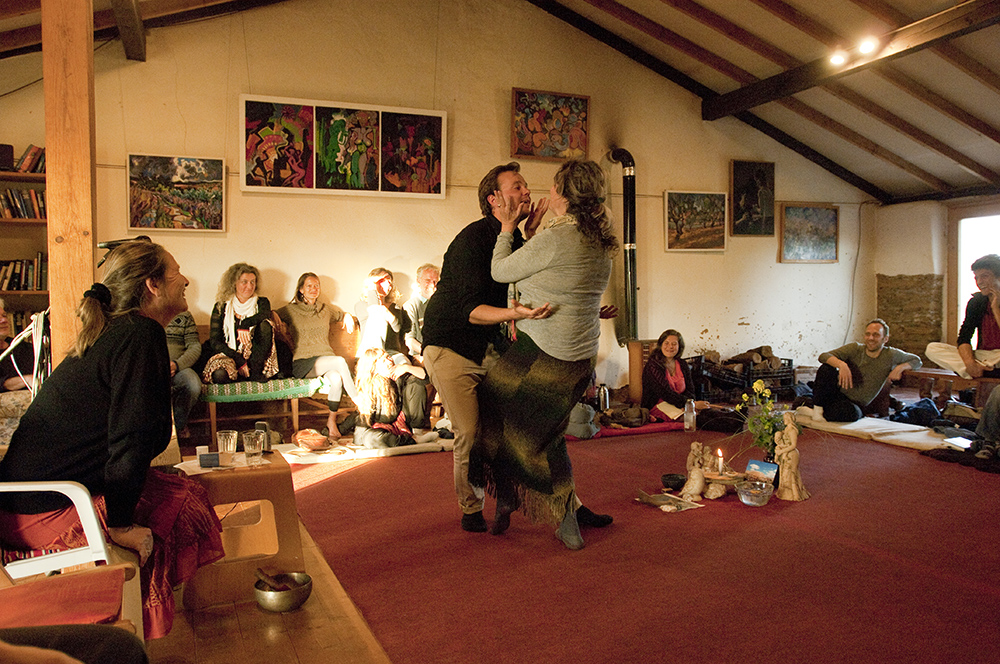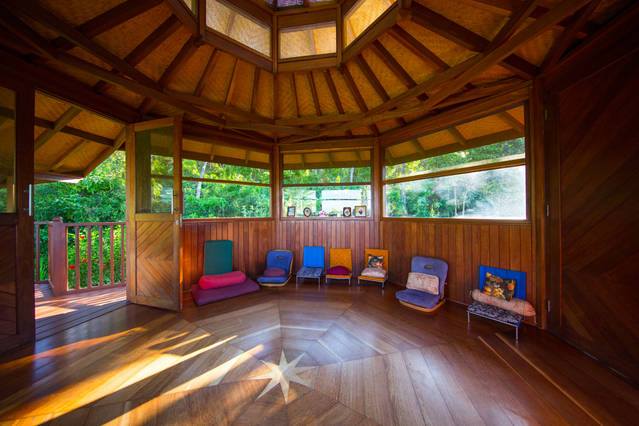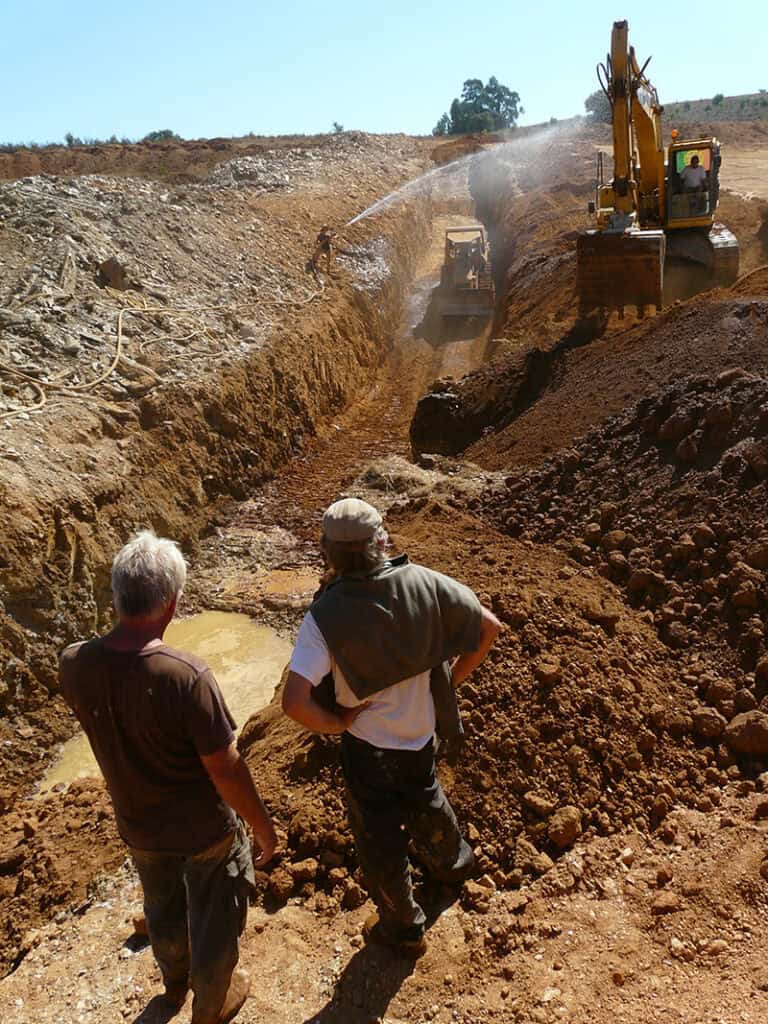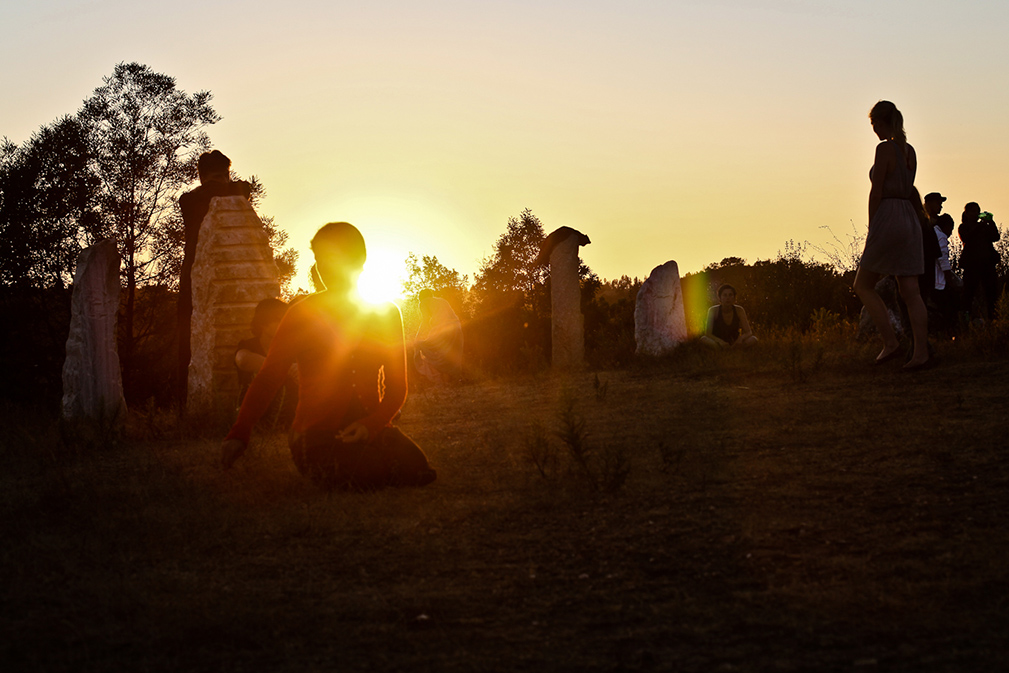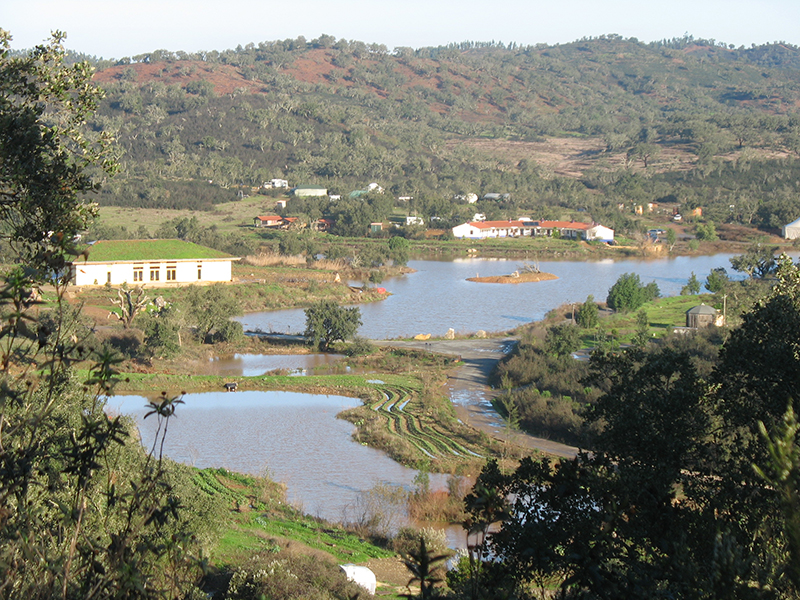
Scenic view of Tamera Healing Biotope with water bodies and green hills.

Tamera - Healing Biotope 1

  • Communities

About the Communities

  • Established
  • Ecological
  • Rural

Founding year

  • 1978

What we do

Tamera is a Peace Research & Education Center, a model for a peace civilization and a research station for a realistic utopia.
The project was founded in Germany in 1978 by Dieter Duhm, Sabine Lichtenfels and Charly Rainer Ehrenpreis. In 1995 it moved to Portugal. Today 180 people live and work on a property of 330 acres.
The founding thought was to develop a non-violent life model for cooperation between human being, animal and nature. Soon it became clear that the healing of love and of human community had to be placed at the center of this work. Sexuality, love and partnership need to be freed from lying and fear, for there can be no peace on Earth as long as there is war in love. The ecological and technological research of Tamera includes the implementation of a retention landscape for the healing of water and nature, as well as a model for regional autonomy in energy and food. Through the Global Campus and the Defend the Sacred Alliance we are working within a global network on the social, ecological and ethical foundations for a new Earth – Terra Nova.

Our Mission

The Healing Biotope I Tamera is a peace research center with the goal to create the model for a future society that is free from hatred, lies, violence and fear. Tamera should become an acupuncture point of peace, a greenhouse of trust, a prototype for an existence free of fear on this planet, a post-capitalist societal model and a place where the human and spiritual realm of life come together.
Our mission and wish is, to empower people around the world to build a regenerative, nonviolent culture by
researching the ethical, social, sexual, ecological, technological and economic foundations, and creating a replicable model. Tamera offers training and education for those committed to build communities, that follow the idea of a Healing Biotope. Through our global networking we are building a planetary community and sharing our vision of Terra Nova.

  • Purpose
  • Ecological
  • Community type
  • Ecovillage
  • Commune
  • Sustainability practices
  • Renewable energy systems
  • Regenerative agriculture or permaculture
  • Permaculture design
  • Activities
  • Education
  • Experiences
  • Networking
  • Services Business

Commemorative dates

  • January 1, 1978
  • Started planning
  • January 1, 1991
  • Started living together

Video

  • 90 Total members
  • Not open to new members
  • Open to visitors
Total
180

How to join

We are currently not able to receive more co-workers.

Basic expectations or agreements for members

Please find on our website the seminar and event calendar to register. Once a month during the guest season we offer guided tours as day visit. You find the dates on the event calendar!
The Guest Center of Tamera is meeting place, home and study space for a growing international community of people. We warmly welcome you to get to know Tamera, its specific projects and people, and especially the vision of a new Earth.
You visit an emerging new culture that rattles conventional thinking and behavioral patterns. In the following, we want to give an introduction as to what you can expect in such an unconventional environment:
We are working to take all areas of life back to our own responsibility. This also concerns the material supply of food, energy and water. We learn from the cooperation with nature what it means to live again in wealth and real abundance and receive nature’s gifts with gratitude. We meet all creatures, even the smallest, with mindfulness and respect. They, just as we humans, belong to the great family of life.
We invite all our guests to get involved in a simple life in community during the period of your stay. You will get to know a communitarian lifestyle, meeting over meals, working together and sleeping in dormitories. Our kitchens serve vegan meals from predominantly regionally produced and organic food. The night lights up with a sea of stars, but there are no street lights.

Primary decision-making authority

  • Small Leadership Group

A few people (not elected by the broader community) make the major decisions.

Decision-making process

  • Modified Consensus

Generally seek agreement, but have backup methods when consensus isn’t reached.

Governance structure

  • Collaborative/Horizontal

Power and responsibility are shared relatively equally among members.

Conflict resolution approach

The responsible persons of the projects form a co-holding group. This group and different working groups prepare decisions. Those decisions are being approved by the plenary by modified consensus, not in a formal way, based on trust and solidarity and encouraging the best future ideas.

Economic model

  • Partial Income-Sharing

Members contribute a percentage of income to community funds.

Economic scenarios for this community

  • There is a labor obligation

Additional economic information

Labor: Yes (28 hrs/week)
Tamera is based on a community of trust. This is also reflected in its economic structure. Money is, like everything in a community of trust, subject to the communitarian ethics: transparency, mutual support and responsible participation.
The community is regularly informed about all cash flow, economic projects and investments. All decisions are transparent; all community members are invited to the relevant councils. Tamera itself, with all its buildings and purchases belongs to “the community” – the legal figure is listed below.
Trust is not the result of paragraphs and articles. It is a human quality. The deeper the trust is among each other and the more one has embraced the political objectives of Tamera, the more he or she will take responsibility for the whole and move away from his previously private existence into a communitarian way of life. This also includes a responsible way of dealing with the subject of money. It is a challenging research topic to invent a monetary system that promotes trust and community and reduces competitive thoughts. We are currently navigating through a mixture of both communal and private property with the increasing orientation towards a communitarian economy.
The Legal Figure of the Tamera Economy
If we wanted to describe Tamera in entrepreneurial terms, we could say its product consists in building a global model of peace and information fields for healing; its profit consists of the knowledge that is passed to the world as help, its shareholders are all the people who want to invest their money, their knowledge, their labor.
Tamera is a communitarian undertaking. In the existing legal system, there is so far no elaborate legal form, which really captures the complex structure of a community. We have therefore developed a structure combining the form of companies and associations for our communitarian framework.
The property of Tamera and its infrastructure is owned by the company Ilos, Peace Research Center, Lda. The shareholders of Ilos are the registered associations “G.R.A.C.E.” and “Associação para um Mundo Humanitario” (AMH). The active members of the associations are the community members of Tamera.
The Associação para um Mundo Humanitario (AMH) is responsible for the environmental and technological research projects of Tamera: the Solar Village Test Field, the Water Retention Landscape, ecological landscape healing, the reforestation project, building alimentary biotopes and for establishing the regional network.
The G.R.A.C.E Association is responsible for the field of peace education, including the Global Campus, the youth school for global education, Place of the Children, as well as internal education and global peace actions. The Association also has a special training and scholarship fund for student peace workers from more impoverished countries. It is possible to sponsor students.
This structure is made up of a business, which is allowed to make profit, and a charitable non-profit sector, which finances its activities through donations and grants. Profits from ILOS are equally shared between the two associations.
Tamera has three monetary circuits:
1. Basic Household
This is the heart of the communitarian economy of Tamera. It covers all basic costs of the place and the people including services, repairs, maintenance, and supply. The Basic Household is funded by guests and the revenue from seminars, and from the Book Shop, the Support Circle and direct donations, as well as by the community itself. Considering the size of the project, this Basic Household is relatively low. It makes it possible that within the community there are no wages and labor costs. All co-workers work for room and board and receive a small monthly stipend.
The co-workers of Tamera take the responsibility for any financial deficits. They are therefore required to attract money outside of Tamera to compensate for any shortage in the Basic Household.
2. Loan Budget
The purchase of Tamera’s land and the initial investment were financed in part with loans. For several years we decided to stop using loans for investments, for political reasons. The Loan Household can be repaid with the help of interest-free exchange loans so that private loans that are due can be paid back.
3. Investment Budget
Funds donated here will go towards the individual project groups. Donations from the Investment Budget are used for building projects, the Solar Village Test Field, the further expansion of the Water Retention Landscape, food autonomy, landscaping, the creation of the International School “Escola da Esperança”, political actions, networking journeys, etc.
The “silent” costs incurred for each new investment – operating costs, costs for maintenance, spending on infrastructure, cooperation, planning and preparing projects – are not charged extra each time but are set at 30% of the incoming donations. This 30% is redirected to the Basic Household, which carries these silent costs.

Shared resources and amenities that are accessible to everyone in the community

Common House, Garden(s), Greenhouse(s), Vehicle Share, Library, Workshop, Outbuilding(s), Swimming pond or pool, Outdoor Kitchen, Large Scale Kitchen, Tractor & Farm Equipment, Stage or Auditorium, Fire pit, Swingsets & play areas, Recreational vehicles, Gym or sports area, Internet

Frequency of communal meals

  • Approximately all meals

Significant food acquisition practices

  • Locally sourced
  • Livestock / Animal Husbandry

Dietary restriction

  • People can cook and eat what they want in their own residence

Community activities and engagement

  • School, Educational Institute or Experience
  • Ethical Business, Investment Group, or Alternative Currency
  • Organization, Resource, or Network
  • Festivals, Conferences, Events

Substance use culture

  • Substance use appears in public spaces but no pressure
  • Religions
  • Christian
  • Buddhist
  • Jewish
  • Muslim
  • Sufi
  • Native

Gender composition

  • Roughly balanced (no group over 60%)

Age demographics

  • Family-focused (many children and parents)

Property status

  • Privately owned

Property owner

  • By a Land Trust, Home Owners Association, or corporation

Setting

  • Rural

Countryside locations with significant distance from urban centers.

Sustainability approach

  • Renewable energy systems
  • Regenerative agriculture or permaculture
  • Permaculture design

Land practices in our community

  • The community practices permaculture

Self-produced energy

  • 33 - 66%

Energy sources used

  • Photovoltaic Solar
  • Biomass (from wood or other organic materials)

Self-produced food

  • 33 - 66%

Local, organic, or fair trade food

  • 33 - 66%

Food systems

  • Community garden
  • Greenhouse / aquaponics
  • Livestock / poultry
  • Seed saving / exchange
  • Land area size
    330 acres

Guest Book

Written reviews are available for plus members. Click here to upgrade.

Location

  • Alentejo, Portugal

Tamera - Healing Biotope 1

Needs and Offers

Connecting people and communities through an intentional online marketplace

  • Promoted
Offer
  • Real Estate For Sale
3 weeks ago

Beautiful 3+ Bed, 2.5 Bath Townhome in Established West Emerald CoHousing, Seattle

A rare home is available at West Emerald Cohousing, an established all-ages intentional community in West Seattle. For those considering a move to the Pacific Northwest—or hoping to join a mature community rather than one still in the forming stages—West Emerald offers decades of community life, beautiful gardens, shared resources and a peaceful setting within the city in a convenient location since 1999. This unit has a unique floor plan that is ideal for co-buying, co-living, or for one household. The home itself offers a flexible 3+ bedroom, 2.5 bath layout: Garden-level room with a separate exterior entrance and half bath—ideal for a home office, studio, guest space or client-facing business Main-level bedroom and full bath, laundry, making one-level living possible Open great room with large windows overlooking gardens filled with birdsong Well-designed kitchen with generous storage and pantry Two additional light-filled spacious bedrooms and a full bath upstairs Thoughtfully maintained and updated Located at the end of a common pathway for added privacy and garden views, Just feet from parking, which is out of view West Emerald community amenities include: Common House with gathering and activity spaces Community meals and events Mature gardens and shared outdoor spaces Workshop/maker spaces and bike barn Exercise room EV charging opportunity Excellent Metro access to Downtown Seattle just minutes away Nestled into a dell, it’s Seattle’s best-kept secret South Seattle College and lifelong learning, NW Wine Academy, the Seattle Chinese Garden are nearby, with easy access to Alki Beach, Lincoln Park, magnet schools, ferries, and the shops and restaurants of the West Seattle Junction. 6000 17th Ave SW, Seattle, WA Is a wonderful opportunity to have your own comfortable, private home while becoming part of a vibrant and well-established Seattle all-ages cohousing community. For more information contact the friendly Realtor at 206-579-9066, or at ki**********@**********te.com who will be happy to meet you there or do a facetime tour.
  • Promoted
Need
  • Promoted
Offer
  • Communities with Openings
4 months ago

Do you feel called to help co-create a small, newly forming eco-spiritual community?

Old structures are crumbling. New ways of living are calling. We are answering that call. Wild Grace is an eco-spiritual community located in the Sierra foothills 30 minutes from Grass Valley, California. We recently completed new homes for those who feel called to our vision. Currently there are four of us living on this sacred 80 acres of land although we are a hub for an expanded neighborhood community. Many join us weekly for potlucks, expressive dance, Qi Gong, monthly musical gatherings, and seasonal celebrations in our temple, as well as tending to our orchard. We are excited to welcome others to join us on the land who are dedicating their lives to spiritual growth and ready to live in a more focused and intimate heart-centered lifestyle. Might that be you or someone you know? The fundamentals are simple. Spirit. We listen personally and collectively together most mornings, usually starting with a musical offering, a prayer, or a short reading, followed by about 40 minutes of what we call “sacred silence.” Heart Circles. About once a week we gather to share and listen. We are informed by authentic and compassionate communication practices. Nature. The land itself—an 80-acre oasis of field and forest perched above the wild and scenic South Yuba River—calls for our stewardship in the gardens, orchard, greenhouses, and general care. In turn, nature feeds us abundantly, both literally and spiritually. Interbeing. We join with others to share inspiration and connection as we host monthly gatherings of song, story and prayer that draws from the larger community in addition to other events we share with our closer neighbors. As we attend to these fundamentals, Grace flows to and through us—often in “Wild” or unexpected ways. Grace catalyzes through us, but is not something we possess. Because we all are connected, we feel that Grace actively transforms n
Offer
  • Professional Services
3 weeks ago

Community Planning, Facilitation & Coaching for Intentional Communities

Through Radicle Collective, I support intentional communities and the people within them as they navigate the practical and relational work of building life together. My work can include visioning and community planning, facilitated conversations and retreats, decision-making and governance design, conflict transformation, establishing group agreements, culture-building, and individual or group coaching. I work with communities at many stages – whether it’s a few people exploring whether to live together, a fledgling community developing its foundations, or an established community in transition or conflict. I draw from training in psychology, coaching, urban and regional planning, facilitation, Nonviolent Communication, permaculture, and related practices to approach community as a living system – one shaped by individual needs, relationships, shared structures, place, and the connections between them. Rather than bringing a single model for how community should work, I help groups understand what is happening across those different layers, surface what matters, work honestly with difference, and create structures and practices that support connection, agency, belonging, and the values that brought them together in the first place. I’m based in Berlin and available to work online or in person, depending on location and scope. I offer sliding-scale pricing and am open to creative forms of exchange where appropriate. If your community is forming, stuck, changing, or simply wants some skilled outside support for an important conversation, I’d be glad to explore what might be useful. You can learn more about my work and get in touch at radiclecollective.com.
Need
  • Communities with Openings
5 days ago

Heart-centered, nature-loving unschooling family seeking a community to land with for winter 2027

We’re a German-American family who left conventional life about four years ago to live in line with our values: freedom, connection, nature, and spirituality. We started out as worldschoolers, moving every month or two. That taught us a lot, including that too much movement leaves a family rootless. Since then we’ve been looking for the balance between adventure and belonging. We found a taste of it on a multigenerational farm community in Austria, and we’re now living alongside a small community in Norway. For January to March 2027, we’d love to spend a season inside a community that feels like home. What we’re hoping for A community with teenagers and a culture that welcomes self-directed learning, where unschooling is understood and not just tolerated Nature at your doorstep (forest, land, animals, or garden) Some shared meals, perhaps shared rhythms, and real relationships, not just a place to park A spiritual or reflective thread, whatever form it takes for you An opportunity to get to know your community by giving back (although we can’t do a ‘full’ volunteering program as we have the past three years – ie: Workaway- because we have meetings online that take up too much of our time to volunteer full time)  What we bring Resilience and emotional wellbeing. I’m an online resilience coach with a BA in Developmental Psychology, certified in HeartMath®, and an experienced yoga and meditation teacher. I can offer community sessions in nervous system regulation, stress resilience, and meditation, and support for parents and teens. Experience raising three children in a nomadic, family-centered lifestyle, including years of travel across Europe. Open, adaptable, and grounded. We’ve lived in many settings and adapt quickly. We show up as contributors, not consumers. Unschooling and homeschooling know-how. We’re glad to share what we’ve learned, especially for families navigating legal and practical questions in Europe. Many other shareable skills: carpentry, sourdough bread baking, food fermenting, music making, dad-joke-telling, drone pilots, cookie bakers, food preservation and much much more.   We’re looking for a mutual fit, not just a bed for the winter. If our story resonates and you have space or know someone who does, we’d love to hear from you. Tell us about your community: your values, your daily rhythm, and what you’re hoping for from the people who join you.
Offer
  • Professional Services
2 weeks ago

Rebalancing your pet's well being (also looking for intentional community of animal lovers)

🌿 Can animals look after their own well-being? Science says yes! Zoopharmacognosy is the fascinating behavior in which animals self-medicate by selecting, inhaling, or topically applying plants, soils, and insects with natural well-being properties. Applied zoopharmacognosy brings these principles into practical use, providing animals with sensory choices for general well-being and environmental enrichment. 🧠 Driven by Consciousness & Evolution The Cambridge Declaration on Consciousness (2012): Signed by global neuroscientists, this milestone established that non-human animals possess the neurological framework for consciousness, intentional behaviors, and emotional states. Describing an animal experiencing fear, joy, or grief is a biologically accurate observation, not a human projection. Prominent advocates like Jane Goodall and animal lovers have always known this from personal experience! Innate Sensory Guidance: Only the animal knows the required plant and amount. This behavior is entirely guided by highly specialized senses of taste and smell, which is an evolutionary survival mechanism of animals. 👀 Incredible Behaviors Observed in Nature: 🐦 Birds (Starlings): Male starlings incorporate yarrow, wild carrot, and agrimony into their nests to ward off pests; chicks in nests lacking these plants suffer from significantly higher mite burdens (Clark & Mason 1988). 🦜 Birds (Parrots): Amazon parrots intentionally consume clay to neutralize toxic alkaloids ingested from wild plants (Gilardi 1999). 🐛 Insects: Parasitized caterpillars ingest specific plants rich in pyrrolizidine alkaloids to support their health (Singer & Bernays 2010; Smilanich et al. 2011). 🐒 Primates: Chimpanzees suffering from intestinal bugs intentionally select and consume bitter, anti-parasitic plants (Huffman & Seifu 1989). 🐑 Livestock: Lambs actively select plants high in tannins when dealing with internal challenges (Villalba & Provenza 2005). 🐘 Elephants: Excavate salt deposits to neutralize dietary toxins (Redmond 1992), and select botanical oils to support their natural defense mechanisms (Ingraham 2007). 🤝 How I Practice The IMIM approach honors the animal as an intelligent being capable of directing its own well-being by honoring its instinct and non-verbal language. I provide safe educational consultations to help you connect with your animal on a deeper level. (Contact me at ge*********@*****il.com to learn how to offer this sensory enrichment for the well-being of your animal!) ℹ️ Further Learning: Learn more about IMIM methodology, case studies and research at carolineingraham.com. ⚠️ Veterinary Disclaimer: Applied zoopharmacognosy is an educational and supportive tool for well-being. It does not offer veterinary advice, diagnose, or prescribe, and should never replace professional veterinary care.

Update to a Public Profile

  • Log in
  • Go to your profile page
  • Toggle on the "Add my profile to the directory"
  • Save your profile

Information

Communities

A residential project: people live here as their primary home.

Organizations

An institution, business, network, or project that isn’t a residence (e.g. a learning center, farm, or network with no one living there full-time).

Plus Community Membership

  • Find people with Profile Match
  • Access to your community listing statistics
  • Create Discussion Groups
  • Access to our affiliate program
  • Member badge on your community profile
I am an official member of this community
Disclaimer
I affirm that my information is accurate and I am authorized to manage this listing
Foundation for Intentional Community FIC Member badge logo.

Free Plan

Free Membership
Free

Intentional Advertising

  • Subtotal

    {{ currencyFormat( pricing_summary.total_amount ) }}

Icon representing community connections and collaboration for intentional communities.

Plus Membership

  • Find communities with Profile Match
  • View detailed reviews about communities
  • Create free listings in Needs & Offers
  • Plus Member resources in CommUniversity
  • View communities detailed reviews
  • Plus Member badge on your profile