Putney Commons (www.putneycommonsvt.com) is a small, owner developed, intentional community located in Putney, Vermont. Six homes were completed in 2009, and a seventh was built in 2014. Our eighth and ninth dwellings were completed in 2022 and 2023.
The 9 units are surrounded by field, garden, hills and woods. We are currently a community of 12 individuals and are open to families, couples, and single persons of all ages. We share a vision for being good stewards of the land and supporting one another in living greener and healthier lifestyles.
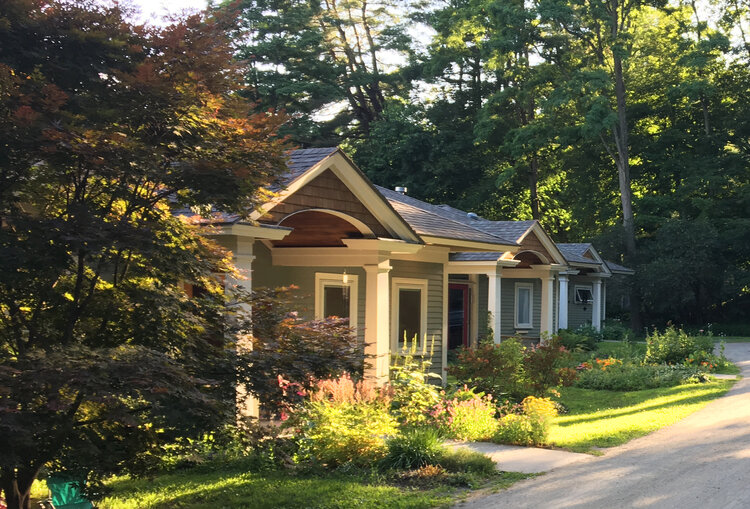
The six original houses were built in two clusters of three semi-detached homes. They are single-story, on slabs, have no attics, are super-insulated and boast a Five Plus Star Energy rating. They range from 1100 to 1475 sq. ft. and are clustered on the north end of a 3.5 acre field. Each has a garage with a small storage unit. The seventh home stands alone.
Interior designs vary greatly, based on owner-designed preferences. Five homes have photo voltaic panels; one household has a share in a local solar farm.
Members meet monthly to discuss business and living concerns. We make decisions by consensus. We have no common house and eat independently, but we enjoy sharing pot luck dinners and occasional work days. Our $275 monthly owner’s association fee covers common element expenses, e.g., mowing, plowing, sanding, trash, insurance, land maintenance and an operating reserve fund. Homeowners are financially responsible for repair and maintenance to the exterior and interior of their units. Legally we are a condominium association.
Our 11.4 acres of land are secluded and private; they include fields, woodlands, a bit of Sacketts Brook, a common fenced-in vegetable garden with individual plots available to interested members and several neighbors, and walking trails. Amazingly, we are also right in the heart of Putney village, across the street from the post office and behind the first row of houses. We are within easy walking distance to the many community events and services offered in and around downtown Putney. Putney also has a familty medical practice, a post office, two banks, a town library, a food coop and general store, gas station/auto repair, as well as a rich variety of arts and cultural institutions.
Our nearest neighbor is the Putney Community Center, which houses a community foodshelf. A seasonal farmers’ market is within walking distance of the town center, and there are restaurants /eateries within half a mile. Nearby, the Connecticut River and Putney Mountain offer hikers, bikers, rowers, kayakers, and swimmers many opportunities for enjoyment. Putney has three private schools and Landmark College, as well as a strong public elementary school. Many community-based events are held throughout the year, including a village-wide community supper held on the second Friday of each month.
We are located ten miles north of Brattleboro just half a mile from I-91, exit 4.
We are a small, cooperative neighborhood of diverse individuals, sharing friendship and support while living independently in an ecologically responsible community, making decisions through consensus.
Contact us via our website for more information.
Please contact us via our website: putneycommonsvt.com.
A few people (not elected by the broader community) make the major decisions.
Generally seek agreement, but have backup methods when consensus isn’t reached.
Power and responsibility are shared relatively equally among members.
We have 4 designated officers. We meet monthly and make decisions by consensus. Tasks are shared by all community members.
Members maintain separate personal finances with minimal sharing.
Regular fees: Yes
Garden(s)
Smaller municipalities with local services but rural character.
Private homes with shared common facilities, designed for neighborly
interaction while maintaining independence.
Geographically close groups of independently-owned homes whose residents actively cultivate community relationships and shared values.
Connecting people and communities through an intentional online marketplace
There are no needs and offers
We use cookies to improve your experience on our site. By using our site, you consent to cookies.
Manage your cookie preferences below:
Essential cookies enable basic functions and are necessary for the proper function of the website.
These cookies are needed for adding comments on this website.
Statistics cookies collect information anonymously. This information helps us understand how visitors use our website.
Service URL: policies.google.com (opens in a new window)
A residential project: people live here as their primary home.
An institution, business, network, or project that isn’t a residence (e.g. a learning center, farm, or network with no one living there full-time).

{{ item.label }}
{{ item.value ? item.value : currencyFormat( item.amount ) }}
Subtotal
{{ currencyFormat( pricing_summary.total_amount ) }}
There are no results matching your search

We’re introducing new Plus features — including community reviews, Profile Match, and unlimited Needs & Offers posts — while keeping most of FIC free for everyone. Membership costs less than two coffees a month.