
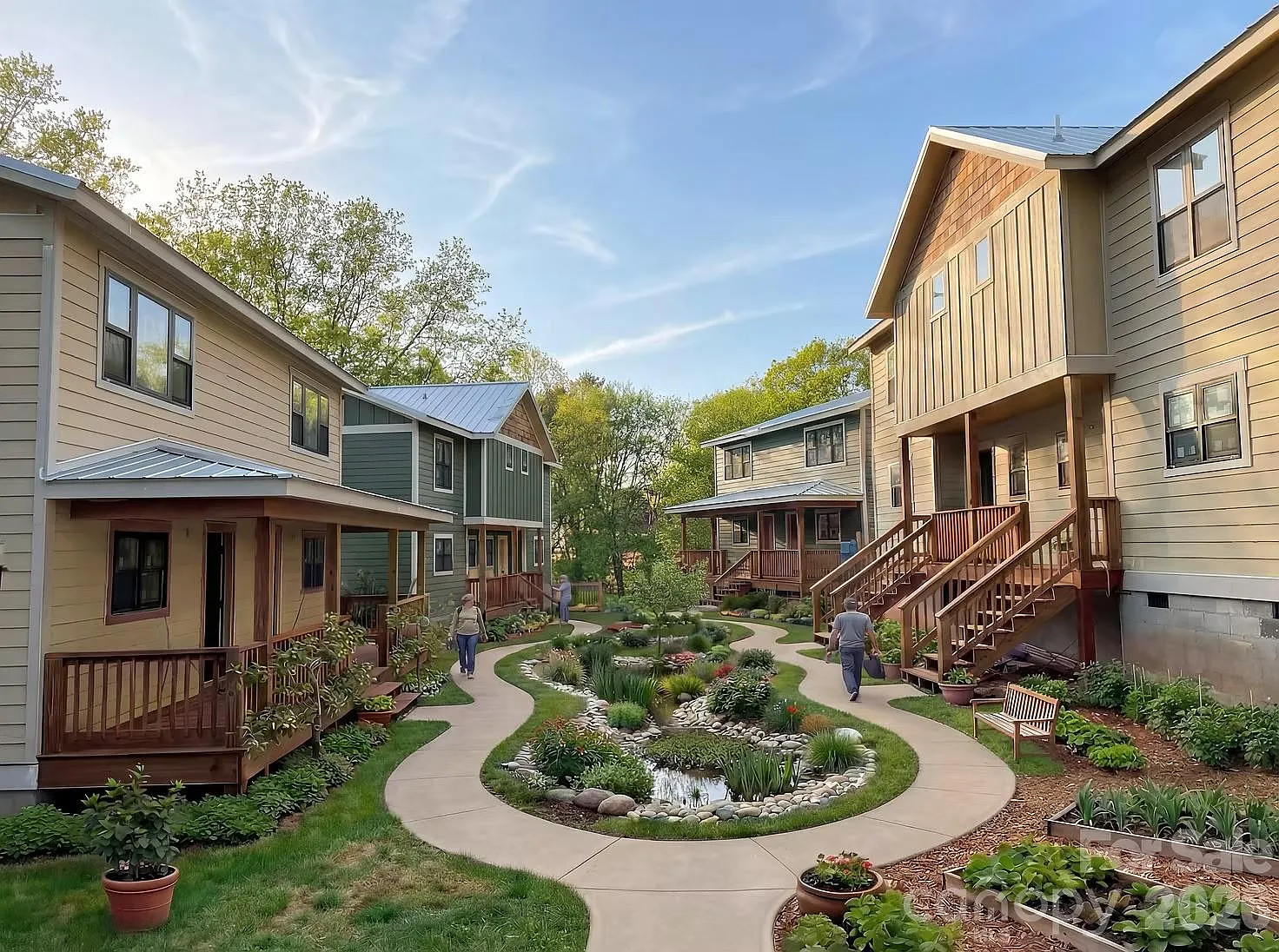
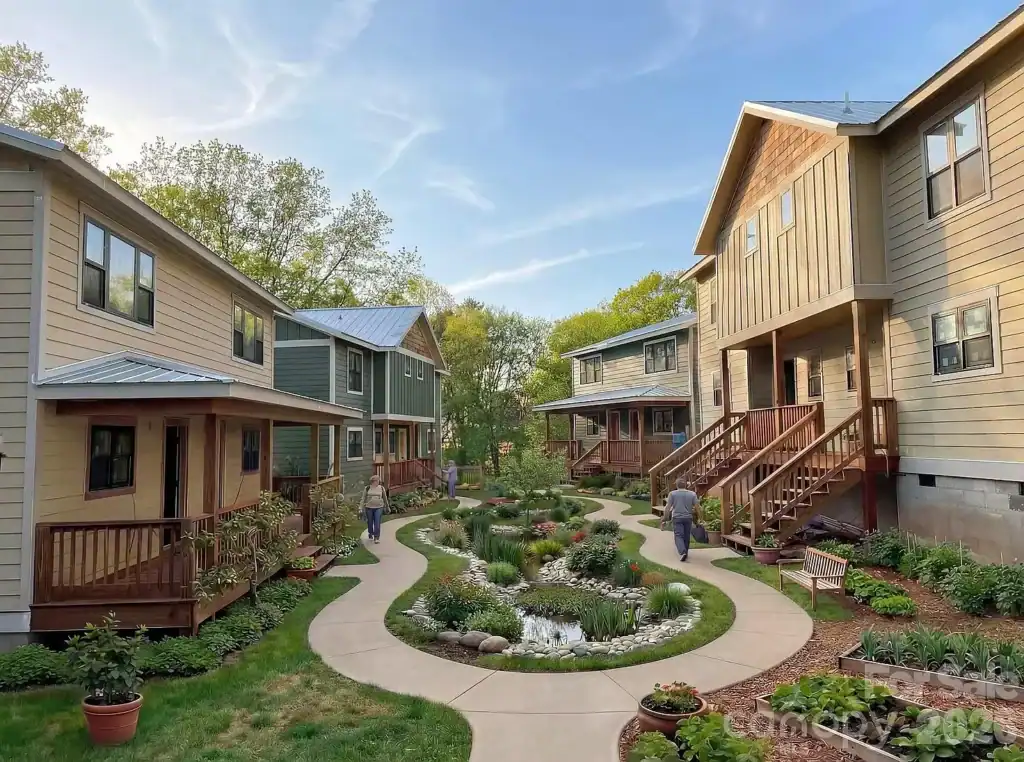
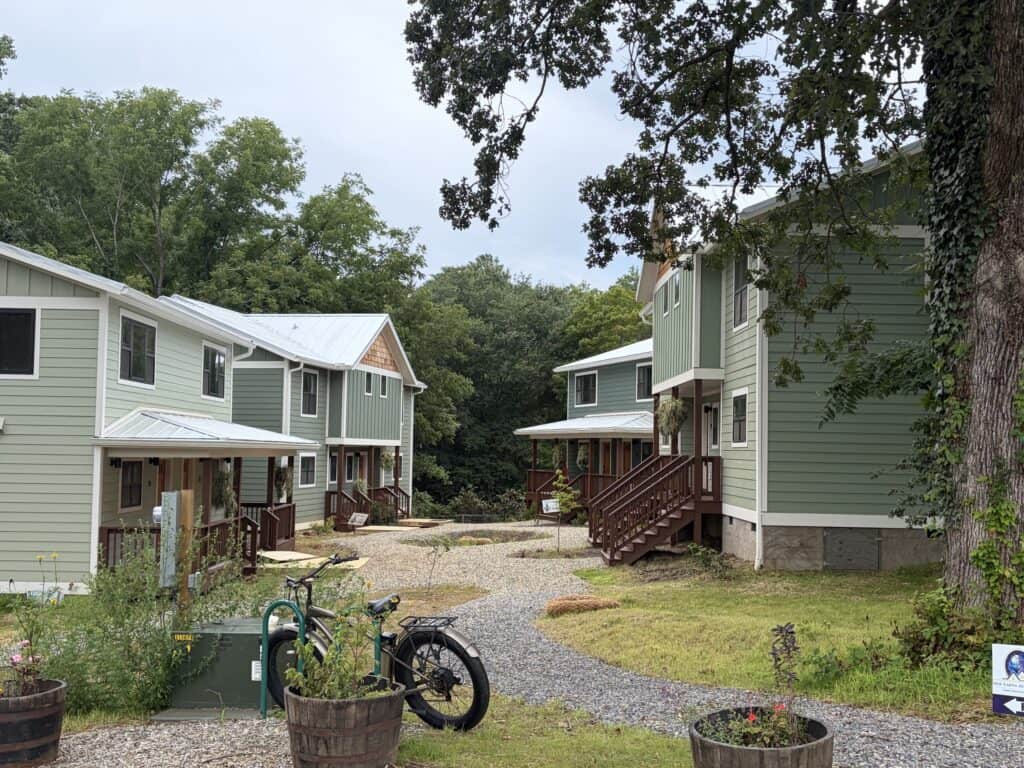
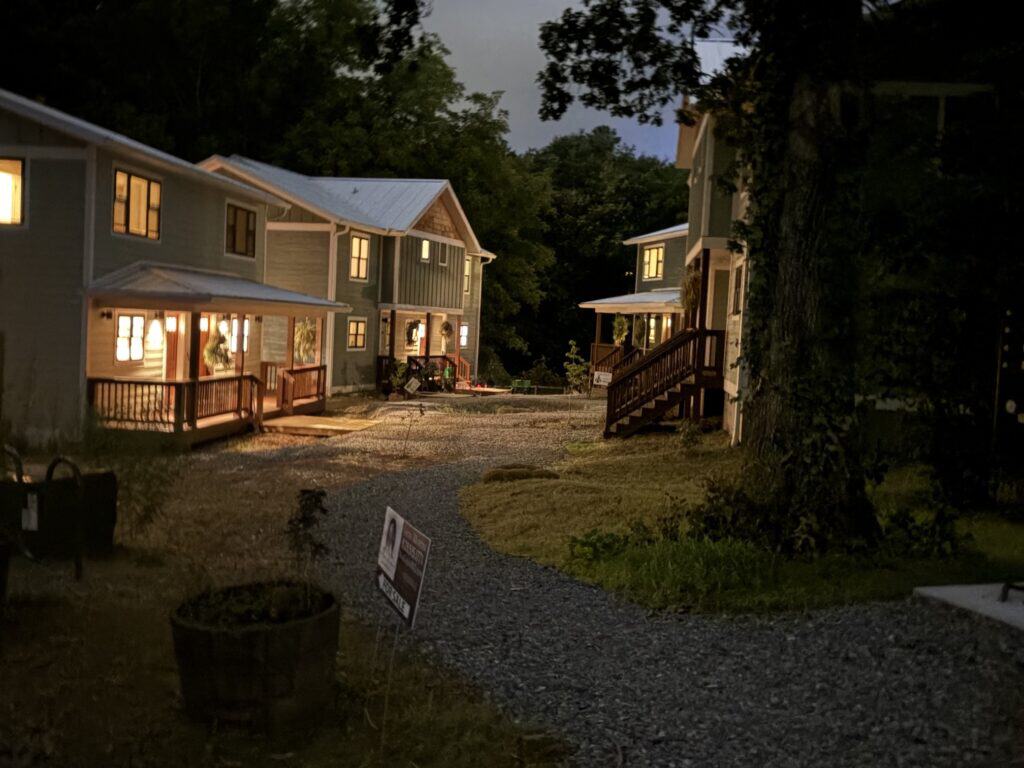
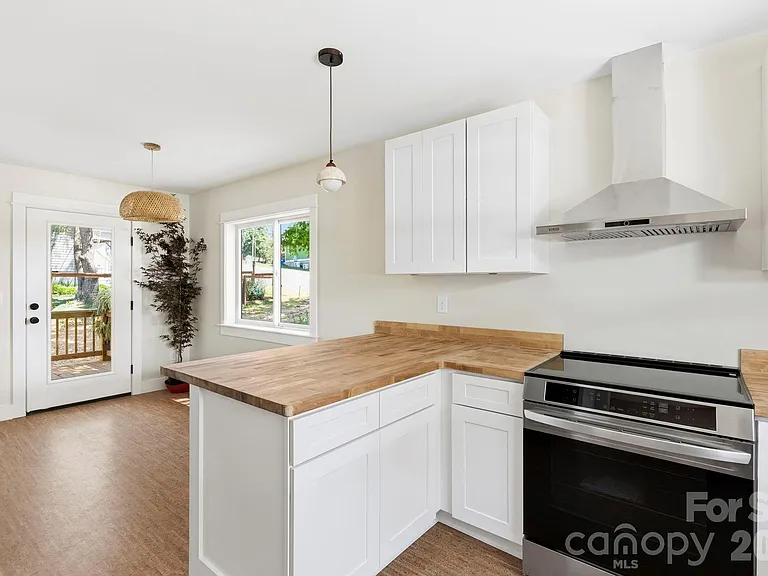
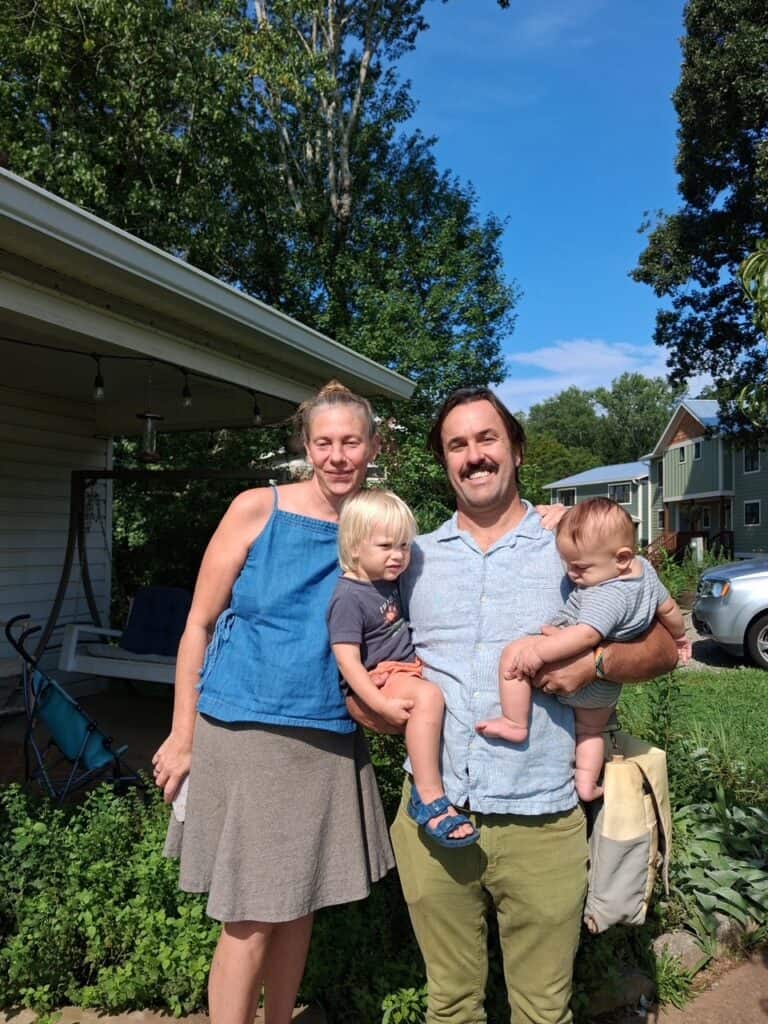
Eco-friendly community housing with landscaped gardens and walking paths.

Terra Futura Regenerative Neighborhood

  • Communities

About the Communities

  • Established
  • English
  • Social
  • Urban

Founding year

  • 2022

What we do

Terra Futura is an intentionally designed regenerative neighborhood in Asheville, North Carolina. We bring many of the qualities people seek in intentional communities and cohousing—meaningful connection, shared spaces, participatory governance, ecological stewardship, and everyday mutual support—into a neighborhood model that also preserves independence and connection to city life. Situated just 1.5 miles from the restaurants and nightlife of walkable West Asheville and just a 10 minute drive to downtown, our land adjoins a forested ravine that offers privacy and views of wildlife.

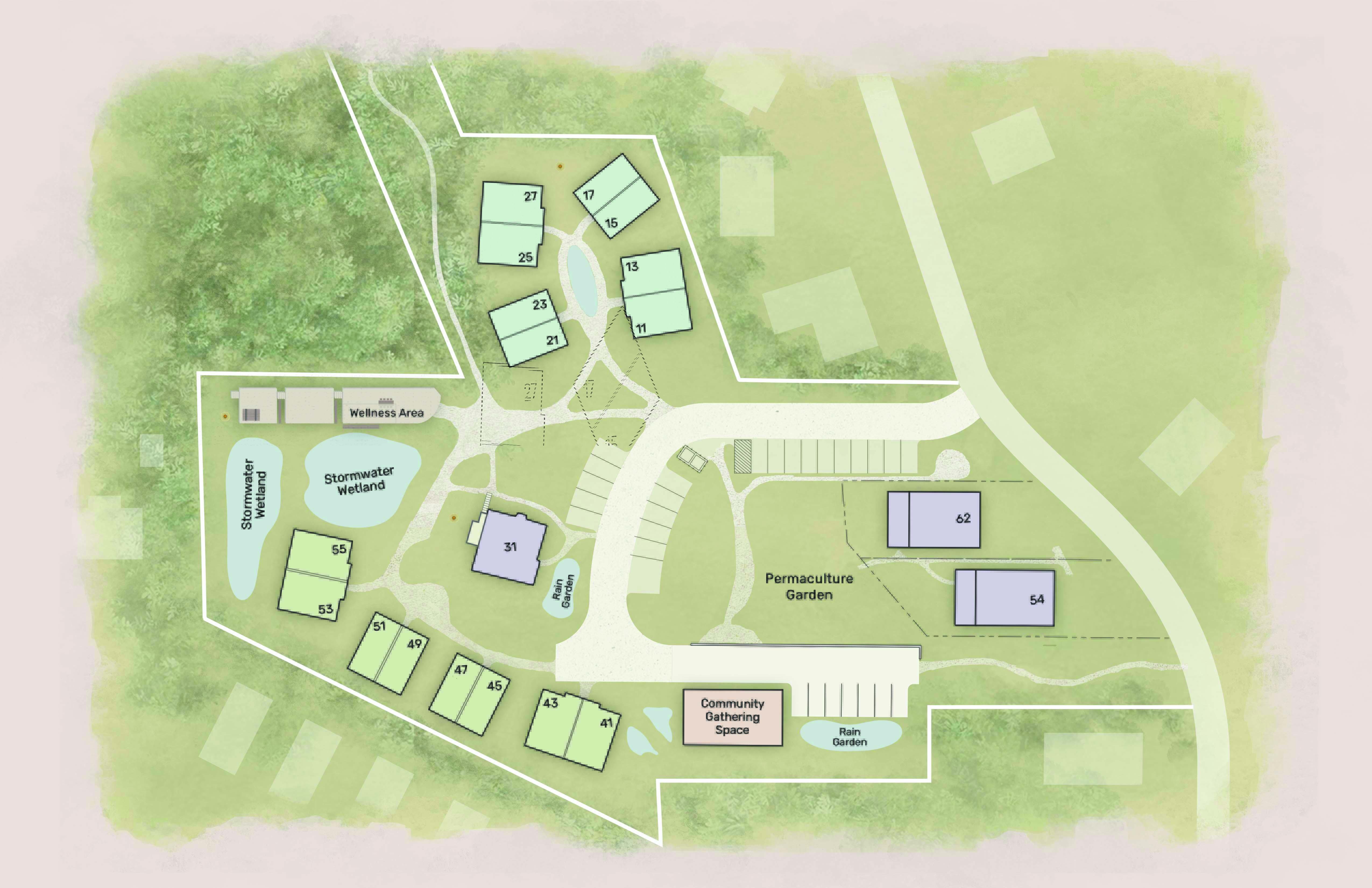
Our Green Built homes are clustered within regenerative landscapes, a Permaculture garden, and shared gathering spaces designed to make it easier for neighbors to actually know one another. Right now, much of the life of the neighborhood centers around young families, with kids moving between homes and natural play spaces, while adults gather for shared meals, projects, and everyday connection. We are excited to welcome people in other stages of life who are drawn to a more connected way of living. Homes are available through a mix of ownership and long-term rental opportunities.

Our Vision

We exist to inspire a deep sense of belonging, interdependence, and connection to the land.
Guided by ancestral wisdom, and shaped by the incremental actions we take today, Terra Futura is an optimistic experiment in cooperative living. In harmony with one another on sacred land, together we envision a more abundant tomorrow.

Our Mission

We’re dedicated to building a regenerative neighborhood that nurtures community, and fosters intentional living.
Rooted in belonging, and guided by recognition that we are an integral part of the natural world, we’re embarking on the journey of co-creating a thriving, values-aligned community that cultivates an ethos of mutual care.

  • Purpose
  • Social
  • Ecological
  • Languages
  • English
  • Community type
  • Cohousing
  • Ecovillage
  • Intentional Neighborhoods
  • Sustainability practices
  • Sustainability education and community engagement
  • Waste reduction / composting
  • Regenerative agriculture or permaculture
  • Permaculture design
  • Activities
  • Permaculture
  • Property management
  • Education
  • Ecosystem
  • Temperate Forest

Commemorative dates

  • September 30, 2022
  • Purchased Land
  • March 1, 2025
  • Phase One Complete
  • August 1, 2025
  • Started Living Together
  • August 15, 2026
  • Phase Two Complete

Video

Gallery

  • 8 Total members
  • Open to new members
  • Open to visitors
Total
18

How to join

For now, membership is purchase of a unit or rental from an owner.

Basic expectations or agreements for members

Please write in**@*************rm.com to visit the community. We will be in construction phase for about 2 years.

Decision-making process

  • Consent-Based (Sociocracy)

Decisions proceed unless someone has a reasoned objection.

Governance structure

  • Sociocratic/Circle-Based

Organized in circles or domains with distributed authority.

Conflict resolution approach

We like governance structures like sociocracy, holocracy, and anarchy, but as a “next step” community, we will begin with a simple HOA board of owners and members in a non-exempt nonprofit.

Economic model

  • Independent Finances

Members maintain separate personal finances with minimal sharing.

Economic scenarios for this community

  • There is a one-time fee, investment, or share purchase to join the community separate from accessing housing
  • Members need to pay fees, dues, or similar to live there on a per month or per year basis
  • Members typically need to have their own job or other personal source of income to cover their expenses while living in the community?

Additional economic information

Join fee: Yes
Regular fees: Yes
Members with pre-existing debt: allowed
We will have a standard HOA fee for maintenance of buildings, grounds, farm, amenities, and programs.

Shared resources and amenities that are accessible to everyone in the community

Common House, Garden(s), Greenhouse(s), Vehicle Share, Library, Workshop, Outbuilding(s), Swimming pond or pool, Hot tub or hot springs, Outdoor Kitchen, Large Scale Kitchen, Tractor & Farm Equipment, Fire pit, Swingsets & play areas, Internet

Frequency of communal meals

  • 1-3 times per month

Significant food acquisition practices

  • Growing our own
  • Locally sourced

Nature of social activity

  • People in the community regularly socialize together

Community activities and engagement

Terra Futura is still in an early, co-creative stage, so new residents have a real opportunity to help shape the culture and rhythms of community life. In addition to already sharing meals, current residents are starting to form ideas around garden workdays, seasonal harvest and food preservation activities, a parent-led homeschool/preschool coop, and hands-on projects like building a cob oven or improving shared spaces.

Longer term, we’re also interested in exploring shared resources, such as a cooperatively owned vehicle, that could help households live more lightly and depend less on multiple cars.

Educational and retreat offerings

Our educational offerings will grow alongside the community. We plan to bring in experienced facilitators for workshops in sociocracy, conflict resolution, nonviolent communication, and other practices that support healthy communication and strong community culture.

We also envision occasional learning opportunities around Permaculture gardening, DIY and homesteading skills, natural building, yoga, wellness, and other resident interests.  Our soon-to-be-renovated barn/common house will features a kitchen and 750 sq. ft. of open multi-use space for workshops and events, as well as a cozy loft for meditation, small retreats, and other intimate gatherings. 

Pet policy

  • Pets are allowed, with special approval or according to policy

Substance use culture

  • Substance use occurs primarily at celebrations or ceremonies
  • Substance use occurs in peripheral / discrete / only in personal or private spaces

DEI and anti-oppression training

  • Yes, some individuals

Building Bridges of Asheville’s 9-week course

Internal and external practices

  • Engages with local politics
  • Organizes trainings and workshops for your members

Building Bridges of Asheville’s 9-week course

Level of LGBTQIA+ inclusion

  • Somewhat - we have some LGBTQIA+ members

Gender composition

  • Roughly balanced (no group over 60%)

Age demographics

  • Family-focused (many children and parents)

Racial / ethnic demographics

  • Mostly homogeneous (primarily one background)

Socioeconomic and wealth composition

  • Moderately diverse (some economic variety)

Diversity representation

  • Neurodiverse (ex. autism, ADHD, sensory processing etc.)

Property status

  • Privately owned

Property owner

  • By several individuals through an LLC or a Tenancy In Common agreement

Ecosystem

  • Temperate Forest

Moderate climate with distinct seasonal changes
Includes deciduous and mixed forest types
Examples: Eastern North American Forests, European Broadleaf Forests

Setting

  • Urban

Within city limits with access to urban amenities and infrastructure.

Community type

  • Cohousing

    Private homes with shared common facilities, designed for neighborly
    interaction while maintaining independence.

  • Ecovillage

    Integrated communities designed around ecological principles with sustainable living practices.

  • Intentional Neighborhoods

    Geographically close groups of independently-owned homes whose residents actively cultivate community relationships and shared values.

  • Land-Based Communities

    Communities centered around shared land stewardship, sustainable agriculture, or connection to specific natural environments.

Community type

  • Super-insulated to reduce energy usage

Sustainability approach

  • Sustainability education and community engagement
  • Waste reduction / composting
  • Regenerative agriculture or permaculture
  • Permaculture design

Land practices in our community

  • The community is working to build soil using only natural methods
  • Permaculture-inspired stormwater management system that includes rain gardens and a planted wetland

Community type

  • Super-insulated to reduce energy usage

Some or all of the buildings are...

  • Super-insulated to reduce energy usage

Self-produced energy

  • Up to 33%

Energy production methods

Homes are Net-Zero Ready; owners can easily install solar panels. We have plans for EV charging stations (not installed yet).

Self-produced food

  • Up to 33%

Food production methods

Our Permaculture gardens, chicken housing and edible landscaping are in development and will be installed over the next year.  We intend to use only organic inputs and will incorporate compost and chicken manure from on site for nutrient cycling.

Food systems

  • Community garden
  • Greenhouse / aquaponics

Source of water

  • Public water supply

Wastewater management

  • Public sewage

Water conservation practices

  • Efficient irrigation (drip, timed, or moisture-based systems)

Waste management practices

  • Composting
  • Public waste collection
  • Recycling program
  • Land area size
    3 acres
  • Land allocated for food production
    eventually ~0.5 acres, intensively managed
  • Land used for biodiversity enhancement
    0.25 acres
  • Land used for tree planting
    0.25 acres

Needs & Offers

Offer

Guest Book

Written reviews are available for plus members. Click here to upgrade.

Location

  • North Carolina, United States

Terra Futura Regenerative Neighborhood

Needs and Offers

Connecting people and communities through an intentional online marketplace

  • Promoted
  • Events
2 weeks ago

Restoring Choice - free online practice group, from Australia

Restoring Choice – free sessions and a practice group Many of us are less practised at three things than we realise: making clear requests, saying no when it isn’t a full yes, and hearing no without something getting damaged. These aren’t personality traits. They’re capacities that were trained out of many of us by ordinary structures – families where some needs were allowed and others weren’t, workplaces that reward overstretch. They can be trained back. Why this might interest people here Most communities teach communication after people arrive, once conflict has already surfaced. This works the other way round – building capacity first, and finding out what a group can do when most people already have it. What’s running Free 60-minute introduction, online. Same session each time; come to whichever suits. Register for intro session below: https://events.humanitix.com/reclaim-your-power-with-restoring-choice Four-week practice group, Tuesdays from 15 September, 6:30-8:00pm. One session a week, and at least one short written entry a day about a real situation in your own life. The writing is the actual work; the sessions support it. Sign up by Sunday 13 September. Register for practice group below: https://events.humanitix.com/restoring-choice-practice-group Everything is free. Times are Australian Eastern 6:30pm here is the early hours in most of the Americas. Worth checking before you register. Who it’s for No prior experience needed. It isn’t therapy, and I’m not a therapist. Many people find that looking honestly at how well they ask, decline, or hear a no is less flattering than expected. That’s common, and it isn’t a verdict on anyone. Run by Glenn Russo – 13 years practising this material, seven years co-facilitating an NVC practice group in Castlemaine. If you’re already living in community and would rather share what you’ve learned than join anything, I’d like to hear from you too.
Offer
  • Real Estate For Sale
3 weeks ago

Unit C-2, Woodard Lane Cohousing — Olympia, WA

Join Olympia’s first and longest-running cohousing community, in a quiet West Side neighborhood 1.6 miles from downtown, backing onto a forested ravine along Schneider Creek. Unit C-2 offers 1,904 SF. Two stories, 4 bedrooms, 2 full bathrooms, and a bonus loft room on the main level. It can be lived in as one spacious family home — or split into two independent living spaces, each with its own kitchen, entrance, and effective soundproofing. Great for multigenerational households, live/work arrangements, or an owner-occupied half with a rented or shared half. Upper level: bedroom, full bath, bonus room with built-in loft bed, and an open kitchen-dining-living area with a deck facing the forest. Lower level: 3 bedrooms, full bath with dual sinks, second full kitchen, laundry room, and a second patio. Features: 2 full kitchens, radiant floor heat, stained concrete floors (bamboo upstairs), double-pane windows, bolted keyed entries at both levels, dedicated laundry, concrete patios facing the ravine, shared parking with 18 EV charging stations.   Ownership includes a Common House with a guest room, full kitchen, gathering space, and kids’ play area; a shared vegetable garden; a wood shop and bike storage; and wooded grounds with a stream path and central Green. Monthly dues are $799, covering all utilities except internet. Established in 2010, Woodard Lane is home to ~40 residents across 18 homes, with shared meals, work parties, and genuine neighborliness. Learn more about Woodard Lane Cohousing  We’re looking for a buyer who wants to participate fully in community life. $630,000. Contact Kate Greene: yo******@***il.com or text: 360-789-7587.
Need
  • Forming Communities
2 weeks ago

A call for pioneers, trade-builders, and the four Elemental Elders to construct our first cooperative village prototype.

Intake Open: Flagship WE Network Village in Clubb, MO Call for pioneers, trade-builders, and 4 Elemental Elders to construct our first cooperative village prototype. WE Network is opening ground zero in Clubb, Missouri—our living model to build trade shops and train leadership teams for nationwide village rollout. We are building a self-sustaining, salvaged homestead ecosystem operating as a parallel society alongside existing systems. Bring your own living setup (tents, micro-campers, trucks, schoolies, tiny homes) to secure your lot within the co-op village. The 3×3 Exchange: Mental, Physical, & Spiritual Maintain your lot via our 3×3 exchange (3 hours/day, 3 days/week = 9 hours total): Mental: Classroom teaching, strategy, skill-sharing, and village instruction. Physical: Hands-on labor building active land and shop projects. Spiritual: Participation in our weekly Friday Fellowship Fire Circle. Trade Shops & Lot Placement Every member contributes directly to our local micro-economy: Trade Holders: Set up your specific service shop for the co-op. Transitioning Members: Assigned a trade lot to focus on constructing the physical shop structure. Weekend Operations: Retail open Saturdays and Sundays. Mid-week is reserved for building and life. Priority Intake: The Four Elemental Elders We are recruiting four foundational Elders: Earth Elder: Land, soil, livestock, permaculture, and natural materials. Air Elder: Building structures and Eco Junk waste-to-material upcycling. Fire Elder: Spiritual health, Natural Law, body healing, and Fire Circles. Water Elder: Resource flow, food storage, bookkeeping, and services. How to Apply 👉 Visit fffc.wtf to submit your intake request today.

Update to a Public Profile

  • Log in
  • Go to your profile page
  • Toggle on the "Add my profile to the directory"
  • Save your profile

Information

Communities

A residential project: people live here as their primary home.

Organizations

An institution, business, network, or project that isn’t a residence (e.g. a learning center, farm, or network with no one living there full-time).

Plus Community Membership

  • Find people with Profile Match
  • Access to your community listing statistics
  • Create Discussion Groups
  • Access to our affiliate program
  • Member badge on your community profile
I am an official member of this community
Disclaimer
I affirm that my information is accurate and I am authorized to manage this listing
Foundation for Intentional Community FIC Member badge logo.

Free Plan

Free Membership
Free

Intentional Advertising

  • Subtotal

    {{ currencyFormat( pricing_summary.total_amount ) }}

Icon representing community connections and collaboration for intentional communities.

Plus Membership

We’re introducing new Plus features — including community reviews, Profile Match, and unlimited Needs & Offers posts — while keeping most of FIC free for everyone. Membership costs less than two coffees a month. 

  • Find communities with Profile Match
  • View detailed reviews about communities
  • Create free listings in Needs & Offers
  • Plus Member resources in CommUniversity
  • View communities detailed reviews
  • Plus Member badge on your profile