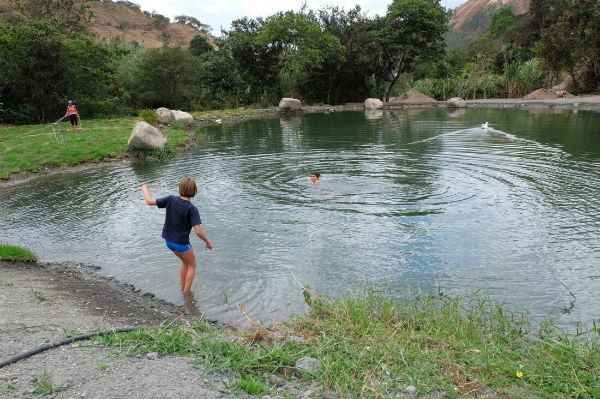
Children playing and swimming in a natural outdoor pond surrounded by trees.

Chambalabamba

  • Communities

About the Communities

  • Established
  • Ecological
  • Rural

Founding year

  • 2011

What we do

Welcome to Ecoaldea Chambalabamba, evolving community. You can spend time participating in the volunteer program that includes organic garden management-permaculture, agroforestry implementation, bioconstruction of natural buildings, art workshops, making crafts, creative projects, alternative schooling, carpentry, vegetarian cuisine, etc. You can also experience the dynamic organization of the living cell, in which we are creating a caring and sustainable culture. Living near each other, cooperate and share resources so that we can live more lightly and joyfully on earth.
We are always under construction and development of homes, gardens, artistic, and educational projects, which daily physical effort is conducted and intellectual and spiritual work, where you’ll find a balance for a fuller life.
We will wait for you!!!
Bienvenido a Ecoaldea Chambalabamba, comunidad en evolución. Puedes pasar tiempo participando en el programa de voluntariado que incluye manejo de huertos orgánicos-permacultura, implementación de agroforestería, bioconstrucción de edificios naturales, talleres de arte, elaboración de artesanías, proyectos creativos, escolaridad alternativa, carpintería, cocina vegetariana, etc. También puedes experimentar la organización dinámica de la célula viva, en la que estamos creando una cultura solidaria y sostenible. Vivir cerca unos de otros, cooperar y compartir recursos para que podamos vivir más ligeros y alegres en la tierra.
Actualmente estamos en construcción y desarrollo de viviendas, jardines y proyectos educativos, en los que diariamente se realiza un esfuerzo físico y un trabajo intelectual y espiritual, donde encontrarás un equilibrio para una vida más plena.
¡¡¡Te esperamos!!!

Our Mission

Our focus is to create an environment where human beings can THRIVE. Food forests, arts & entertainment, happiness and rainbows. we are exploring, living in freedom and love.
Nuestro objetivo es crear un ambiente en donde los seres humanos puedan prosperar. Bosques de alimentos, artes y entretenimiento, la felicidad y el arco iris. exploramos viviendo en libertad y amor.

  • Purpose
  • Ecological
  • Community type
  • Ecovillage
  • Sustainability practices
  • Permaculture design
  • Natural / low-impact building
  • Activities
  • Farming
  • Education
  • Experiences

Commemorative dates

  • January 1, 2011
  • Started planning
  • January 1, 2012
  • Started living together

Video

  • 7 Total members
  • Open to new members
  • Open to visitors
Total
18

How to join

volunteer initially for one month or more, then after more months, if it feels right on both sides, one can become a member. we are mostly a latino community of artists, so its good to speak spanish and have artistic or other kinds of skills. it takes some months as a volunteer until its a big yes from all the community and a big yes from the new residents. one needs to write to us through chambalabamba.org under volunteers.

Basic expectations or agreements for members

Please email for a visit through our website: chambalabamba.org under volunteers.! For better integration and learning, we suggest a stay with us for a period of one month as long as there is harmony between the two sides. After a month of volunteering, if you intend to remain, a meeting will decide on the matter to be, We are also open to the possibility of new residents — families with children, couples and singles. And we have 4 beautiful rental houses and 3 rooms in the treehouse.

Primary decision-making authority

  • All Community Members Together

The whole membership decides collectively.

Decision-making process

  • Full Consensus

Everyone must agree before moving forward.

Governance structure

  • Collaborative/Horizontal

Power and responsibility are shared relatively equally among members.

Conflict resolution approach

we are a living example of anarchism. that is, consensus decision making process, all are equal, no rules, only agreements, self organizing.

Economic model

  • Partial Income-Sharing

Members contribute a percentage of income to community funds.

Economic scenarios for this community

  • Members need to pay fees, dues, or similar to live there on a per month or per year basis
  • There is a labor obligation

Additional economic information

Regular fees: $20
Labor: Yes (20 hrs/week)
we are looking for ways for the community to make money, like retreats, workshops, festivals, concerts, making things in our wood and metal shop, products from our gardens. if anyone reading this can help bring people here for a 10 day retreat, please contact us. and also, people currently must spend about $20 per week for us to buy food at the market.

Shared resources and amenities that are accessible to everyone in the community

Common House, Garden(s), Greenhouse(s), Workshop, Outbuilding(s), Swimming pond or pool, Large Scale Kitchen, Tractor & Farm Equipment, Stage or Auditorium, Fire pit, Swingsets & play areas, Waterfront access, Internet

Frequency of communal meals

  • 2-5 times per week

Dietary type

  • Vegetarian Only

Dietary restriction

  • People can cook and eat what they want in their own residence

Community activities and engagement

  • School, Educational Institute or Experience
  • Volunteer, Internship, or Apprenticeship, or WWOOF’ing
  • WWOOF'ing, Guest Farming
  • Festivals, Conferences, Events

Substance use culture

  • Substance use occurs primarily at celebrations or ceremonies
  • Substance use is prohibited in the community

Gender composition

  • Roughly balanced (no group over 60%)

Age demographics

  • Multi-generational (all ages well represented)

Property status

  • Privately owned

Property owner

  • By a Community Land Trust or some other kind of nonprofit

Setting

  • Rural

Countryside locations with significant distance from urban centers.

Community type

  • Ecovillage

    Integrated communities designed around ecological principles with sustainable living practices.

Community type

  • Partially built or remodeled with recycled or environmentally friendly materials, and/or using natural building methods

Sustainability approach

  • Permaculture design
  • Natural / low-impact building

Land practices in our community

  • The community practices permaculture

Community type

  • Partially built or remodeled with recycled or environmentally friendly materials, and/or using natural building methods

Some or all of the buildings are...

  • Partially built or remodeled with recycled or environmentally friendly materials, and/or using natural building methods

Self-produced energy

  • Up to 33%

Self-produced food

  • 33 - 66%

Local, organic, or fair trade food

  • Up to 33%

Food systems

  • Community garden
  • Food forest
  • Greenhouse / aquaponics
  • Land area size
    15 acres

Guest Book

Written reviews are available for plus members. Click here to upgrade.

Location

  • Loja, Ecuador

Chambalabamba

Needs and Offers

Connecting people and communities through an intentional online marketplace

  • Promoted
Offer
  • Real Estate For Sale
5 days ago

Beautiful 3+ Bed, 2.5 Bath Townhome in Established West Emerald CoHousing, Seattle

A rare home is available at West Emerald Cohousing, an established all-ages intentional community in West Seattle. For those considering a move to the Pacific Northwest—or hoping to join a mature community rather than one still in the forming stages—West Emerald offers decades of community life, beautiful gardens, shared resources and a peaceful setting within the city in a convenient location since 1999. This unit has a unique floor plan that is ideal for co-buying, co-living, or for one household. The home itself offers a flexible 3+ bedroom, 2.5 bath layout: Garden-level room with a separate exterior entrance and half bath—ideal for a home office, studio, guest space or client-facing business Main-level bedroom and full bath, laundry, making one-level living possible Open great room with large windows overlooking gardens filled with birdsong Well-designed kitchen with generous storage and pantry Two additional light-filled spacious bedrooms and a full bath upstairs Thoughtfully maintained and updated Located at the end of a common pathway for added privacy and garden views, Just feet from parking, which is out of view West Emerald community amenities include: Common House with gathering and activity spaces Community meals and events Mature gardens and shared outdoor spaces Workshop/maker spaces and bike barn Exercise room EV charging opportunity Excellent Metro access to Downtown Seattle just minutes away Nestled into a dell, it’s Seattle’s best-kept secret South Seattle College and lifelong learning, NW Wine Academy, the Seattle Chinese Garden are nearby, with easy access to Alki Beach, Lincoln Park, magnet schools, ferries, and the shops and restaurants of the West Seattle Junction. 6000 17th Ave SW, Seattle, WA Is a wonderful opportunity to have your own comfortable, private home while becoming part of a vibrant and well-established Seattle all-ages cohousing community. For more information contact the friendly Realtor at 206-579-9066, or at ki**********@**********te.com who will be happy to meet you there or do a facetime tour.
Need
  • Communities with Openings
3 days ago

Looking for a family-friendly farm, cohousing, or intentional community

This might be a little hard to explain, but I’m going to try. I’m 28, Colombian-American, and I have a seven-year-old daughter. Our life is a little unconventional. I travel, my work is not a normal 9–5, and I’ve realized I don’t want to keep building our life around temporary housing, hired help, and having to recreate a support system everywhere we go. I keep wondering whether there is somewhere we could actually belong. Not necessarily an “intentional community” in the formal sense. It could be a farm, a group of families, cohousing, an intergenerational household, or something I don’t have the language for yet. What I want is for my daughter to grow up around people she really knows. Other children. Adults who become familiar and trusted over time. A place where people notice when someone needs help, where meals or childcare or work sometimes overlap naturally, and where community is more than everyone living near each other. And for myself, I want people I can actually think and build with. I care a lot about spirituality, inner work, land, education, caregiving, and learning how to live differently. But I also care about power and about whether the communities we create reproduce the same things we say we’re trying to get away from. I need to be around people who can acknowledge things like racism, class, gender and systemic inequality without becoming defensive or treating those conversations as inherently divisive. I’ve been developing some of my own thinking around all of this through a framework I call Conscious Colombia, Participating Wisely, and Contemporary Sādhana. A lot of it comes down to a question I keep returning to: how do we become people who can participate in community wisely, while also creating structures that remain accountable and open to correction? I don’t have a fixed location in mind and I’m not looking to rush into anything. I’m really just trying to find the people and places where this kind of life is already being attempted — imperfectly, seriously, in real life. If you’re building something like this, living in something like this, or even asking similar questions, I’d love to talk.
  • Events
2 weeks ago

Coastal Regeneration Immersion: Permaculture Design Certification in Jalisco, Mexico

Tropical Dry Forest Permaculture Design & Regenerative Stewardship Certification (PDC)12-Day Intensive | 120 Hours | Costalegre, Jalisco, Mexico Join us for an immersive Permaculture Design Certificate course set in the tropical dry forest bioregion of coastal Jalisco. This 120-hour intensive blends internationally recognized PDC curriculum with hands-on regenerative practice — combining ecological design, agroforestry, natural building, and community stewardship into one integrated learning experience. Lead Faculty Jorge Luis Gtz. Olarte (Arborescencia RedGenerativa) – Regenerative Design, Soil Biology & Agroforestry Ozzy Lusth (Survior & Xochiraíz) – Wilderness Resilience & Survival Skills Dave Collins (Capacha Coastal Conservation Center) – Bioarchitecture & Ecological Development What You’ll LearnThe course moves through six progressive phases: Permaculture & Ecological Literacy – ethics, principles, and reading the tropical dry forest landscape Water & Soil Systems – keyline design, water harvesting, living soils, and compost systems Horticulture – food garden design, propagation, and biological pest control Regenerative Food Systems – tropical agroforestry, food forest design, and guild planting Ecological Infrastructure – bamboo bioarchitecture, bioclimatic farm design, compost toilets, greywater, and rocket stoves Integrated Design Studio – team-based final design projects covering watershed strategy, agroforestry, food forest layout, infrastructure, and phased implementation Daily RhythmMornings begin with optional surf/yoga and journaling, followed by field practicums and hands-on workshops. Afternoons include design studio and construction lab work, with reflection circles, communal dinners, and evening talks, films, or campfire discussions rounding out the day. Final ProjectParticipants work in teams to produce a full regenerative design package — landscape analysis, water plan, agroforestry design, food forest plan, ecological infrastructure, and bioclimatic farm plan — presented to a faculty review panel on the final day, followed by a closing ceremony, certificate delivery, and community feast. CertificationGraduates receive the Tropical Dry Forest Permaculture Design & Regenerative Stewardship Certification (120 contact hours), hosted by Capacha Coastal Conservation Center and Tierralegre, A.C. Curriculum integrates international PDC standards with tropical ecology, agroforestry, ecological restoration, bamboo bioarchitecture, bioclimatic design, GIS/photogrammetry, and regenerative leadership. Highlights Hands-on bamboo construction (temazcal, bathhouses, sculpture) Tropical dry forest silviculture practicum Community mapping and design project for Ekoa Green Community Talent show and sea turtle release
November 13, 2026 09:00 – November 25, 2026 16:00
  • Events
4 weeks ago

Restoring Choice - free online practice group, from Australia

Restoring Choice – free sessions and a practice group Many of us are less practised at three things than we realise: making clear requests, saying no when it isn’t a full yes, and hearing no without something getting damaged. These aren’t personality traits. They’re capacities that were trained out of many of us by ordinary structures – families where some needs were allowed and others weren’t, workplaces that reward overstretch. They can be trained back. Why this might interest people here Most communities teach communication after people arrive, once conflict has already surfaced. This works the other way round – building capacity first, and finding out what a group can do when most people already have it. What’s running Free 60-minute introduction, online. Same session each time; come to whichever suits. Register for intro session below: https://events.humanitix.com/reclaim-your-power-with-restoring-choice Four-week practice group, Tuesdays from 15 September, 6:30-8:00pm. One session a week, and at least one short written entry a day about a real situation in your own life. The writing is the actual work; the sessions support it. Sign up by Sunday 13 September. Register for practice group below: https://events.humanitix.com/restoring-choice-practice-group Everything is free. Times are Australian Eastern 6:30pm here is the early hours in most of the Americas. Worth checking before you register. Who it’s for No prior experience needed. It isn’t therapy, and I’m not a therapist. Many people find that looking honestly at how well they ask, decline, or hear a no is less flattering than expected. That’s common, and it isn’t a verdict on anyone. Run by Glenn Russo – 13 years practising this material, seven years co-facilitating an NVC practice group in Castlemaine. If you’re already living in community and would rather share what you’ve learned than join anything, I’d like to hear from you too.
Offer
Offer
Offer

Update to a Public Profile

  • Log in
  • Go to your profile page
  • Toggle on the "Add my profile to the directory"
  • Save your profile

Information

Communities

A residential project: people live here as their primary home.

Organizations

An institution, business, network, or project that isn’t a residence (e.g. a learning center, farm, or network with no one living there full-time).

Plus Community Membership

  • Find people with Profile Match
  • Access to your community listing statistics
  • Create Discussion Groups
  • Access to our affiliate program
  • Member badge on your community profile
I am an official member of this community
Disclaimer
I affirm that my information is accurate and I am authorized to manage this listing
Foundation for Intentional Community FIC Member badge logo.

Free Plan

Free Membership
Free

Intentional Advertising

  • Subtotal

    {{ currencyFormat( pricing_summary.total_amount ) }}

Icon representing community connections and collaboration for intentional communities.

Plus Membership

We’re introducing new Plus features — including community reviews, Profile Match, and unlimited Needs & Offers posts — while keeping most of FIC free for everyone. Membership costs less than two coffees a month. 

  • Find communities with Profile Match
  • View detailed reviews about communities
  • Create free listings in Needs & Offers
  • Plus Member resources in CommUniversity
  • View communities detailed reviews
  • Plus Member badge on your profile