
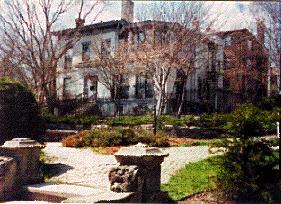
Historic residential building with lush garden and stone pathway in community setting.

Hypatia Cooperative House

  • Communities

About the Communities

  • Mature
  • Home-sharing
  • Urban

Founding year

  • 1963

What we do

Hypatia is a 12-person cooperative that is currently home to graduate and undergraduate students, workers, and professionals. We are located in a beautiful mansion surrounded by a historic garden. Our house is in a quiet neighborhood three blocks north of the capitol, eight blocks from campus, and one block from Lake Mendota. Our spacious living and dining room has hardwood floors, floor-to-ceiling windows that face the capitol, and a fireplace.

Our Mission

MCC strives to improve the Madison community by providing low-cost, not-for-profit cooperative housing for very low- to moderate-income people and to be inclusive of underrepresented and marginalized groups.

  • Purpose
  • Home-sharing
  • Community type
  • Coliving

Commemorative dates

  • January 1, 1963
  • Started planning
  • January 1, 1963
  • Started living together
  • 12 Total members
  • Open to new members
  • Open to visitors
Total
12

How to join

Briefly, we ask that people come to three dinners, fill in a survey. If from out of town, we make modifications to the process.

Basic expectations or agreements for members

email us at hy***************@**************ty.coop

Primary decision-making authority

  • All Community Members Together

The whole membership decides collectively.

Decision-making process

  • Majority Vote

More than 50% agreement needed.

Governance structure

  • Collaborative/Horizontal

Power and responsibility are shared relatively equally among members.

Conflict resolution approach

MCC is an umbrella cooperative that is run by a volunteer Board of Directors, elected from the general membership. Anyone living in any of MCC’s eleven houses, of which Hypatia is one, is eligible to serve on the Board of Directors.

Economic model

  • Independent Finances

Members maintain separate personal finances with minimal sharing.

Economic scenarios for this community

  • There is a one-time fee, investment, or share purchase to join the community separate from accessing housing
  • Members need to pay fees, dues, or similar to live there on a per month or per year basis
  • There is a labor obligation
  • Members typically need to have their own job or other personal source of income to cover their expenses while living in the community?

Additional economic information

Join fee: $200
Regular fees: Yes
Labor: Yes
About 22 hours/month
about $75-100
Monthly room & food charges

Shared resources and amenities that are accessible to everyone in the community

Common House, Garden(s), Large Scale Kitchen, Internet

Frequency of communal meals

  • 2-5 times per week

Substance use culture

  • Substance use appears in public spaces but no pressure

Gender composition

  • Roughly balanced (no group over 60%)

Age demographics

  • Mixed adults (few or no children)

Property status

  • Privately owned

Property owner

  • By a Land Trust, Home Owners Association, or corporation

Setting

  • Urban

Within city limits with access to urban amenities and infrastructure.

Community type

  • Coliving

    Shared living spaces with private bedrooms/bathrooms and communal
    kitchens, dining, and social areas.

Energy sources used

  • Photovoltaic Solar

Self-produced food

  • Up to 33%

Food systems

  • Community garden
  • Land area size
    .2 acres

Guest Book

Written reviews are available for plus members. Click here to upgrade.

Location

  • Wisconsin, United States

Hypatia Cooperative House

Needs and Offers

Connecting people and communities through an intentional online marketplace

Offer
Offer
Offer
  • Events
3 days ago

Coastal Regeneration Immersion: Permaculture Design Certification in Jalisco, Mexico

Tropical Dry Forest Permaculture Design & Regenerative Stewardship Certification (PDC)12-Day Intensive | 120 Hours | Costalegre, Jalisco, Mexico Join us for an immersive Permaculture Design Certificate course set in the tropical dry forest bioregion of coastal Jalisco. This 120-hour intensive blends internationally recognized PDC curriculum with hands-on regenerative practice — combining ecological design, agroforestry, natural building, and community stewardship into one integrated learning experience. Lead Faculty Jorge Luis Gtz. Olarte (Arborescencia RedGenerativa) – Regenerative Design, Soil Biology & Agroforestry Ozzy Lusth (Survior & Xochiraíz) – Wilderness Resilience & Survival Skills Dave Collins (Capacha Coastal Conservation Center) – Bioarchitecture & Ecological Development What You’ll LearnThe course moves through six progressive phases: Permaculture & Ecological Literacy – ethics, principles, and reading the tropical dry forest landscape Water & Soil Systems – keyline design, water harvesting, living soils, and compost systems Horticulture – food garden design, propagation, and biological pest control Regenerative Food Systems – tropical agroforestry, food forest design, and guild planting Ecological Infrastructure – bamboo bioarchitecture, bioclimatic farm design, compost toilets, greywater, and rocket stoves Integrated Design Studio – team-based final design projects covering watershed strategy, agroforestry, food forest layout, infrastructure, and phased implementation Daily RhythmMornings begin with optional surf/yoga and journaling, followed by field practicums and hands-on workshops. Afternoons include design studio and construction lab work, with reflection circles, communal dinners, and evening talks, films, or campfire discussions rounding out the day. Final ProjectParticipants work in teams to produce a full regenerative design package — landscape analysis, water plan, agroforestry design, food forest plan, ecological infrastructure, and bioclimatic farm plan — presented to a faculty review panel on the final day, followed by a closing ceremony, certificate delivery, and community feast. CertificationGraduates receive the Tropical Dry Forest Permaculture Design & Regenerative Stewardship Certification (120 contact hours), hosted by Capacha Coastal Conservation Center and Tierralegre, A.C. Curriculum integrates international PDC standards with tropical ecology, agroforestry, ecological restoration, bamboo bioarchitecture, bioclimatic design, GIS/photogrammetry, and regenerative leadership. Highlights Hands-on bamboo construction (temazcal, bathhouses, sculpture) Tropical dry forest silviculture practicum Community mapping and design project for Ekoa Green Community Talent show and sea turtle release
November 13, 2026 09:00 – November 25, 2026 16:00
Need
  • Forming Communities
3 weeks ago

A call for pioneers, trade-builders, and the four Elemental Elders to construct our first cooperative village prototype.

Intake Open: Flagship WE Network Village in Clubb, MO Call for pioneers, trade-builders, and 4 Elemental Elders to construct our first cooperative village prototype. WE Network is opening ground zero in Clubb, Missouri—our living model to build trade shops and train leadership teams for nationwide village rollout. We are building a self-sustaining, salvaged homestead ecosystem operating as a parallel society alongside existing systems. Bring your own living setup (tents, micro-campers, trucks, schoolies, tiny homes) to secure your lot within the co-op village. The 3×3 Exchange: Mental, Physical, & Spiritual Maintain your lot via our 3×3 exchange (3 hours/day, 3 days/week = 9 hours total): Mental: Classroom teaching, strategy, skill-sharing, and village instruction. Physical: Hands-on labor building active land and shop projects. Spiritual: Participation in our weekly Friday Fellowship Fire Circle. Trade Shops & Lot Placement Every member contributes directly to our local micro-economy: Trade Holders: Set up your specific service shop for the co-op. Transitioning Members: Assigned a trade lot to focus on constructing the physical shop structure. Weekend Operations: Retail open Saturdays and Sundays. Mid-week is reserved for building and life. Priority Intake: The Four Elemental Elders We are recruiting four foundational Elders: Earth Elder: Land, soil, livestock, permaculture, and natural materials. Air Elder: Building structures and Eco Junk waste-to-material upcycling. Fire Elder: Spiritual health, Natural Law, body healing, and Fire Circles. Water Elder: Resource flow, food storage, bookkeeping, and services. How to Apply 👉 Visit fffc.wtf to submit your intake request today.

Update to a Public Profile

  • Log in
  • Go to your profile page
  • Toggle on the "Add my profile to the directory"
  • Save your profile

Information

Communities

A residential project: people live here as their primary home.

Organizations

An institution, business, network, or project that isn’t a residence (e.g. a learning center, farm, or network with no one living there full-time).

Plus Community Membership

  • Find people with Profile Match
  • Access to your community listing statistics
  • Create Discussion Groups
  • Access to our affiliate program
  • Member badge on your community profile
I am an official member of this community
Disclaimer
I affirm that my information is accurate and I am authorized to manage this listing
Foundation for Intentional Community FIC Member badge logo.

Free Plan

Free Membership
Free

Intentional Advertising

  • Subtotal

    {{ currencyFormat( pricing_summary.total_amount ) }}

Icon representing community connections and collaboration for intentional communities.

Plus Membership

We’re introducing new Plus features — including community reviews, Profile Match, and unlimited Needs & Offers posts — while keeping most of FIC free for everyone. Membership costs less than two coffees a month. 

  • Find communities with Profile Match
  • View detailed reviews about communities
  • Create free listings in Needs & Offers
  • Plus Member resources in CommUniversity
  • View communities detailed reviews
  • Plus Member badge on your profile