

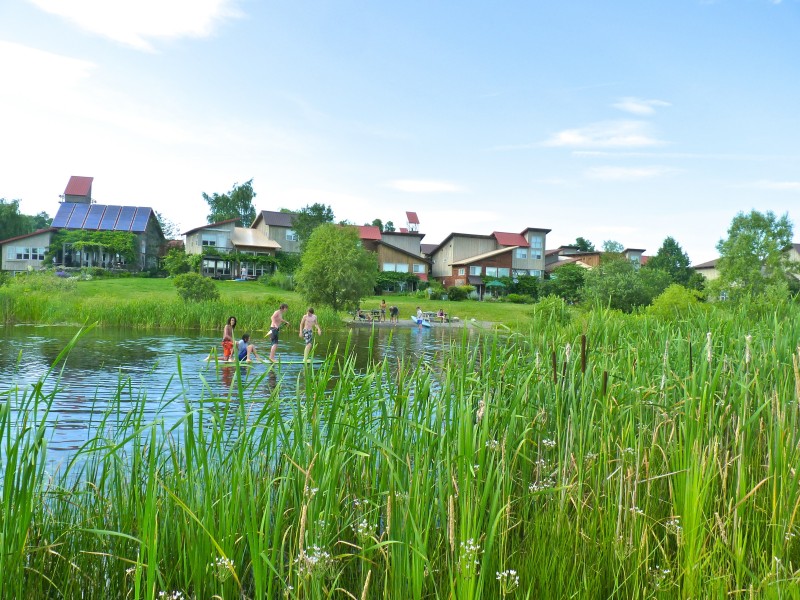
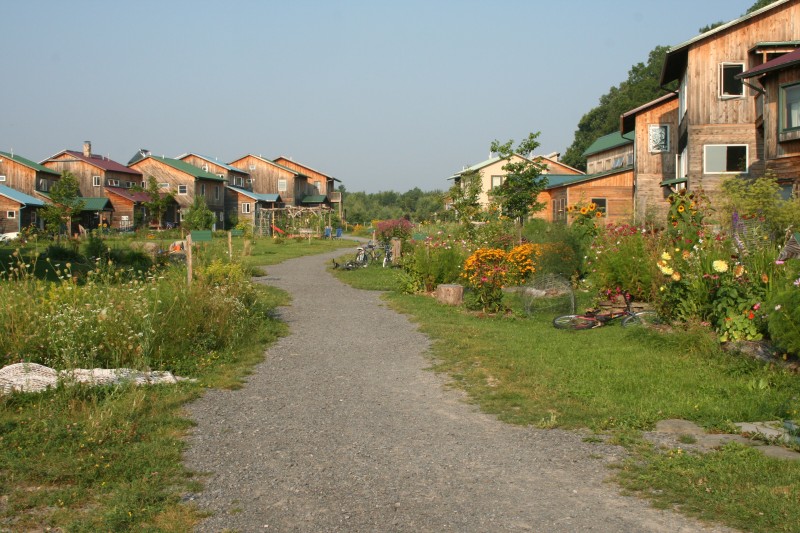
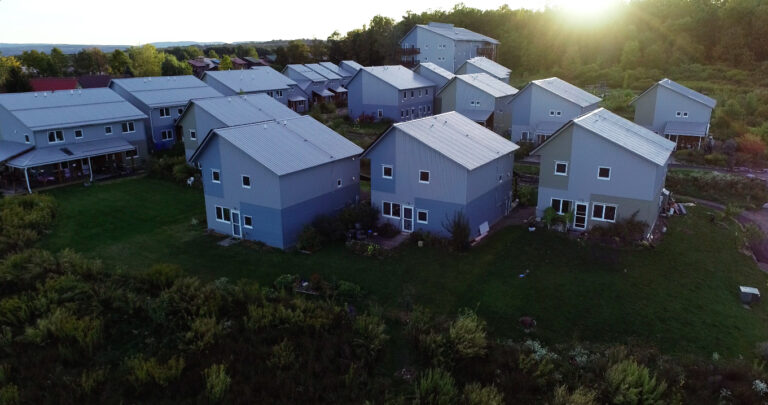
Community members gather outdoors at EcoVillage at Ithaca for a sustainable living event.

EcoVillage at Ithaca

  • Communities

About the Communities

  • Established
  • Ecological
  • Suburban

Founding year

  • 1991

What we do

Located in the beautiful region of New York’s Finger Lakes, EcoVillage at Ithaca has three thriving cohousing neighborhoods. The village features cooperative dining in the common houses, a swimming pond, neighborhood community gardens, hiking trails, play spaces, eighty-five energy efficient homes, a common house with 15 apartments, all in a multigenerational village-scale community.

The pedestrian village is surrounded by woods and open meadows. We have a 10-acre organic fruit and vegetable farm on site that provides produce for residents as well as the wider Ithaca area, and a 5-acre CSA berry farm that has delicious organic u-pick berries. We also host a 10 acre teaching farm, the Groundswell Incubator Farm, which offers support for beginning, low-income farmers.

Our goal is to build a replicable model of a cooperative, environmentally sensitive village that can also serve as a demonstration site for teaching principles of sustainability and permaculture.

Our nonprofit educational organization, THRIVE, is affiliated with the Center for Transformative Action at Cornell University. In addition to giving tours to over 500 visitors a year, our developing educational program provides hands-on training in community life, building sustainable communities, and green building techniques for building and planning professionals. We have helped to initiate and contribute to a sustainability movement in our locality that is bringing about profound changes in the region.

EcoVillage is located on 170 acres, two miles from downtown Ithaca, and three miles from Cornell University and Ithaca College. Ninety percent of the land is preserved as green space for organic agriculture and wildlife habitat. For more information about EVI, read Liz Walker’s book, “EcoVillage at Ithaca: Pioneering a Sustainable Culture,” New Society Publishers, 2005. It is available from our website.

Our Mission

Our mission is to promote experiential learning about ways of meeting human needs for shelter, food, energy, livelihood and social connectedness that are aligned with the long-term health and viability of Earth and all its inhabitants.

  • Purpose
  • Ecological
  • Community type
  • Cohousing
  • Ecovillage
  • Sustainability practices
  • Permaculture design
  • Activities
  • Property management
  • Experiences
  • Networking

Commemorative dates

  • January 1, 1991
  • Started planning
  • January 1, 1996
  • Started living together

Gallery

  • 158 Total members
  • Open to new members
  • Open to visitors
Total
218

How to join

Those seriously interested in living at EVI should complete our educational process, which involves visiting us, participating in work and social events, reading Liz Walker’s first book, studying our web site, and meeting with the Village Membership Committee. In this way, we assist people to self-select whether living at EVI will be a good fit for them.

Basic expectations or agreements for members

Please check our website for information at: https://ecovillageithaca.org/live/

Primary decision-making authority

  • All Community Members Together

The whole membership decides collectively.

Decision-making process

  • Modified Consensus

Generally seek agreement, but have backup methods when consensus isn’t reached.

Governance structure

  • Collaborative/Horizontal

Power and responsibility are shared relatively equally among members.

Conflict resolution approach

The third neighborhood is using Sociocracy as a means of governance.

Economic model

  • Independent Finances

Members maintain separate personal finances with minimal sharing.

Economic scenarios for this community

  • Members need to pay fees, dues, or similar to live there on a per month or per year basis
  • There is a labor obligation
  • Members typically need to have their own job or other personal source of income to cover their expenses while living in the community?

Additional economic information

Regular fees: Yes
Labor: Yes (2 hrs/week)
Members with pre-existing debt: allowed
Monthly costs include maintenance and upkeep of the property, exterior of all dwellings, and the three neighborhood common houses, plus real estate and school taxes, water, and capital reserve funds. Electricity is metered and billed accordingly. Other additional costs may include Internet access, land line phone service, the Social Justice Fund, and membership in the two non-profit organizations. There may, from time to time, be additional assessments, but these must be approved by the community.

Shared resources and amenities that are accessible to everyone in the community

Common House, Garden(s), Library, Workshop, Swimming pond or pool, Large Scale Kitchen, Tractor & Farm Equipment, Fire pit, Swingsets & play areas, Internet

Frequency of communal meals

  • 2-5 times per week

Significant food acquisition practices

  • Locally sourced

Dietary restriction

  • People can cook and eat what they want in their own residence

Community activities and engagement

  • Volunteer, Internship, or Apprenticeship, or WWOOF’ing
  • Neighborhood, Community Housing, or Homeowner's Association
  • Organization, Resource, or Network

Substance use culture

  • Substance use appears in public spaces but no pressure
  • Substance use occurs primarily at celebrations or ceremonies

Gender composition

  • Roughly balanced (no group over 60%)

Age demographics

  • Family-focused (many children and parents)

Property status

  • Privately owned

Property owner

  • By a Community Land Trust or some other kind of nonprofit

Setting

  • Suburban

Residential areas outside city centers but within metropolitan regions.

Community type

  • Cohousing

    Private homes with shared common facilities, designed for neighborly
    interaction while maintaining independence.

  • Ecovillage

    Integrated communities designed around ecological principles with sustainable living practices.

Sustainability approach

  • Permaculture design

Land practices in our community

  • The community practices permaculture

Self-produced energy

  • 33 - 66%

Energy sources used

  • Photovoltaic Solar

Self-produced food

  • 33 - 66%

Local, organic, or fair trade food

  • 33 - 66%

Food systems

  • Community garden
  • Land area size
    170 acres

Guest Book

Written reviews are available for plus members. Click here to upgrade.

Location

  • New York, United States

EcoVillage at Ithaca

Needs and Offers

Connecting people and communities through an intentional online marketplace

  • Events
2 weeks ago

Restoring Choice - free online practice group, from Australia

Restoring Choice – free sessions and a practice group Many of us are less practised at three things than we realise: making clear requests, saying no when it isn’t a full yes, and hearing no without something getting damaged. These aren’t personality traits. They’re capacities that were trained out of many of us by ordinary structures – families where some needs were allowed and others weren’t, workplaces that reward overstretch. They can be trained back. Why this might interest people here Most communities teach communication after people arrive, once conflict has already surfaced. This works the other way round – building capacity first, and finding out what a group can do when most people already have it. What’s running Free 60-minute introduction, online. Same session each time; come to whichever suits. Register for intro session below: https://events.humanitix.com/reclaim-your-power-with-restoring-choice Four-week practice group, Tuesdays from 15 September, 6:30-8:00pm. One session a week, and at least one short written entry a day about a real situation in your own life. The writing is the actual work; the sessions support it. Sign up by Sunday 13 September. Register for practice group below: https://events.humanitix.com/restoring-choice-practice-group Everything is free. Times are Australian Eastern 6:30pm here is the early hours in most of the Americas. Worth checking before you register. Who it’s for No prior experience needed. It isn’t therapy, and I’m not a therapist. Many people find that looking honestly at how well they ask, decline, or hear a no is less flattering than expected. That’s common, and it isn’t a verdict on anyone. Run by Glenn Russo – 13 years practising this material, seven years co-facilitating an NVC practice group in Castlemaine. If you’re already living in community and would rather share what you’ve learned than join anything, I’d like to hear from you too.
  • Events
2 weeks ago

Harvest Moon Fellowship Fire Circle

Harvest Moon Fellowship Fire Circle WE Network Flagship Village – Clubb, MO Join us under the rising Harvest Moon for our monthly Fellowship Fire Circle as we align with Natural Law, celebrate our monthly birthdays, and hold space for community fellowship. When: Friday, September 25, 2026 (Gathering begins at dusk) Where: Flagship Village Grounds – Clubb, Missouri Who: Pioneers, trade-builders, families, and community supporters Astrological & Lunar Alignments The Harvest Moon in Aries: Sitting opposite the Sun in Virgo, this full moon illuminates Aries, bringing pioneer energy, bold action, initiative, and the drive to build. Virgo Birthdays: At this gathering, we celebrate all village members born under Virgo (harvesting skills, practical service, order, and detail). Natural Law & Elemental Alignment Earth & Water (Harvest & Storage): As the Autumnal Equinox turns the season, we honor the physical yields of our raw materials, soil stewardship, and long-term storage preparation. Fire & Air (Fellowship & Vision): We gather around the flames to heal the body, align with Natural Law, share upcoming trade shop plans, and build our parallel community ecosystem together. Seeking Foundational Elders We are actively recruiting our Four Elemental Elders (Earth, Air, Fire, Water) to help lead and anchor our flagship village. If you feel called to step into a leadership role for land stewardship, eco-upcycling, spiritual/body healing, or community systems, come connect with us at the fire. What to Bring: Camp chairs, blankets, and a spirit of fellowship. 👉 Details & Intake: Visit fffc.wtf
September 25, 2026 00:00 – September 27, 2026 23:59
Offer
  • Real Estate For Sale
3 weeks ago

Unit C-2, Woodard Lane Cohousing — Olympia, WA

Join Olympia’s first and longest-running cohousing community, in a quiet West Side neighborhood 1.6 miles from downtown, backing onto a forested ravine along Schneider Creek. Unit C-2 offers 1,904 SF. Two stories, 4 bedrooms, 2 full bathrooms, and a bonus loft room on the main level. It can be lived in as one spacious family home — or split into two independent living spaces, each with its own kitchen, entrance, and effective soundproofing. Great for multigenerational households, live/work arrangements, or an owner-occupied half with a rented or shared half. Upper level: bedroom, full bath, bonus room with built-in loft bed, and an open kitchen-dining-living area with a deck facing the forest. Lower level: 3 bedrooms, full bath with dual sinks, second full kitchen, laundry room, and a second patio. Features: 2 full kitchens, radiant floor heat, stained concrete floors (bamboo upstairs), double-pane windows, bolted keyed entries at both levels, dedicated laundry, concrete patios facing the ravine, shared parking with 18 EV charging stations.   Ownership includes a Common House with a guest room, full kitchen, gathering space, and kids’ play area; a shared vegetable garden; a wood shop and bike storage; and wooded grounds with a stream path and central Green. Monthly dues are $799, covering all utilities except internet. Established in 2010, Woodard Lane is home to ~40 residents across 18 homes, with shared meals, work parties, and genuine neighborliness. Learn more about Woodard Lane Cohousing  We’re looking for a buyer who wants to participate fully in community life. $630,000. Contact Kate Greene: yo******@***il.com or text: 360-789-7587.
Offer
  • Forming Communities
4 weeks ago

Cohousing ABQ: Life is better together. We're moving in during 2026. Last homes available!

We’ve broken ground on a multigenerational cohousing community along the Rio Grande River in Albuquerque, NM! Our community features 25 beautiful, energy-efficient homes clustered around a shared open space, with a fully equipped common house and a range of community amenities. A few last homes are still available — please refer to our website for up-to-date availability. These homes will be move-in ready in the summer/fall of 2026. Or you might be interested in our Wait Pool for unit sizes no longer available. Click here to watch a video of our cohousing community: https://cohousingabq.org/video Our land is on a quiet road with lots of families and kids. The neighborhood’s agricultural roots give it a rural feel, but the center of town is just a 3-minute drive away. Our community plans include play areas for kids, a shared farming area, a year-round greenhouse, an orchard, a workshop and electric vehicle charging. We are diverse in age, background and identity, representing a mix of families with children, couples and singles. We range in age from 2 to 82, and there are 13 kids in our community so far. We have created a fun, caring culture among our group, regularly getting together for meals, camping trips and play dates by the river, in addition to collaborating on our community plans and supporting one another through life’s ups and downs. In Albuquerque, there’s lots to keep us busy, from museums and galleries to nationally recognized wineries and breweries. With 310 sunny days per year, you can often find us outside—hiking, biking or skiing, or exploring the mountains, parks and historic sites all around the region. The Rio Grande that flows through the city center is a playground for kayakers, and miles of walking and cycling trails wind through its wooded banks. Reach out to us or join an upcoming Meet & Greet to learn more about becoming a part of our community! Email: neig

Update to a Public Profile

  • Log in
  • Go to your profile page
  • Toggle on the "Add my profile to the directory"
  • Save your profile

Information

Communities

A residential project: people live here as their primary home.

Organizations

An institution, business, network, or project that isn’t a residence (e.g. a learning center, farm, or network with no one living there full-time).

Plus Community Membership

  • Find people with Profile Match
  • Access to your community listing statistics
  • Create Discussion Groups
  • Access to our affiliate program
  • Member badge on your community profile
I am an official member of this community
Disclaimer
I affirm that my information is accurate and I am authorized to manage this listing
Foundation for Intentional Community FIC Member badge logo.

Free Plan

Free Membership
Free

Intentional Advertising

  • Subtotal

    {{ currencyFormat( pricing_summary.total_amount ) }}

Icon representing community connections and collaboration for intentional communities.

Plus Membership

We’re introducing new Plus features — including community reviews, Profile Match, and unlimited Needs & Offers posts — while keeping most of FIC free for everyone. Membership costs less than two coffees a month. 

  • Find communities with Profile Match
  • View detailed reviews about communities
  • Create free listings in Needs & Offers
  • Plus Member resources in CommUniversity
  • View communities detailed reviews
  • Plus Member badge on your profile