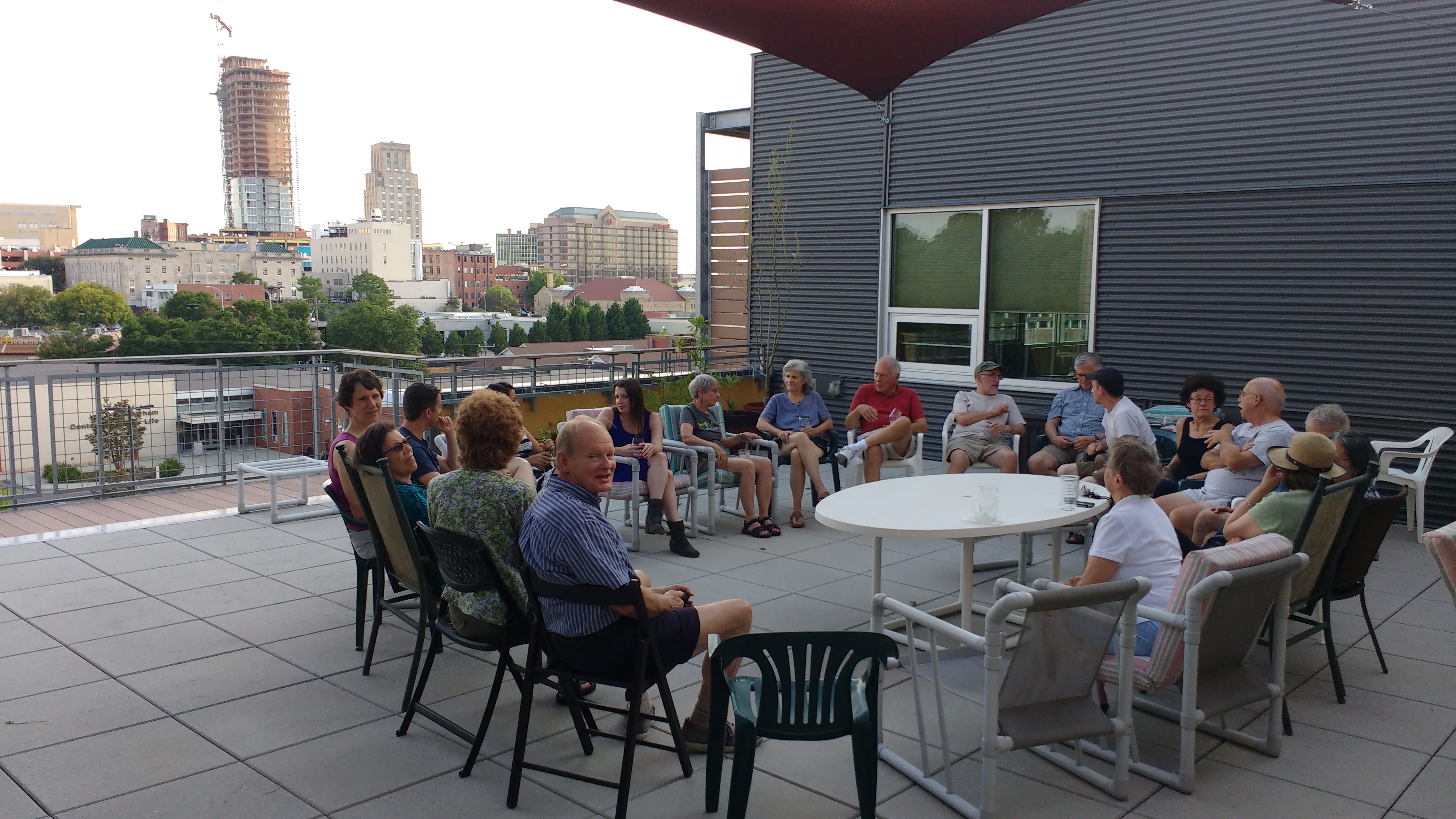
Community gathering on a rooftop terrace with city skyline in background.

Durham Central Park Cohousing Community

  • Communities

About the Communities

  • Established
  • Home-sharing
  • Urban

Founding year

  • 2007

What we do

(Construction completed in July 2014, with all condo units sold. Please visit www.durhamcoho.com for more info and to sign up for communications.)
Durham Coho (Durham Central Park Cohousing Community) is a group of individuals, couples and families who have created an urban, green, intentional cooperative housing community in downtown Durham, North Carolina.
We are located within easy walking distance of the Farmers’ Market, the library, the YMCA, restaurants, stores, county senior center, parks, performing arts center, and theaters. We’re less than 2 miles Duke University and its famous Medical Center. Our four-story building of 24 urban condominiums designed for aging-in-place was completed in July 2014 with units of 850-1700 sq ft and with access to common dining room, kitchen, great room, meeting rooms, guest bedrooms, gardens, and top floor terraces.
As cool as our building is, our community of members is what makes Durham Coho truly special. Our lively and creative group includes medical, legal and financial professionals, scientists, teachers, academics, social workers, musicians, published authors, craftsmen and artists.

Our Mission

Sustainable urban cohousing

  • Purpose
  • Home-sharing
  • Community type
  • Cohousing
  • Activities
  • Property management

Commemorative dates

  • January 1, 2007
  • Started planning
  • January 1, 2014
  • Started living together
  • 37 Total members
  • Open to new members
  • Open to visitors
Total
40

How to join

Contact du************@***il.com; details on our website page “Interested in Joining Us?”
www.durhamcoho.com

Basic expectations or agreements for members

Email us at du************@***il.com

Primary decision-making authority

  • All Community Members Together

The whole membership decides collectively.

Decision-making process

  • Full Consensus

Everyone must agree before moving forward.

Governance structure

  • Collaborative/Horizontal

Power and responsibility are shared relatively equally among members.

Conflict resolution approach

Managed by hubs (committees) and task circles that integrate

Economic model

  • Independent Finances

Members maintain separate personal finances with minimal sharing.

Economic scenarios for this community

  • Members need to pay fees, dues, or similar to live there on a per month or per year basis
  • There is a labor obligation
  • Members typically need to have their own job or other personal source of income to cover their expenses while living in the community?

Additional economic information

Regular fees: Yes
Labor: Encouraged or suggested

Shared resources and amenities that are accessible to everyone in the community

Common House, Garden(s), Library, Workshop, Large Scale Kitchen, Fire pit, Internet

Frequency of communal meals

  • About once a week

Significant food acquisition practices

  • Locally sourced

Dietary restriction

  • People can cook and eat what they want in their own residence

Community activities and engagement

  • Neighborhood, Community Housing, or Homeowner's Association

Substance use culture

  • Substance use appears in public spaces but no pressure
  • Substance use is prohibited in the community

Gender composition

  • Roughly balanced (no group over 60%)

Age demographics

  • Multi-generational (all ages well represented)

Property status

  • Privately owned

Property owner

  • By a Land Trust, Home Owners Association, or corporation

Setting

  • Urban

Within city limits with access to urban amenities and infrastructure.

Community type

  • Cohousing

    Private homes with shared common facilities, designed for neighborly
    interaction while maintaining independence.

Self-produced energy

  • 33 - 66%

Energy sources used

  • Photovoltaic Solar

Self-produced food

  • Up to 33%

Local, organic, or fair trade food

  • 33 - 66%

Food systems

  • Community garden
  • Land area size
    0.6 acres

Guest Book

Written reviews are available for plus members. Click here to upgrade.

Location

  • North Carolina, United States

Durham Central Park Cohousing Community

Needs and Offers

Offer
  • Real Estate For Sale
2 months ago

“Lots” of Goodness For Sale!

Are you seeking to live in a sustainable, wellness-oriented community that prioritizes nature and environmental conservation? Living Well Ecovillage offers the perfect opportunity to be part of a vibrant, self-sufficient community committed to holistic health and ecological harmony. Available lots are equipped with city utilities and fiber internet access. Located in a unique mixed-use community with a variety of land uses planned for the future, including small business/commercial spaces, tiny houses, cluster housing, and a 10-acre farm. Currently, there are still 7 lots available. The Ecovillage is home to a diverse range of homes, such as timber frame, Deltec, hempcrete, and Net-Zero energy designs—all built with green building principles in mind. This community prioritizes sustainability and wellness in every aspect of life. About the Living Well Ecovillage Spanning 126 acres, the Living Well Ecovillage is bordered by the Deep River and Sandy Creek, offering stunning natural beauty and a tranquil environment. The Ecovillage includes shared spaces like a community garden, a Greenway/Rail Trail, and a neighborhood park. Over 53 acres of natural land buffer the river and creek, preserving the area’s pristine beauty and offering residents a true connection to nature. Your Dream Home Awaits Find your ideal spot to build your sustainable home, surrounded by trees, rock outcroppings, and abundant wild edible plants. Experience breathtaking views and a peaceful setting, perfect for those seeking a slower, more connected way of life. A Community That Supports Wellness The Living Well Ecovillage is not just about space—it’s about community. With access to the Folk School, residents engage in hands-on learning, sustainable practices, and personal growth, fostering a sense of belonging and purpose. Perfectly Located Just
Need

Information

Communities

A residential project: people live here as their primary home.

Organizations

An institution, business, network, or project that isn’t a residence (e.g. a learning center, farm, or network with no one living there full-time).

Plus Community Memberhsip

  • Find people with Profile Match
  • Access to your community listing statistics
  • Create Discussion Groups
  • 50% commission when your members purchase a Plus Membership
  • Access to our affiliate program
  • Member badge on your community profile
I am an official member of this community
Disclaimer
I affirm that my information is accurate and I am authorized to manage this listing
Foundation for Intentional Community FIC Member badge logo.

Free Plan

Free Membership
Free

Intentional Advertising

  • Subtotal

    {{ currencyFormat( pricing_summary.total_amount ) }}

Icon representing community connections and collaboration for intentional communities.

Plus Membership

  • Find communities with Profile Match
  • View detailed reviews about communities
  • Direct message and view contact information
  • Create free listings in Needs & Offers
  • Plus Member resources in CommUniversity
  • Plus Member badge on your profile