
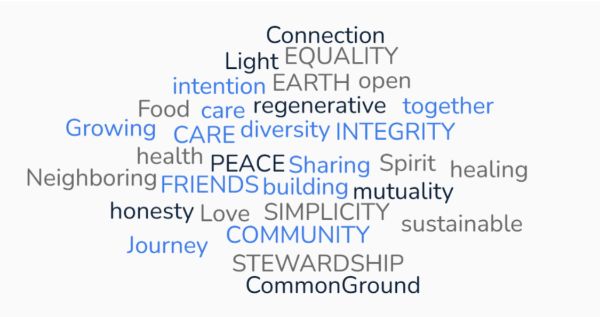
Word cloud of community values including peace, integrity, diversity, and sustainability.

Common Ground Southwest - Name And Details Subject To Change

  • Communities

About the Communities

  • Forming
  • Ecological
  • Suburban

Founding year

  • 2024

What we do

Interested in intentional intergenerational community living, living mindfully, simply and lightly on the earth? Regenerative agriculture & permaculture, rewilding, sustainability, traditional building, water protection and general earth care? Please contact us to learn more! Newly forming community near Albuquerque, New Mexico seeking additional founding members. The forming community has access to 5+ urban rental units in the city limits of Albuquerque which relocating members may rent while we identify and acquire a larger community site. We also have access to food growing space available on another 1/2 acre in Bosque Farms, about 30 minutes South of Albuquerque. We’ve begun meeting regularly to share meals, build community, and plan. If you are in Albuquerque and interested in learning more, please join us for a 2nd Saturday potluck, 5pm at The Albuquerque Friends Meetinghouse – 1600 5th St., NW (PO Box 25462) , Albuquerque, NM 87125-5462 We will also be hosting a more focused planning session on 4th Saturday’s at 10am at this location. (Please email before attending as we may change times or locations on short notice as needed)
In March our core group began looking at property together and are in early discussions about initial financial buy in and ownership structure. We hope to identify a property and begin the process of forming the physical community in the next 12-36 months.
We are seeking to collectively purchase ~5-50 acres of land near Albuquerque where community members can live intentionally together in a variety of housing types, with natural ecological preservation and agricultural potential while still easily accessible to the Albuquerque metro area. The most likely area for this type of community is currently the South Valley of Bernalillo County, which is a traditional agricultural community located along the bosque of the Rio Grande river. Ideally the land will have well or ditch irrigation to help preserve communal water resources, agrarian land access and respectable affordable housing options.
This effort began with 2 community minded Quakers in Albuquerque seeking a way to live intergenerationally, sustainably, and intentionally together. Quaker/Spiritual affiliation is not required, though principles and values like Community, Simplicity, Peace, Equality, Integrity, Stewardship, Empathy, Mindfulness, and Ecological Integrity, to Right Action, Growth, Endurance. etc. are appreciated. (https://quakerspeak.com/video/9-core-quaker-beliefs/ & https://quakerearthcare.org/emerge/ ) Click here to learn more about Quakers concern for Earth Care and Climate Action: https://quakerearthcare.org/
Our current participant group includes individuals without religious affiliation, and those from the Quaker, Mennonite, Unitarian Universalist, ,and those with a background in the Presbyterian. Southern Baptist, Catholic, and Mormon backgrounds. We are interested in a diversity of experiences which may enhance community as we strive to live out lives which reflect our common values.

Our Mission

To Be Finalized As Additional Members Join. The word cloud used on our profile is made up of concepts and values our founding members have shared. We seek to live intentionally together in an intergenerational model. Build resilient community networks, preserve water and agrarian land access for future generations, and explore ways to steward land collectively in partnership with the historical land stewards of our area.

  • Purpose
  • Ecological
  • Community type
  • Cohousing
  • Coliving
  • Student Co-op
  • Sustainability practices
  • Regenerative agriculture or permaculture
  • Permaculture design
  • Activities
  • Property management
  • Experiences
  • Networking
  • Services Business
  • Others

Commemorative dates

  • January 1, 2024
  • Started planning
  • January 1, 2028
  • Started living together

Gallery

  • 8 Total members
  • Open to new members
  • Open to visitors
Total
8

How to join

To Be Finalized As Additional Members Show Interest.
We would like prospective members/residents to begin attending our 2nd and 4th Saturday gatherings so that we can get to know you. If you live out of state, please contact us via email for more information and to arrange to meet up should you visit Albuquerque.
We’ve discussed a 6-9-12 month introductory period for determining if new and existing members are in alignment.
We are in particular need of people with 1) Construction/rehab skills 2) Water harvesting/landscaping/irrigation experience. 3) Agriculture/Dryland Farming. 4) Elder care/Nursing. 5) Teaching/Hosting Workshops. One or more full-time persons to reside in the village who can commit them/her/himself to the needs of site development and maintenance would be ideal.

Basic expectations or agreements for members

Email and attend a second or fourth Saturday planning meeting and meal.

Primary decision-making authority

  • Small Leadership Group

A few people (not elected by the broader community) make the major decisions.

Decision-making process

  • Full Consensus

Everyone must agree before moving forward.

Governance structure

  • Collaborative/Horizontal

Power and responsibility are shared relatively equally among members.

Conflict resolution approach

Quaker Business Process – https://www.fgcquaker.org/fgcresources/practical/practices/quaker-business-basics/

Economic model

  • Independent Finances

Members maintain separate personal finances with minimal sharing.

Economic scenarios for this community

  • There is a one-time fee, investment, or share purchase to join the community separate from accessing housing
  • Members need to pay fees, dues, or similar to live there on a per month or per year basis
  • There is a labor obligation
  • Members typically need to have their own job or other personal source of income to cover their expenses while living in the community?

Additional economic information

Join fee: Yes
Regular fees: Yes
Labor: Encouraged or suggested (10 hrs/week)
Current rental unit rates range between $500 for a one room casita with shared bathroom/kitchen and $8000 for a 1bdr 600sq ft studio. Community economics will change as a larger community property is identified. We will potentially have a 2bdr 1 bath in the city limits opening in 2026/2027 which will rent for $1,200 for community members.
We are currently looking at properties in the $400k – $900k price range, and equal buy in per member would be ideal. We are discussing ways to allow for more equitable buy in and membership opportunities with rentals, tiny home parking, or rent to own/real estate contract type arrangements.

Shared resources and amenities that are accessible to everyone in the community

Common House, Garden(s), Greenhouse(s), Vehicle Share, Library, Workshop, Outbuilding(s), Outdoor Kitchen, Fire pit, Internet

Frequency of communal meals

  • 1-3 times per month

Significant food acquisition practices

  • Locally sourced

Community activities and engagement

  • Transition Town (post-petroleum and off-grid communities.)
  • Volunteer, Internship, or Apprenticeship, or WWOOF’ing
  • Neighborhood, Community Housing, or Homeowner's Association
  • Ethical Business, Investment Group, or Alternative Currency
  • Organization, Resource, or Network

Substance use culture

  • Substance use occurs primarily at celebrations or ceremonies
  • Substance use is prohibited in the community
  • Religions
  • Buddhist
  • Quaker
  • Unitarian Universalist

Gender composition

  • Majority cis (over 60%)

Age demographics

  • Mixed adults (few or no children)

Property status

  • Privately owned

Property owner

  • TBD for planned site. Founding member owns current rentals.

Setting

  • Suburban

Residential areas outside city centers but within metropolitan regions.

Community type

  • Cohousing

    Private homes with shared common facilities, designed for neighborly
    interaction while maintaining independence.

  • Coliving

    Shared living spaces with private bedrooms/bathrooms and communal
    kitchens, dining, and social areas.

  • Student Co-op

    Cooperative housing primarily for students, often with shared chores,
    meals, and democratic decision-making.

  • Ecovillage

    Integrated communities designed around ecological principles with sustainable living practices.

  • Intentional Neighborhoods

    Geographically close groups of independently-owned homes whose residents actively cultivate community relationships and shared values.

  • Spiritual Retreat Centers

    Residential communities focused on providing space for meditation, spiritual practice, and personal growth retreats.

Sustainability approach

  • Regenerative agriculture or permaculture
  • Permaculture design

Land practices in our community

  • The community practices permaculture

Self-produced energy

  • Up to 33%

Self-produced food

  • Up to 33%

Local, organic, or fair trade food

  • 33 - 66%

Food systems

  • Community garden
  • Greenhouse / aquaponics
  • Livestock / poultry
  • Land area size
    1 acres

Guest Book

Written reviews are available for plus members. Click here to upgrade.

Location

  • New Mexico, United States

Common Ground Southwest - Name And Details Subject To Change

Needs and Offers

Connecting people and communities through an intentional online marketplace

  • Promoted
  • Events
17 hours ago

Coastal Regeneration Immersion: Permaculture Design Certification in Jalisco, Mexico

Tropical Dry Forest Permaculture Design & Regenerative Stewardship Certification (PDC)12-Day Intensive | 120 Hours | Costalegre, Jalisco, Mexico APPLY AT XOCHIRAIZ.COM Join us for an immersive Permaculture Design Certificate course set in the tropical dry forest bioregion of coastal Jalisco. This 120-hour intensive blends internationally recognized PDC curriculum with hands-on regenerative practice — combining ecological design, agroforestry, natural building, and community stewardship into one integrated learning experience. Lead Faculty Jorge Luis Gtz. Olarte (Arborescencia RedGenerativa) – Regenerative Design, Soil Biology & Agroforestry Ozzy Lusth (Survior & Xochiraíz) – Wilderness Resilience & Survival Skills Dave Collins (Capacha Coastal Conservation Center) – Bioarchitecture & Ecological Development What You’ll LearnThe course moves through six progressive phases: Permaculture & Ecological Literacy – ethics, principles, and reading the tropical dry forest landscape Water & Soil Systems – keyline design, water harvesting, living soils, and compost systems Horticulture – food garden design, propagation, and biological pest control Regenerative Food Systems – tropical agroforestry, food forest design, and guild planting Ecological Infrastructure – bamboo bioarchitecture, bioclimatic farm design, compost toilets, greywater, and rocket stoves Integrated Design Studio – team-based final design projects covering watershed strategy, agroforestry, food forest layout, infrastructure, and phased implementation Daily RhythmMornings begin with optional surf/yoga and journaling, followed by field practicums and hands-on workshops. Afternoons include design studio and construction lab work, with reflection circles, communal dinners, and evening talks, films, or campfire discussions rounding out the day. Final ProjectParticipants work in teams to produce a full regenerative design package — landscape analysis, water plan, agroforestry design, food forest plan, ecological infrastructure, and bioclimatic farm plan — presented to a faculty review panel on the final day, followed by a closing ceremony, certificate delivery, and community feast. CertificationGraduates receive the Tropical Dry Forest Permaculture Design & Regenerative Stewardship Certification (120 contact hours), hosted by Capacha Coastal Conservation Center and Tierralegre, A.C. Curriculum integrates international PDC standards with tropical ecology, agroforestry, ecological restoration, bamboo bioarchitecture, bioclimatic design, GIS/photogrammetry, and regenerative leadership. Highlights Hands-on bamboo construction (temazcal, bathhouses, sculpture) Tropical dry forest silviculture practicum Community mapping and design project for Ekoa Green Community Talent show and sea turtle release
January 10, 2027 00:00 – January 24, 2027 23:59
  • Promoted
Offer
  • Promoted
  • Events
4 weeks ago

Healing Love Healing Money: Trust As The Foundation For A New Culture

Money, love and power are among the hardest things any community works with, and many of us carry the same fears into both: not having enough, losing what we have, and the sense that if someone else gets money or love, we won’t. Healing Love, Healing Money: Trust as the Foundation for a New Culture is taught by two intentional communities. Karen McAllister and Duncan Cryle are from Clear Sky Meditation and Retreat Center, a Buddhist-lineage community in the BC Rockies. Monika Alleweldt and Benjamin von Mendelssohn from Tamera Healing Biotope, a community of about 160 people in southern Portugal that has spent decades studying love, trust and relationship. Clear Sky has spent years working on its relationship with money, and our two communities found surprising parallels in the fears beneath both. Over four sessions we explore the roots of fear around money and belonging, love, possession and power, trust as infrastructure (community as a container for healing), and ethical livelihood. We use short meditations, body-based practices, reflection and small-group conversation. You do not need to be in a romantic relationship or live in community. When: October 27, Nov 3, 10, 17. All four sessions: 12–2pm Vancouver, 1–3pm Alberta, 7–9pm UK and Portugal, 8–10pm Central Europe. Note: US and some Canadian provinces change clocks on November 1, so the US west coast is 12–2pm on October 27, then 11am–1pm for the remaining sessions, and Eastern is 3–5pm on October 27, then 2–4pm for the rest. Cost: sliding scale Details and registration: https://www.clearskycenter.org/event/healing-love-healing-money-online/  
October 27, 2026 13:00 – November 17, 2026 15:00
Offer
Offer
  • Real Estate For Sale
2 weeks ago

Breathe the Magic

Set in Sea Elephant, Tasmania, within a remarkable conservation landscape, this contemporary home offers genuine privacy with the assurance that the surrounding native environment is protected for the future.  With its cool King Island climate and abundant rain and water supply, your lifetyle is secure in a climate future that is becoming unsettling. Experience the unique community lifestyle that only King Island can offer.  Sleep with the peace of knowing you live in a place where everyone looks out for everyone else, and someone will always have your back. 1675 Reekara Road offers slightly more than 51 hectares of protected King Island wilderness, of which approximately 48.84 hectares are protected under a conservation covenant encompassing King Island scrub, blue gum forest, remarkable wildlife. The property is surrounded by the Lavinia State Reserve and Council Hill Conservation Area. A 2 hectare residential entitlement provides ample space for planting vegetables, fruit trees,  keeping chickens, or creating other sustainable living infrastructure.  Already included are: – A well-maintained house built in 2023 with upstairs en-suite bedroom and deck with gorgeous views, including forest/ocean outlook. – A spacious downstairs bathroom provides options for guest accommodation – Just include a sleeper couch or 2 in the ample living area. – A large pristine kitchen, including pantry and laundry. – Small wood shed – Large shed or double garage built in 2024 – Enclosed garden – 40,000 litre water storage tank – large dam An existing approved DA means you have the option of further development.  Buy the property furnighed, unfurnished, or with a 2015 Jeep Wrangler thrown in.

Update to a Public Profile

  • Log in
  • Go to your profile page
  • Toggle on the "Add my profile to the directory"
  • Save your profile

Information

Communities

A residential project: people live here as their primary home.

Organizations

An institution, business, network, or project that isn’t a residence (e.g. a learning center, farm, or network with no one living there full-time).

Plus Community Membership

  • Find people with Profile Match
  • Access to your community listing statistics
  • Create Discussion Groups
  • Access to our affiliate program
  • Member badge on your community profile
I am an official member of this community
Disclaimer
I affirm that my information is accurate and I am authorized to manage this listing
Foundation for Intentional Community FIC Member badge logo.

Free Plan

Free Membership
Free

Intentional Advertising

  • Subtotal

    {{ currencyFormat( pricing_summary.total_amount ) }}

Icon representing community connections and collaboration for intentional communities.

Plus Membership

  • Find communities with Profile Match
  • View detailed reviews about communities
  • Create free listings in Needs & Offers
  • Plus Member resources in CommUniversity
  • View communities detailed reviews
  • Plus Member badge on your profile