
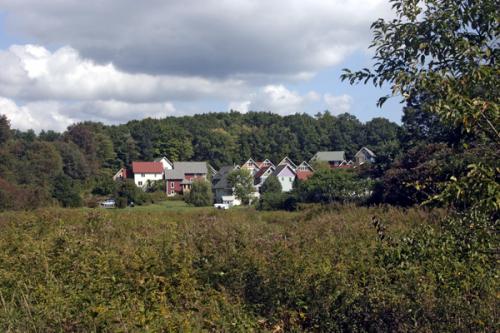
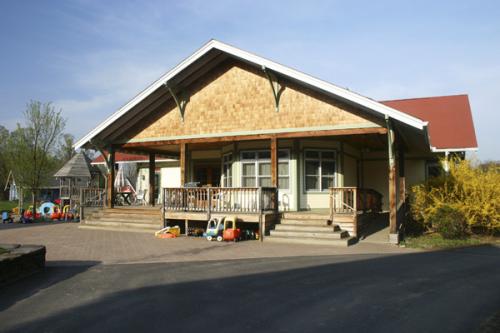
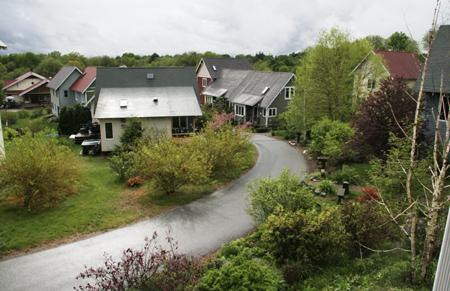
Scenic view of Cherry Hill Cohousing community with houses and greenery.

Cherry Hill Cohousing (formerly Pioneer Valley)

  • Communities

About the Communities

  • Established
  • Home-sharing
  • Town/Small City

Founding year

  • 1989

What we do

Cherry Hill Cohousing set out to create a living environment that encourages a strong sense of community, supports our need for privacy, makes life affordable, and provides a secure and enriched setting for children and adults. We have a place where people know their neighbors in a meaningful way, a neighborhood where different traditions and values are respected, and where we can all have a sense of security and belonging. Even after so many years together, we are still a work in progress, continuing to get better and better at living our values and goals.
Our group purchased a 23-acre meadow site in North Amherst where we built 32 units and a large common house, moving in June – September 1994. We built a clustered mix of single, duplex, and triplex buildings on seven of those acres. The rest is field and woods, surrounded by town lands.
Residents own their own homes, as well as a share of the land and the common house. The common house is a place for weekly community dinners, meetings, entertainment, and other public and private functions. It includes a large kitchen/dining room, children’s playroom, guest rooms, laundry facilities, library, sauna, exercise room, and recycling center.
We have optional (but well-attended) dinners two nights a week, gardens, play and work spaces, hiking trails, and other shared amenities chosen by residents that have social and economic advantages.
The community is a short walk from a municipal lake; a recreation park with tennis, swimming, and playing fields; a small shopping center; a library; the university; and public transportation.

Our Mission

We envision a thriving community in which we celebrate life’s joys and give solace in times of sorrow; strive to be the “someone else who will do it” as a gift of generosity to honor our neighbors and out of love for our planet; seek to transform ourselves through the creative forces of conflict and forgiveness; welcome differences as connecting bridges while respecting healthy boundaries; and share our physical, emotional, and spiritual resources in the spirit of the “co” in cohousing.

  • Purpose
  • Home-sharing
  • Community type
  • Cohousing
  • Sustainability practices
  • Waste reduction / composting

Commemorative dates

  • January 1, 1989
  • Started planning
  • January 1, 1994
  • Started living together

Gallery

  • 60 Total members
  • Open to new members
  • Open to visitors
Total
97

How to join

We are an owner-occupied community. Individuals who are interested in learning how to become a future unit owner should visit our website and read the ‘Membership’ page for more information.

Basic expectations or agreements for members

People may visit any time, but if you are interested in joining our waiting list, read our website’s Membership page; then request a community tour, by contacting John Porcino at john.porcino(at)cohousing.com.

Primary decision-making authority

  • Small Leadership Group

A few people (not elected by the broader community) make the major decisions.

Decision-making process

  • Consent-Based (Sociocracy)

Decisions proceed unless someone has a reasoned objection.

Governance structure

  • Sociocratic/Circle-Based

Organized in circles or domains with distributed authority.

Conflict resolution approach

Functioning by Dynamic Governance (sociocracy), with a set of working circles including a Coordinating Circle.

Economic model

  • Independent Finances

Members maintain separate personal finances with minimal sharing.

Economic scenarios for this community

  • Members need to pay fees, dues, or similar to live there on a per month or per year basis
  • There is a labor obligation
  • Members typically need to have their own job or other personal source of income to cover their expenses while living in the community?

Additional economic information

Regular HOA fees: Yes
Labor: Yes (6+ hours/month)
Our guidelines ask for 6-8 hours work per month perperson. Reality is that there is a wide variation in work hours and types of jobs.
We are legally a condominium and collect condo fees monthly.

Vehicle accessibility

  • Most / all people own their own vehicles

Shared resources and amenities that are accessible to everyone in the community

Common House, Garden(s), Greenhouse(s), Vehicle Share, Library, Workshop, Large Scale Kitchen, Tractor & Farm Equipment, Swingsets & play areas, Gym or sports area, Internet

Frequency of communal meals

  • 2-5 times per week

Dietary type

  • Vegetarian Only

Dietary restriction

  • People can cook and eat what they want in their own residence

Local connectedness

  • We try to engage with our local community

Substance use culture

  • Substance use occurs primarily at celebrations or ceremonies
  • Substance use is prohibited in the community

Gender composition

  • Roughly balanced (no group over 60%)

Age demographics

  • Multi-generational (all ages well represented)

Property status

  • Privately owned

Property owner

  • By a Land Trust, Home Owners Association, or corporation

Setting

  • Town/Small City

Smaller municipalities with local services but rural character.

Community type

  • Cohousing

    Private homes with shared common facilities, designed for neighborly
    interaction while maintaining independence.

Sustainability approach

  • Waste reduction / composting

Self-produced energy

  • 33 - 66%

Energy sources used

  • Photovoltaic Solar

Self-produced food

  • Up to 33%

Local, organic, or fair trade food

  • 33 - 66%

Food systems

  • Community garden
  • Greenhouse / aquaponics

Source of water

  • Public water supply

Wastewater management

  • Public sewage

Waste management practices

  • Composting
  • Recycling program
  • Land area size
    23 acres

Guest Book

Written reviews are available for plus members. Click here to upgrade.

Location

  • Massachusetts, United States

Cherry Hill Cohousing (formerly Pioneer Valley)

Needs and Offers

Connecting people and communities through an intentional online marketplace

  • Promoted
Offer
  • Promoted
  • Events
4 weeks ago

Healing Love Healing Money: Trust As The Foundation For A New Culture

Money, love and power are among the hardest things any community works with, and many of us carry the same fears into both: not having enough, losing what we have, and the sense that if someone else gets money or love, we won’t. Healing Love, Healing Money: Trust as the Foundation for a New Culture is taught by two intentional communities. Karen McAllister and Duncan Cryle are from Clear Sky Meditation and Retreat Center, a Buddhist-lineage community in the BC Rockies. Monika Alleweldt and Benjamin von Mendelssohn from Tamera Healing Biotope, a community of about 160 people in southern Portugal that has spent decades studying love, trust and relationship. Clear Sky has spent years working on its relationship with money, and our two communities found surprising parallels in the fears beneath both. Over four sessions we explore the roots of fear around money and belonging, love, possession and power, trust as infrastructure (community as a container for healing), and ethical livelihood. We use short meditations, body-based practices, reflection and small-group conversation. You do not need to be in a romantic relationship or live in community. When: October 27, Nov 3, 10, 17. All four sessions: 12–2pm Vancouver, 1–3pm Alberta, 7–9pm UK and Portugal, 8–10pm Central Europe. Note: US and some Canadian provinces change clocks on November 1, so the US west coast is 12–2pm on October 27, then 11am–1pm for the remaining sessions, and Eastern is 3–5pm on October 27, then 2–4pm for the rest. Cost: sliding scale Details and registration: https://www.clearskycenter.org/event/healing-love-healing-money-online/  
October 27, 2026 13:00 – November 17, 2026 15:00
  • Promoted
  • Events
2 days ago

Coastal Regeneration Immersion: Permaculture Design Certification in Jalisco, Mexico

Tropical Dry Forest Permaculture Design & Regenerative Stewardship Certification (PDC)12-Day Intensive | 120 Hours | Costalegre, Jalisco, Mexico APPLY AT XOCHIRAIZ.COM Join us for an immersive Permaculture Design Certificate course set in the tropical dry forest bioregion of coastal Jalisco. This 120-hour intensive blends internationally recognized PDC curriculum with hands-on regenerative practice — combining ecological design, agroforestry, natural building, and community stewardship into one integrated learning experience. Lead Faculty Jorge Luis Gtz. Olarte (Arborescencia RedGenerativa) – Regenerative Design, Soil Biology & Agroforestry Ozzy Lusth (Survior & Xochiraíz) – Wilderness Resilience & Survival Skills Dave Collins (Capacha Coastal Conservation Center) – Bioarchitecture & Ecological Development What You’ll LearnThe course moves through six progressive phases: Permaculture & Ecological Literacy – ethics, principles, and reading the tropical dry forest landscape Water & Soil Systems – keyline design, water harvesting, living soils, and compost systems Horticulture – food garden design, propagation, and biological pest control Regenerative Food Systems – tropical agroforestry, food forest design, and guild planting Ecological Infrastructure – bamboo bioarchitecture, bioclimatic farm design, compost toilets, greywater, and rocket stoves Integrated Design Studio – team-based final design projects covering watershed strategy, agroforestry, food forest layout, infrastructure, and phased implementation Daily RhythmMornings begin with optional surf/yoga and journaling, followed by field practicums and hands-on workshops. Afternoons include design studio and construction lab work, with reflection circles, communal dinners, and evening talks, films, or campfire discussions rounding out the day. Final ProjectParticipants work in teams to produce a full regenerative design package — landscape analysis, water plan, agroforestry design, food forest plan, ecological infrastructure, and bioclimatic farm plan — presented to a faculty review panel on the final day, followed by a closing ceremony, certificate delivery, and community feast. CertificationGraduates receive the Tropical Dry Forest Permaculture Design & Regenerative Stewardship Certification (120 contact hours), hosted by Capacha Coastal Conservation Center and Tierralegre, A.C. Curriculum integrates international PDC standards with tropical ecology, agroforestry, ecological restoration, bamboo bioarchitecture, bioclimatic design, GIS/photogrammetry, and regenerative leadership. Highlights Hands-on bamboo construction (temazcal, bathhouses, sculpture) Tropical dry forest silviculture practicum Community mapping and design project for Ekoa Green Community Talent show and sea turtle release
January 10, 2027 00:00 – January 24, 2027 23:59
Offer
Need
  • Communities with Openings
2 weeks ago

Needs: Quiet nature focused community with work exchange

About Me Hello, I’m Nanu. I’m 46 years old in need of a peaceful, nature-centered community where I can contribute, maintain my independence, and potentially establish a long-term home. I’m autistic and sometimes experience periods when I’m nonverbal. I appreciate direct communication, clear expectations, and people who respect different communication styles without making assumptions. I’m independent, value personal boundaries, and do best in environments where people can coexist comfortably without constant social interaction. The Environment I’m Seeking I’m looking for a wooded, green setting with mature trees, grass, and access to nature. Forests, trails, gardens, and peaceful outdoor spaces are important to me. I’d prefer a region with relatively mild winters, avoiding both desert landscapes and areas with harsh, snowy winters. Privacy is essential. I’m interested in a residential community where people respect one another’s space and participation in social activities is optional. I’m not looking for a retreat center, event venue, or community that regularly hosts outside groups, workshops, classes, or large gatherings on the residential property. Occasional visitors are understandable, but I prefer a quiet environment where residents can enjoy their homes without a constant flow of people coming and going. Work Exchange and Housing I’m interested in exchanging practical work for housing. Possible contributions include community gardening, planting, watering, harvesting, kitchen assistance, meal preparation, property upkeep, and other mutually agreed-upon tasks. I’d like the responsibilities, schedule, and expectations clearly established in advance. A trial stay or introductory period would be ideal so both sides can determine whether the arrangement is a good fit. Potential for Long-Term Ownership My longer-term goal is to explore purchasing a small home, a defined parcel of land, or a legally documented ownership interest in an established cooperative community. I have limited savings available for a potential investment and want to use those funds carefully toward lasting housing stability. I’m not interested in vague promises of future ownership or arrangements that depend entirely on one person’s continued involvement. I’d want clear documentation of ownership rights, decision-making, ongoing expenses, and what happens if a resident leaves or the community dissolves. I’m also not interested in traditional HOA-style arrangements or unpredictable fees. Reasonable, transparent shared expenses are open for discussion. Community Culture I’m looking for people who value mutual respect, personal autonomy, honest communication, and practical cooperation. I appreciate companionship but also need quiet and solitude. I don’t expect everyone to share my interests, only to respect one another’s boundaries. What I’d Like to Know If your community offers work exchange, a private and peaceful living environment, wooded surroundings, and a realistic possibility of long-term housing or ownership, I’d love to hear from you. Please share information about your location, climate, current residents, available housing, work-exchange expectations, visitor policies, ongoing costs, and potential ownership arrangements. I’d like to visit and get acquainted before making any commitments. My goal is to find a genuine mutual fit. Thank you for reading!

Update to a Public Profile

  • Log in
  • Go to your profile page
  • Toggle on the "Add my profile to the directory"
  • Save your profile

Information

Communities

A residential project: people live here as their primary home.

Organizations

An institution, business, network, or project that isn’t a residence (e.g. a learning center, farm, or network with no one living there full-time).

Plus Community Membership

  • Find people with Profile Match
  • Access to your community listing statistics
  • Create Discussion Groups
  • Access to our affiliate program
  • Member badge on your community profile
I am an official member of this community
Disclaimer
I affirm that my information is accurate and I am authorized to manage this listing
Foundation for Intentional Community FIC Member badge logo.

Free Plan

Free Membership
Free

Intentional Advertising

  • Subtotal

    {{ currencyFormat( pricing_summary.total_amount ) }}

Icon representing community connections and collaboration for intentional communities.

Plus Membership

  • Find communities with Profile Match
  • View detailed reviews about communities
  • Create free listings in Needs & Offers
  • Plus Member resources in CommUniversity
  • View communities detailed reviews
  • Plus Member badge on your profile