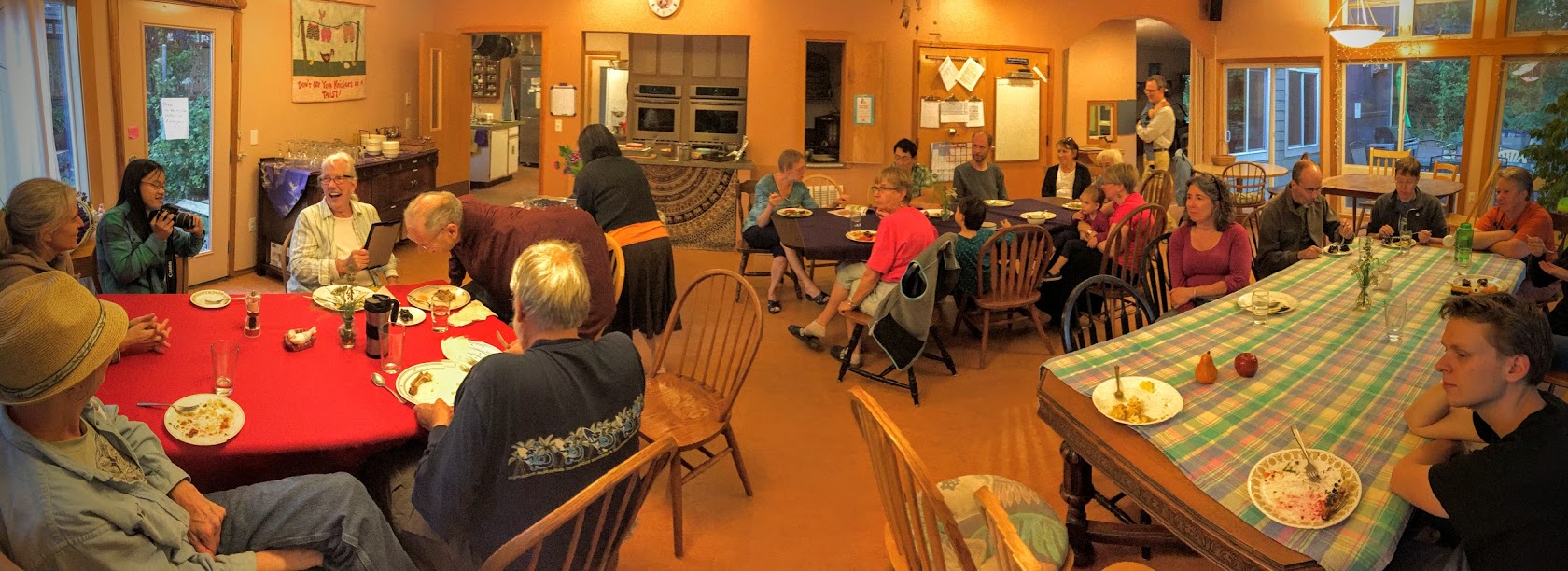
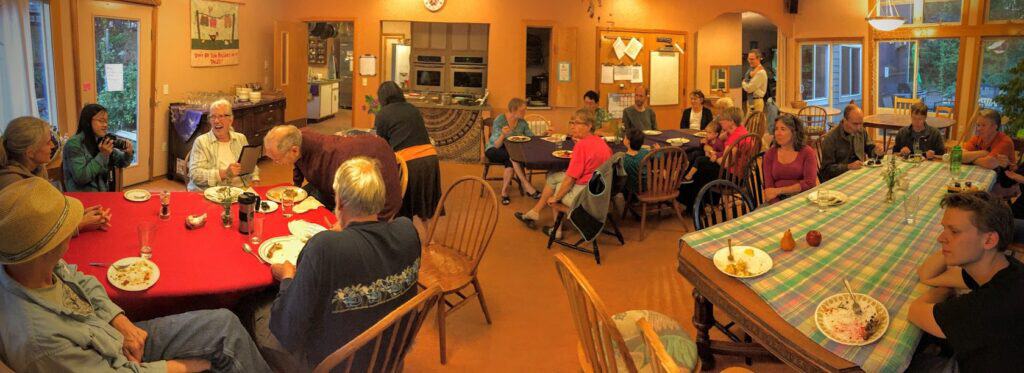
Community gathering in a warm, inviting dining room with people sharing a meal.

Cascadia Commons Cohousing Community

  • Communities

About the Communities

  • Established
  • Home-sharing
  • Suburban

Founding year

  • 1992

What we do

Cascadia Commons Cohousing is a community of 26 homes and a common house located in a pleasant suburb six miles southwest of the center of Portland, Oregon. We were self-developed over the period beginning with our incorporation as an LLC in 1995 (after a couple of years as a talking group). Construction was completed in 2001. We continue to develop as an “second-generation” community.
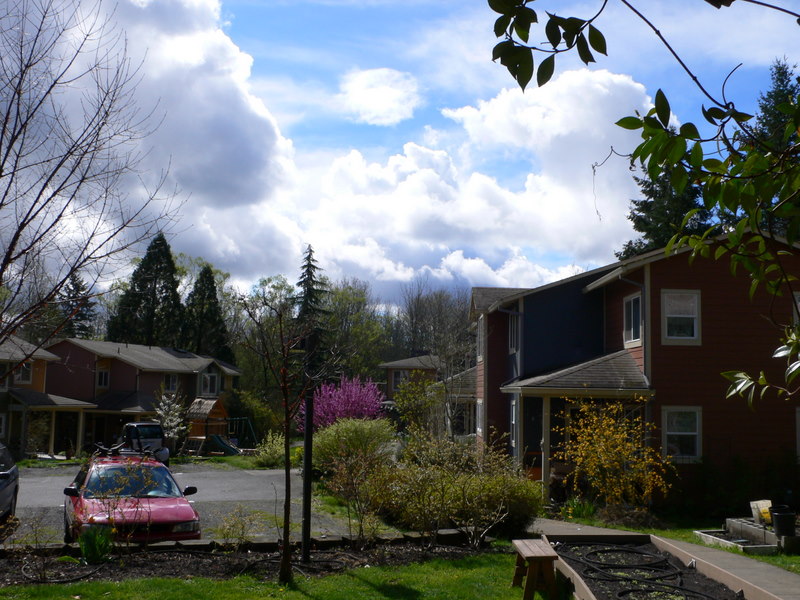
We occupy 2.9 acres of land, of which approximately half is legally designated wetlands and wetlands buffer that is required to be maintained in a natural state. Our homes are a mix of renovated townhouses, and newly constructed flats and townhouses. We are a quarter of a mile from good bus service to the center of Portland, a 35-minute ride. It takes about 10-15 minutes by car.
Our current residents range in age from 3 to 85. We are a mix of singles, single moms, couples, and families. We are ecumenical as to religion, or lack thereof, philosophy, sexual orientation, dietary preferences, and, at least in principle, politics. We share green values of caring for the earth and its creatures.
We are egalitarian in our governance, using consensus decision making, with provision for breaking impasses, as required by Oregon’s condominium law.

Our Mission

Sharing, caring community; Living in community can be a little like living in a rock tumbler. We all have rough edges that could use smoothing. It helps to be able to experience misunderstandings and disagreements as opportunities to grow. Cohousing to us means community: child-friendly, elder-friendly, sociable living; cooperative interaction; a chance to make long-term personal connections with neighbors who share many of your values. In many ways we’re like an extended family more than a neighborhood.

  • Purpose
  • Home-sharing
  • Community type
  • Cohousing
  • Activities
  • Property management

Commemorative dates

  • January 1, 1992
  • Started planning
  • January 1, 2000
  • Started living together

Gallery

  • 42 Total members
  • Open to new members
  • Open to visitors
Total
49

How to join

Only as occupancy of homes change; renters are also welcome (sublet). Prospective buyers tour and meet with current members through joint meals and work parties. It is a mutual decision process. We do keep a waiting list, when there are no sales or rentals available.

Basic expectations or agreements for members

Personal guests of community members visit by arrangement with their hosts.
Non-affiliates contact us by email or telephone. Explain interest and reason for visit. A host will be assigned to work out details.
Currently we reach out via Zoom meetings.

Primary decision-making authority

  • Small Leadership Group

A few people (not elected by the broader community) make the major decisions.

Decision-making process

  • Modified Consensus

Generally seek agreement, but have backup methods when consensus isn’t reached.

Governance structure

  • Collaborative/Horizontal

Power and responsibility are shared relatively equally among members.

Conflict resolution approach

We have some leadership roles in committees
Only by the willingness and capacity of some to do more work than others.
With legally required provision to break impasses

Economic model

  • Independent Finances

Members maintain separate personal finances with minimal sharing.

Economic scenarios for this community

  • Members need to pay fees, dues, or similar to live there on a per month or per year basis
  • There is a labor obligation
  • Members typically need to have their own job or other personal source of income to cover their expenses while living in the community?

Additional economic information

Regular fees: $350
Labor: Yes
Members with pre-existing debt: allowed
Screening of finances is by lenders for individual mortgages
We have a nominal minimum of work/labor of 3 hours per month ( monthly work party) , and required presence at monthly HOA meetings. We also require members to be on one of the organizational committees.
The costs of becoming a resident/owner are all that is required.
Regular Home Owners Association dues are prescribed for each home.

Shared resources and amenities that are accessible to everyone in the community

Common House, Garden(s), Library, Workshop, Hot tub or hot springs, Large Scale Kitchen, Fire pit, Swingsets & play areas

Frequency of communal meals

  • 2-5 times per week

Significant food acquisition practices

  • Locally sourced

Dietary restriction

  • People can cook and eat what they want in their own residence

Community activities and engagement

  • Neighborhood, Community Housing, or Homeowner's Association

Substance use culture

  • Substance use appears in public spaces but no pressure
  • Substance use is prohibited in the community
  • Religions
  • Christian
  • Buddhist
  • Jewish
  • Muslim
  • Quaker
  • Sufi
  • Unitarian Universalist

Gender composition

  • Majority cis (over 60%)

Age demographics

  • Family-focused (many children and parents)

Property status

  • Privately owned

Property owner

  • By a Land Trust, Home Owners Association, or corporation

Setting

  • Suburban

Residential areas outside city centers but within metropolitan regions.

Community type

  • Cohousing

    Private homes with shared common facilities, designed for neighborly
    interaction while maintaining independence.

Self-produced energy

  • Up to 33%

Self-produced food

  • Up to 33%

Local, organic, or fair trade food

  • Over 66%

Food systems

  • Community garden
  • Land area size
    2.9 acres

Guest Book

Written reviews are available for plus members. Click here to upgrade.

Location

  • Oregon, United States

Cascadia Commons Cohousing Community

Needs and Offers

Connecting people and communities through an intentional online marketplace

  • Promoted
  • Events
3 weeks ago

Healing Love Healing Money: Trust As The Foundation For A New Culture

Money, love and power are among the hardest things any community works with, and many of us carry the same fears into both: not having enough, losing what we have, and the sense that if someone else gets money or love, we won’t. Healing Love, Healing Money: Trust as the Foundation for a New Culture is taught by two intentional communities. Karen McAllister and Duncan Cryle are from Clear Sky Meditation and Retreat Center, a Buddhist-lineage community in the BC Rockies. Monika Alleweldt and Benjamin von Mendelssohn from Tamera Healing Biotope, a community of about 160 people in southern Portugal that has spent decades studying love, trust and relationship. Clear Sky has spent years working on its relationship with money, and our two communities found surprising parallels in the fears beneath both. Over four sessions we explore the roots of fear around money and belonging, love, possession and power, trust as infrastructure (community as a container for healing), and ethical livelihood. We use short meditations, body-based practices, reflection and small-group conversation. You do not need to be in a romantic relationship or live in community. When: October 27, Nov 3, 10, 17. All four sessions: 12–2pm Vancouver, 1–3pm Alberta, 7–9pm UK and Portugal, 8–10pm Central Europe. Note: US and some Canadian provinces change clocks on November 1, so the US west coast is 12–2pm on October 27, then 11am–1pm for the remaining sessions, and Eastern is 3–5pm on October 27, then 2–4pm for the rest. Cost: sliding scale Details and registration: https://www.clearskycenter.org/event/healing-love-healing-money-online/  
October 27, 2026 13:00 – November 17, 2026 15:00
  • Promoted
Offer
  • Promoted
Need
Need
  • Communities with Openings
4 weeks ago

Heart-centered, nature-loving unschooling family seeking a community to land with for winter 2027

We’re a German-American family who left conventional life about four years ago to live in line with our values: freedom, connection, nature, and spirituality. We started out as worldschoolers, moving every month or two. That taught us a lot, including that too much movement leaves a family rootless. Since then we’ve been looking for the balance between adventure and belonging. We found a taste of it on a multigenerational farm community in Austria, and we’re now living alongside a small community in Norway. For January to March 2027, we’d love to spend a season inside a community that feels like home. What we’re hoping for A community with teenagers and a culture that welcomes self-directed learning, where unschooling is understood and not just tolerated Nature at your doorstep (forest, land, animals, or garden) Some shared meals, perhaps shared rhythms, and real relationships, not just a place to park A spiritual or reflective thread, whatever form it takes for you An opportunity to get to know your community by giving back (although we can’t do a ‘full’ volunteering program as we have the past three years – ie: Workaway- because we have meetings online that take up too much of our time to volunteer full time)  What we bring Resilience and emotional wellbeing. I’m an online resilience coach with a BA in Developmental Psychology, certified in HeartMath®, and an experienced yoga and meditation teacher. I can offer community sessions in nervous system regulation, stress resilience, and meditation, and support for parents and teens. Experience raising three children in a nomadic, family-centered lifestyle, including years of travel across Europe. Open, adaptable, and grounded. We’ve lived in many settings and adapt quickly. We show up as contributors, not consumers. Unschooling and homeschooling know-how. We’re glad to share what we’ve learned, especially for families navigating legal and practical questions in Europe. Many other shareable skills: carpentry, sourdough bread baking, food fermenting, music making, dad-joke-telling, drone pilots, cookie bakers, food preservation and much much more.   We’re looking for a mutual fit, not just a bed for the winter. If our story resonates and you have space or know someone who does, we’d love to hear from you. Tell us about your community: your values, your daily rhythm, and what you’re hoping for from the people who join you.
Need
  • Forming Communities
2 weeks ago

Forest Community Starting

Description: Willits, CA, Pacific Northwest rainforest system. Forest Haven is seeking forest lovers who value solitude. We have several areas in the main compound and a few tucked away in private. Space is designed for your RV / Tiny Home / +++. We will add power and water for each new Steward’s space. Land: 40 acres(17 hectares), 3ac for humans. Year-round creek at base of parcel. Heavy trees, 40 meter-ish high. Conifer mix. With a large south-facing common garden.   New forest stewards have agreed to prioritize tree health. This means each person here will have a say in whether we cut any single tree. We never cut for wood or sale.  Stewards agree to walk the forest daily as our one required 20-minute group activity.    Limit the number of dwellings to 3-5 Total. There are 8 common buildings, with 3 having flush toilets and one with a hot shower, washer and dryer. We are 100% off-grid.  We have a natural spring and solar. The full-size common kitchen is large enough to process the garden harvest and more. Remote workers and retirees’ welcome. Full online and cell service available.    Forest Haven is currently a private forest reserve.   If 2 households sign on, it will become a 501(c)(3). Each person’s “donation/rent” will be tax-deductible. This is a private forest reserve going public as a nonprofit.    Please inquire if you want to help in a small way using basic permaculture methods to improve our forest’s health, message me to learn more.

Update to a Public Profile

  • Log in
  • Go to your profile page
  • Toggle on the "Add my profile to the directory"
  • Save your profile

Information

Communities

A residential project: people live here as their primary home.

Organizations

An institution, business, network, or project that isn’t a residence (e.g. a learning center, farm, or network with no one living there full-time).
Plus Community Membership

  • Find people with Profile Match
  • Access to your community listing statistics
  • Create Discussion Groups
  • Access to our affiliate program
  • Member badge on your community profile
I am an official member of this community
Disclaimer
I affirm that my information is accurate and I am authorized to manage this listing
Foundation for Intentional Community FIC Member badge logo.

Free Plan

Free Membership
Free

Intentional Advertising

  • Subtotal

    {{ currencyFormat( pricing_summary.total_amount ) }}

Icon representing community connections and collaboration for intentional communities.

Plus Membership

  • Find communities with Profile Match
  • View detailed reviews about communities
  • Create free listings in Needs & Offers
  • Plus Member resources in CommUniversity
  • View communities detailed reviews
  • Plus Member badge on your profile