
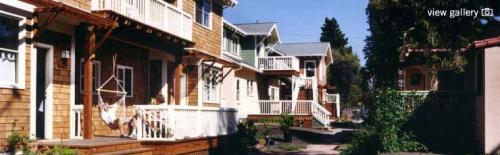
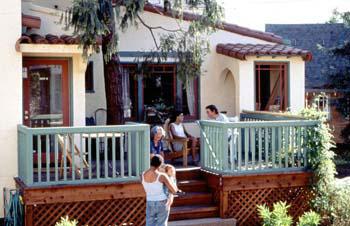
Cozy community homes with wooden decks and lush greenery in Berkeley Cohousing.

Berkeley Cohousing

  • Communities

About the Communities

  • Established
  • Home-sharing
  • Urban

Founding year

  • 1992

What we do

Berkeley Cohousing, on Sacramento Street in the West Berkeley neighborhood (zip code 94702) near Strawberry Creek, was a family farm dating back to near 1900, with a farmer’s daughter’s cottage added. When the Coop Supermarket (formerly Andronico’s) on University Avenue was built in the 1950s, several small houses were moved to the property, and rented out.
Berkeley Cohousing now consists of 17 homes (14 plus a couple “associate member” households nextdoor) — mainly cottages and duplexes — scattered around a green, that also helps filter and buffer runoff from the parking lot on rooftops.
The group has a “limited equity” arrangement with the city that limits price appreciation to area median income growth plus capital improvements, for 30 years from each resale; buyers have to earn less than 120 or 150 percent of area median income. As a result, prices are now around 50 percent below market, and turnover is very low, running about 1 unit resold every 8-10 years; the seller can select the buyer, subject to the above restrictions.
Nearly half the founders still live in the community, after 3 decades.
We have had a dozen children living in the community, with the largest cluster around 8-12 years old, and the youngest less than a year.
We have occasional work parties and building projects. We celebrate everyone’s birthdays together. The Common House is used for many events such as movie nights, Balkan folk music concerts, housecleaner training, family get-togethers, bookkeeper training meetings, to name a few.
Children are a big part of the community. Parents share childcare, carpools and parenting life. Older kids babysit, mow the lawn and wash cars.
Community members have supported each other through a long development process, and through births, marriages, graduations, great adventures, illnesses, and death.
We would love to have neighbors who are familiar with cohousing principles and are choosing this lifestyle, are financially independent with a stable income; who value our three community meals a week and are willing to participate in cooking and cleaning rotations; who are willing to participate in our monthly general meetings and work on a committee.
Berkeley Cohousing does not maintain a waiting list, but invites interested people to come on regularly scheduled tours.

Our Mission

Being good neighbors

  • Purpose
  • Home-sharing
  • Community type
  • Cohousing
  • Activities
  • Property management

Commemorative dates

  • January 1, 1992
  • Started planning
  • January 1, 1994
  • Started living together

Gallery

  • 34 Total members
  • Not open to new members
  • Open to visitors
Total
40

How to join

purchase/rental opportunities rare; low turnover

Basic expectations or agreements for members

See East Bay Cohousing for virtual tours and scheduled events.
Contact us well in advance to make arrangements; guestroom available only to people hosted by a member.

Primary decision-making authority

  • Small Leadership Group

A few people (not elected by the broader community) make the major decisions.

Decision-making process

  • Full Consensus

Everyone must agree before moving forward.

Governance structure

  • Collaborative/Horizontal

Power and responsibility are shared relatively equally among members.

Conflict resolution approach

Agenda Committee = Meeting planners plus rotating facilitator
backup voting available in bylaws but almost never necessary

Economic model

  • Independent Finances

Members maintain separate personal finances with minimal sharing.

Economic scenarios for this community

  • There is a one-time fee, investment, or share purchase to join the community separate from accessing housing
  • Members need to pay fees, dues, or similar to live there on a per month or per year basis
  • There is a labor obligation
  • Members typically need to have their own job or other personal source of income to cover their expenses while living in the community?

Additional economic information

Join fee: Yes
Regular fees: Yes
Labor: Yes
Members with pre-existing debt: allowed
if you can afford a unit and get a mortgage and otherwise qualify
Committee work, workdays, plus cooking/cleaning in meal rotation
purchase of a unit or rental in community
$300-400/mo. in HOA dues per unit

Shared resources and amenities that are accessible to everyone in the community

Common House, Garden(s), Vehicle Share, Workshop, Outbuilding(s), Internet

Frequency of communal meals

  • 2-5 times per week

Significant food acquisition practices

  • Locally sourced

Community activities and engagement

  • Neighborhood, Community Housing, or Homeowner's Association

Substance use culture

  • Substance use appears in public spaces but no pressure
  • Substance use occurs primarily at celebrations or ceremonies
  • Religions
  • Jewish
  • Quaker

Gender composition

  • Majority cis (over 60%)

Age demographics

  • Family-focused (many children and parents)

Property status

  • Privately owned

Property owner

  • By a Land Trust, Home Owners Association, or corporation

Setting

  • Urban

Within city limits with access to urban amenities and infrastructure.

Community type

  • Cohousing

    Private homes with shared common facilities, designed for neighborly
    interaction while maintaining independence.

Self-produced energy

  • 33 - 66%

Energy sources used

Self-produced food

  • Up to 33%

Local, organic, or fair trade food

  • Up to 33%

Food systems

  • Community garden
  • Land area size
    0.8 acres

Guest Book

Written reviews are available for plus members. Click here to upgrade.

Location

  • California, United States

Berkeley Cohousing

Needs and Offers

Connecting people and communities through an intentional online marketplace

  • Promoted
Offer
  • Promoted
  • Events
4 days ago

Coastal Regeneration Immersion: Permaculture Design Certification in Jalisco, Mexico

Tropical Dry Forest Permaculture Design & Regenerative Stewardship Certification (PDC)12-Day Intensive | 120 Hours | Costalegre, Jalisco, Mexico APPLY AT XOCHIRAIZ.COM Join us for an immersive Permaculture Design Certificate course set in the tropical dry forest bioregion of coastal Jalisco. This 120-hour intensive blends internationally recognized PDC curriculum with hands-on regenerative practice — combining ecological design, agroforestry, natural building, and community stewardship into one integrated learning experience. Lead Faculty Jorge Luis Gtz. Olarte (Arborescencia RedGenerativa) – Regenerative Design, Soil Biology & Agroforestry Ozzy Lusth (Survior & Xochiraíz) – Wilderness Resilience & Survival Skills Dave Collins (Capacha Coastal Conservation Center) – Bioarchitecture & Ecological Development What You’ll LearnThe course moves through six progressive phases: Permaculture & Ecological Literacy – ethics, principles, and reading the tropical dry forest landscape Water & Soil Systems – keyline design, water harvesting, living soils, and compost systems Horticulture – food garden design, propagation, and biological pest control Regenerative Food Systems – tropical agroforestry, food forest design, and guild planting Ecological Infrastructure – bamboo bioarchitecture, bioclimatic farm design, compost toilets, greywater, and rocket stoves Integrated Design Studio – team-based final design projects covering watershed strategy, agroforestry, food forest layout, infrastructure, and phased implementation Daily RhythmMornings begin with optional surf/yoga and journaling, followed by field practicums and hands-on workshops. Afternoons include design studio and construction lab work, with reflection circles, communal dinners, and evening talks, films, or campfire discussions rounding out the day. Final ProjectParticipants work in teams to produce a full regenerative design package — landscape analysis, water plan, agroforestry design, food forest plan, ecological infrastructure, and bioclimatic farm plan — presented to a faculty review panel on the final day, followed by a closing ceremony, certificate delivery, and community feast. CertificationGraduates receive the Tropical Dry Forest Permaculture Design & Regenerative Stewardship Certification (120 contact hours), hosted by Capacha Coastal Conservation Center and Tierralegre, A.C. Curriculum integrates international PDC standards with tropical ecology, agroforestry, ecological restoration, bamboo bioarchitecture, bioclimatic design, GIS/photogrammetry, and regenerative leadership. Highlights Hands-on bamboo construction (temazcal, bathhouses, sculpture) Tropical dry forest silviculture practicum Community mapping and design project for Ekoa Green Community Talent show and sea turtle release
January 10, 2027 00:00 – January 24, 2027 23:59
  • Promoted
Offer
  • Promoted
Offer
  • Professional Services
3 months ago

Community Matchmaking: Get Help Finding Your Community

Would you like to join an intentional community but don’t know how? Feel overwhelmed by the number of communities out there? Not sure if there is one that’s a fit for you? CommunityFinders is here to support you on your path to community living. You can find your community by: Taking the free Community Types Quiz to learn which of the most common types of community is a fit for you. Booking a 1:1 consultation with a Community Matchmaker to receive recommendations for communities that are a fit for you. Joining the Money and Community Mini-Course to find out which communities are within your budget. Reading the book Intentional Community to help you understand your options and decide whether community living is right for you. Our goal is to help community seekers become community finders — people with confidence that their community match is out there and they will find it. Looking forward to working with you to find your community! Please be in touch, Cynthia Tina Founder communityfinders.com What communitarians are saying: “Cynthia helped me clarify the intentional communities that fit me, better get to know them, and finally choose one that I’m now a member of. I have no doubt anyone on a community journey will find great value in her guidance.” – Alan Stillman “Out of potentially thousands of communities, Cynthia matched me with very similar values revealed on their websites. I am in the process of applying to visit the number one recommendation. I’m excited and thankful for Cynthia‘s skills. Beyond well worth.” – Tommy Teeple “Due to her extensive community experience, she could offer many insights, provide useful tips and present selected communities to me that she had visited herself.” – Antonia Von Hassell
Need
  • Communities with Openings
3 weeks ago

Needs: Quiet nature focused community with work exchange

About Me Hello, I’m Nanu. I’m 46 years old in need of a peaceful, nature-centered community where I can contribute, maintain my independence, and potentially establish a long-term home. I’m autistic and sometimes experience periods when I’m nonverbal. I appreciate direct communication, clear expectations, and people who respect different communication styles without making assumptions. I’m independent, value personal boundaries, and do best in environments where people can coexist comfortably without constant social interaction. The Environment I’m Seeking I’m looking for a wooded, green setting with mature trees, grass, and access to nature. Forests, trails, gardens, and peaceful outdoor spaces are important to me. I’d prefer a region with relatively mild winters, avoiding both desert landscapes and areas with harsh, snowy winters. Privacy is essential. I’m interested in a residential community where people respect one another’s space and participation in social activities is optional. I’m not looking for a retreat center, event venue, or community that regularly hosts outside groups, workshops, classes, or large gatherings on the residential property. Occasional visitors are understandable, but I prefer a quiet environment where residents can enjoy their homes without a constant flow of people coming and going. Work Exchange and Housing I’m interested in exchanging practical work for housing. Possible contributions include community gardening, planting, watering, harvesting, kitchen assistance, meal preparation, property upkeep, and other mutually agreed-upon tasks. I’d like the responsibilities, schedule, and expectations clearly established in advance. A trial stay or introductory period would be ideal so both sides can determine whether the arrangement is a good fit. Potential for Long-Term Ownership My longer-term goal is to explore purchasing a small home, a defined parcel of land, or a legally documented ownership interest in an established cooperative community. I have limited savings available for a potential investment and want to use those funds carefully toward lasting housing stability. I’m not interested in vague promises of future ownership or arrangements that depend entirely on one person’s continued involvement. I’d want clear documentation of ownership rights, decision-making, ongoing expenses, and what happens if a resident leaves or the community dissolves. I’m also not interested in traditional HOA-style arrangements or unpredictable fees. Reasonable, transparent shared expenses are open for discussion. Community Culture I’m looking for people who value mutual respect, personal autonomy, honest communication, and practical cooperation. I appreciate companionship but also need quiet and solitude. I don’t expect everyone to share my interests, only to respect one another’s boundaries. What I’d Like to Know If your community offers work exchange, a private and peaceful living environment, wooded surroundings, and a realistic possibility of long-term housing or ownership, I’d love to hear from you. Please share information about your location, climate, current residents, available housing, work-exchange expectations, visitor policies, ongoing costs, and potential ownership arrangements. I’d like to visit and get acquainted before making any commitments. My goal is to find a genuine mutual fit. Thank you for reading!

Update to a Public Profile

  • Log in
  • Go to your profile page
  • Toggle on the "Add my profile to the directory"
  • Save your profile

Information

Communities

A residential project: people live here as their primary home.

Organizations

An institution, business, network, or project that isn’t a residence (e.g. a learning center, farm, or network with no one living there full-time).

Plus Community Membership

  • Find people with Profile Match
  • Access to your community listing statistics
  • Create Discussion Groups
  • Access to our affiliate program
  • Member badge on your community profile
I am an official member of this community
Disclaimer
I affirm that my information is accurate and I am authorized to manage this listing
Foundation for Intentional Community FIC Member badge logo.

Free Plan

Free Membership
Free

Intentional Advertising

  • Subtotal

    {{ currencyFormat( pricing_summary.total_amount ) }}

Icon representing community connections and collaboration for intentional communities.

Plus Membership

  • Find communities with Profile Match
  • View detailed reviews about communities
  • Create free listings in Needs & Offers
  • Plus Member resources in CommUniversity
  • View communities detailed reviews
  • Plus Member badge on your profile