

Cohousing Helps Prevent Global Warming by Reducing Carbon Footprint

Placeholder image for Foundation for Intentional Community website.
Codicts Team
  • April 16, 2008
  • Sustainability
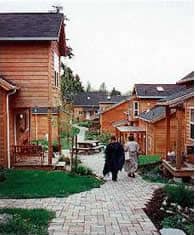
Co-housing community with wooden homes and shared outdoor space.

Cohousing can help residents reduce their carbon footprint and help prevent global warming according to a paper from the University College London.

Those living in cohousing consume nearly 60 per cent less energy in the home, and operate car-sharing and recycling schemes that greatly reduce the pollution from travel and landfill. Having facilities such as office space, workshops and gym within the community also reduces travel and associated emissions. Residents’ direct involvement in the management and maintenance of these communities has also led to the adoption of more energy-efficient systems and renewable sources of energy.

The paper highlights new development models for cohousing which could help it reach a much wider market and increase its impact.

In a paper published in Futures Journal, Dr Jo Williams of the UCL Bartlett School of Planning says that until recently, cohousing has occupied a niche market in the US, largely because the development model adopted has been resident-led. The time, money and effort required to invest in such a project, along with the associated risks, has very much restricted market interest. It takes a minimum of five years to develop a cohousing project, the drop-out rate is high and projects can be expensive.

However, new development models have emerged in the US that reduce resident involvement, risk and cost – namely, partnership, speculative and retrofit models. Developers are beginning to finance and build cohousing both in partnership with prospective residents and speculatively. Residents are also forming their own cohousing communities in existing neighbourhoods, by taking down fences, creating communal facilities and taking on the responsibility for general management and maintenance.

Besides reducing carbon footprint Cohousing could help meet other social goals.

“With concerns about carbon emissions and energy savings, there has never been greater impetus for housing that offers low-carbon lifestyles. If the development models emerging in the US were adopted in the UK, the market for cohousing could be substantially expanded here. This could add to our options for shrinking our carbon footprint as well as meeting social needs, such as safe homes for an ageing population and local childcare facilities for parents who work.”

Cohousing press release from UCL

Original paper ‘Predicting an American future for cohousing’ by Jo Williams is published in the April issue of Futures Journal.

Comments

Featured Blogs

Keep the conversation going with these pieces

Codicts Team
Sun Aug 2009
  • New to community
An article this week in The Oregonian describes the flourishing artistic community at Milepost 5. When the Milepost 5 dream – a development where artists could work, and rent or buy affordable condos – took flight in 2007, Portland’s condo market was still healthy. City leaders were getting serious …
Codicts Team
Mon Sep 2008
  • New to community
Author: Nick Licata Published in Communities Magazine Issue #140 I opened my morning paper anxious to read the first article on my race for a position on Seattle’s City Council. I was living in PRAG House, an old mansion in the Capitol Hill neighborhood that a group of us had converted into a c…
Codicts Team
Sat Mar 2019
  • New to community
  • Economics & Law
CommonSpace CLT fulfills its founder’s dream of using her inheritance to create an affordable, not-for-profit example of diverse community on protected land in perpetuity.
Foundation for Intentional Community
Tue Nov 2019
  • Living in community
  • Governance
Diana Leafe Christian shares Earthaven Ecovillage’s “graduated series of consequences” and how it works. Originally published in Communities magazine.
Kim Kanney
Mon Oct 2018
  • Governance
10 Most Common Mistakes in Consensus A Sneak Peak Inside Wisdom of Communities, Volume 3: Communication in Community by Kim Kanney, Community Bookstore Manager In our new publication series, Wisdom of Communities, we compile hundreds of our favorite articles from Communities magazine and dist…
Codicts Team
Sat Dec 2007
  • New to community
  • Sustainability
Boulder citizens have gotten the Wonderland Hill Development Corporation to rethink its plans for the Washington Village site. After a successful petition drive, WHDC says they will go back to the drawing board and work with citizens to find an agreeable way to develop the site. “Our intention to re…
Codicts Team
Tue Apr 2017
  • New to community
Think Resilience! Post Carbon Institute Self-Guided Course Community Bookstore Book Looking for a deep dive into what resilience means for your life and the world around you? The Post Carbon Institute has produced a self-guided course titled Think Resilience: Preparing Communities for the R…
Codicts Team
Tue Sep 2014
  • Living in community
  • Relationships
For intentional community members, community comes with added benefits, unique challenges, and a call to authenticity.
Codicts Team
Tue Sep 2015
  • Living in community
  • Relationships
An unconventional family fights to stay in their collective house in the face of antiquated local ordinances which suppress community living.
Codicts Team
Thu Dec 2017
  • New to community
  • Sustainability
While it involves inevitable struggles, this replicable model both forms community and provides an ecological framework for living in the city.

Insights & Stories from the Communities Movement

Subscribe to our newsletter for fresh stories and community updates delivered to your inbox.

Join the Communiversity Community

Get unlimited access to courses, exclusive member events, and a supportive network of community builders

Unlimited Learning

Access all courses, books, and premium content

Community Network

Member-only workshops and community builders

Exclusive Events

Member-only workshops and gatherings

Update to a Public Profile

  • Log in
  • Go to your profile page
  • Toggle on the "Add my profile to the directory"
  • Save your profile

Information

Communities

A residential project: people live here as their primary home.

Organizations

An institution, business, network, or project that isn’t a residence (e.g. a learning center, farm, or network with no one living there full-time).

Plus Community Membership

  • Find people with Profile Match
  • Access to your community listing statistics
  • Create Discussion Groups
  • Access to our affiliate program
  • Member badge on your community profile
I am an official member of this community
Disclaimer
I affirm that my information is accurate and I am authorized to manage this listing
Foundation for Intentional Community FIC Member badge logo.

Free Plan

Free Membership
Free

Intentional Advertising

  • Subtotal

    {{ currencyFormat( pricing_summary.total_amount ) }}

Icon representing community connections and collaboration for intentional communities.

Plus Membership

We’re introducing new Plus features — including community reviews, Profile Match, and unlimited Needs & Offers posts — while keeping most of FIC free for everyone. Membership costs less than two coffees a month. 

  • Find communities with Profile Match
  • View detailed reviews about communities
  • Create free listings in Needs & Offers
  • Plus Member resources in CommUniversity
  • View communities detailed reviews
  • Plus Member badge on your profile
