

A New Book Takes A Close Look At Plants and Animals In The Human Habitat

Placeholder image for Foundation for Intentional Community website.
Saul Of-Hearts
  • August 8, 2016
  • Life Transitions
  • Sustainability
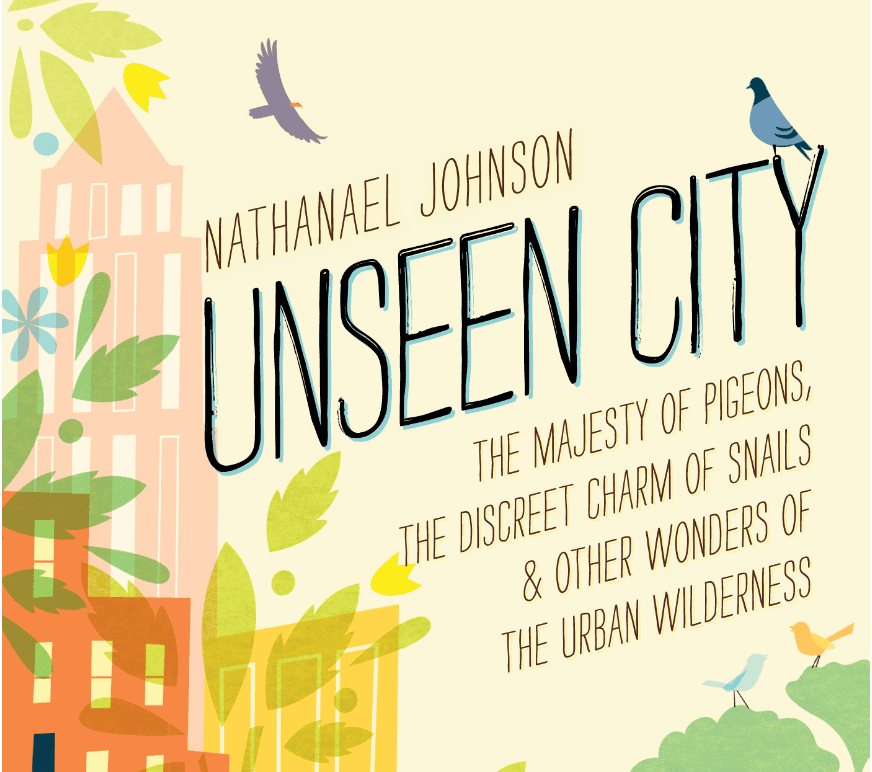
Book cover for 'Unseen City' by Nathaniel Johnson featuring urban wildlife illustrations.

When Nathanael Johnson began taking his two-year-old daughter on nature walks in Berkeley, CA, he realized that he didn’t know the names of half the trees, bugs, and other creatures she pointed to. Even the most common urban animals – pigeons and squirrels – were a mystery to him. How did they manage to become so ubiquitous in the places that humans live?

His new book, “Unseen City,” takes a close look at almost a dozen species, including ants, crows, and snails, as well as plants such as the gingko tree and edible weeds. Johnson calls it “a guide to urban wilderness focusing in on a few city-dwellers so common that we stop seeing them.” He also explores some philosophical questions: to feed or not feed the pigeons? Why is “foraged food” associated with trendy restaurants, and not a skill we practice ourselves?

The book is a call for us to slow down and be more observant of the world around us. It’s also a reminder of how important it is to pass on our knowledge of the natural world to future generations, and how seeing nature through the eyes of a child can help us be more intentional about our place in it:

“When Josephine learned which [weeds] she could eat,” he writes, “this knowledge worked transformative magic upon her…. As a passive recipient of food, there’s no incentive for her to eat anything but the most pleasing flavors. But when she seeks out her own food, it produces a pronounced shift in cognition…. She grows intensely contemplative, pondering the challenging new flavors.”

Kevin Begos in the San Francisco Chronicle writes that, “‘Unseen City’ is a modern classic of nature writing, but also a moving story about learning to be a parent.”

Here are just a few of the things I learned from the book:

  • one species of ant, the Argentine ant, has a “single global mega-colony“
  • crows can recognize human faces – and hold onto grudges for generations
  • the leaves on a ginkgo tree often fall all at once on the same day

Check out the trailer for the book below or listen to Johnson’s interview at KALW!

Gingko photo by Steven Czapski

Comments

Featured Blogs

Keep the conversation going with these pieces

J McCune Porter
Sat Oct 2015
  • New to community
  • Economics & Law
Community Bookstore feature Local Money by Kim Kanney, Community Bookstore Manager Local Money What difference does it make? by John Rogers Digital Edition $10 Local currencies ― sometimes referred to as “local money” or “community currencies” ― allow cities, towns and intentional com…
Rob Wheeler
Mon Jul 2016
  • New to community
  • Sustainability
Diverse ecovillages are modeling how to create more just, equitable, and sustainable human societies.
Kara Huntermoon
Sat Mar 2018
  • Living in community
  • Economics & Law
A co-owner of Heart-Culture Farm Community explores ways to use her privilege to help create a society where people are truly equal.
Molly
Sun Dec 2007
  • New to community
The Galveston Daily News ran a small article about a project just getting underway called Global Ecovillage. Read the article.
Saul Of-Hearts
Thu Mar 2017
  • Living in community
  • Relationships
Midway between Miami and Orlando, the Sustainable Kashi Ashram is an interfaith intentional community that combines yoga, meditation, and permaculture projects on 80 acres land on the eastern coast of Florida. Founded in 1976, the community’s teachings are based on Hindu philosophy, but participants…
Molly
Tue Dec 2009
  • New to community
New York Magazine profiled Brooklyn Co-housing, the first co-housing community in New York City, in an in-depth article recently. This is a level of group interaction that the co-housers haven’t been able to find anywhere else in the city, and that they are betting other New Yorkers would enjoy, too…
Foundation for Intentional Community
Wed Jun 2025
  • Living in community
  • Economics & Law
Meet the young people opting out of society and building utopia for themselves. Read an excerpt from the full article published by Teen Vogue.
Tim Miller
Mon Jun 2009
  • Living in community
  • Relationships
Author: Tim Miller Published in Communities Magazine Issue #143 Visions of Utopia, Part Two Experiments in Sustainable Culture A Documentary by Geoph Kozeny Available from store.ic.org or 1-800-995-8342. ($30 plus shipping; or $50 plus shipping for Parts One and Two together; additional dis…
Saul Of-Hearts
Mon Oct 2016
  • Economics & Law
Many of us are familiar with the farm-to-table movement: we might shop at our neighborhood farmers market, or even subscribe to a CSA (Community-Supported Agriculture) model as a way to support local farms. But what about other products, like seafood? Can we find ways to eat fish locally and sustain…
Christopher Kindig
Tue Mar 2015
  • Economics & Law
Which stage is your tribe? It turns out that by listening to the way people speak to each other in working and social groups one can tell a great deal about their stage cultural of development. David Logan, a researcher and professor of management and leadership at USC, and co-founder and senior…

Insights & Stories from the Communities Movement

Subscribe to our newsletter for fresh stories and community updates delivered to your inbox.

Join the Communiversity Community

Get unlimited access to courses, exclusive member events, and a supportive network of community builders

Unlimited Learning

Access all courses, books, and premium content

Community Network

Member-only workshops and community builders

Exclusive Events

Member-only workshops and gatherings

Update to a Public Profile

  • Log in
  • Go to your profile page
  • Toggle on the "Add my profile to the directory"
  • Save your profile

Information

Communities

A residential project: people live here as their primary home.

Organizations

An institution, business, network, or project that isn’t a residence (e.g. a learning center, farm, or network with no one living there full-time).

Plus Community Membership

  • Find people with Profile Match
  • Access to your community listing statistics
  • Create Discussion Groups
  • Access to our affiliate program
  • Member badge on your community profile
I am an official member of this community
Disclaimer
I affirm that my information is accurate and I am authorized to manage this listing
Foundation for Intentional Community FIC Member badge logo.

Free Plan

Free Membership
Free

Intentional Advertising

  • Subtotal

    {{ currencyFormat( pricing_summary.total_amount ) }}

Icon representing community connections and collaboration for intentional communities.

Plus Membership

  • Find communities with Profile Match
  • View detailed reviews about communities
  • Create free listings in Needs & Offers
  • Plus Member resources in CommUniversity
  • View communities detailed reviews
  • Plus Member badge on your profile