

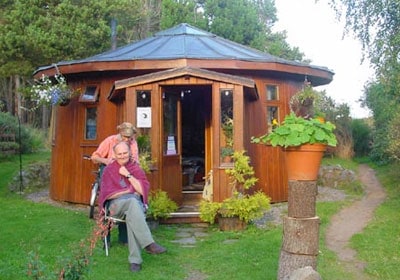
Forbes.com has a special feature section on Utopia which has a great article on intentional communities. The article gives an overview on the US movement with a focus on communities in New York and specifically the Ithaca area. The article includes Photo slideshow of communities around the world including Ecovillage at Ithaca, The Farm, Zegg, Twin Oaks, Arcosanti, Crystal Waters, Findhorn, and Yamagishi.
“The two groups growing dramatically now in America are ecovillages, which are usually rural or semi-rural, and cohousing, which tends to be in or near cities,” says Bill Metcalf, a sociologist at Griffith University in Australia who studies communalism and has lived in two intentional communities.
Part of the motivation is that we have a very strongly increased sense of alienation in the country than we did a generation ago,” said Laird Schaub, founder and resident of Sandhill Farm in Missouri.
Shared common spaces and clever architectural features–like thick walls and south-facing windows–contribute to energy usage per person that is 40% less than for the average American. A typical couple living in Ecovillage at Ithaca pays about $500 in energy bills a year, compared to a couple in a downtown Ithaca apartment who can pay hundreds of dollars a month during the winter.
There is also a short video on The Fellowship Community, a community which focuses on care for the ill and elderly. The video interview with the founders of the community describes their amazing experience in creating a community that could give long term care to their members and residents. Their unique experience offers an alternative to the wider culture’s experiences with elder care. (Note video may not be viewable on Firefox)
But the utopia feature is not all positive on the concept of utopia. Forbes also has an article on the failures of utopian experiments. Mostly the article highlights all the “failed” communities of America’s past and comes from an economic/business perspective (it is Forbes.com after all).
The competition for succession invariably favors not the wise, but the ruthless. This is especially dangerous in communistic societies. Where selfishness is a sin or a crime, everyone is guilty; you don’t want your antagonists gaining the authority to sit in judgment.
A second lesson is that ideals are constraints, and the more constraints one tries to impose, the less viable the community will be. It’s hard enough for a private company–an organization focused exclusively on economic success–to survive intact for multiple generations. Add to that special utopian claims on the firm by the employees and you can see how tough the odds are. The best bet is to run utopia as a business, which is exactly what many communities concluded.
A second lesson is that ideals are constraints, and the more constraints one tries to impose, the less viable the community will be. It’s hard enough for a private company–an organization focused exclusively on economic success–to survive intact for multiple generations. Add to that special utopian claims on the firm by the employees and you can see how tough the odds are. The best bet is to run utopia as a business, which is exactly what many communities concluded.
This last argument seems to contradict the research presented recently in the Economist that claimed that religious communities were more successful if they had more strictures on their membership, not less.
Not to stop with things balanced, Forbes produces another article on the failures of American Utopianism including a photo slideshow including pictures of the Jonestown mass suicide.
But wait there is more! An article about someone’s not-so-happy experience living in a shared household for a year in college. After a brief smack at Earthaven and Damanhur the author describes her brief experience in a dysfunctional version of community, drawing general conclusions from that experience.
Keep the conversation going with these pieces
There are no available blogs
Subscribe to our newsletter for fresh stories and community updates delivered to your inbox.
Get unlimited access to courses, exclusive member events, and a supportive network of community builders
Access all courses, books, and premium content
Member-only workshops and community builders
Member-only workshops and gatherings
We use cookies to improve your experience on our site. By using our site, you consent to cookies.
Manage your cookie preferences below:
Essential cookies enable basic functions and are necessary for the proper function of the website.
These cookies are needed for adding comments on this website.
Statistics cookies collect information anonymously. This information helps us understand how visitors use our website.
Service URL: policies.google.com (opens in a new window)
A residential project: people live here as their primary home.
An institution, business, network, or project that isn’t a residence (e.g. a learning center, farm, or network with no one living there full-time).

{{ item.label }}
{{ item.value ? item.value : currencyFormat( item.amount ) }}
Subtotal
{{ currencyFormat( pricing_summary.total_amount ) }}
There are no results matching your search