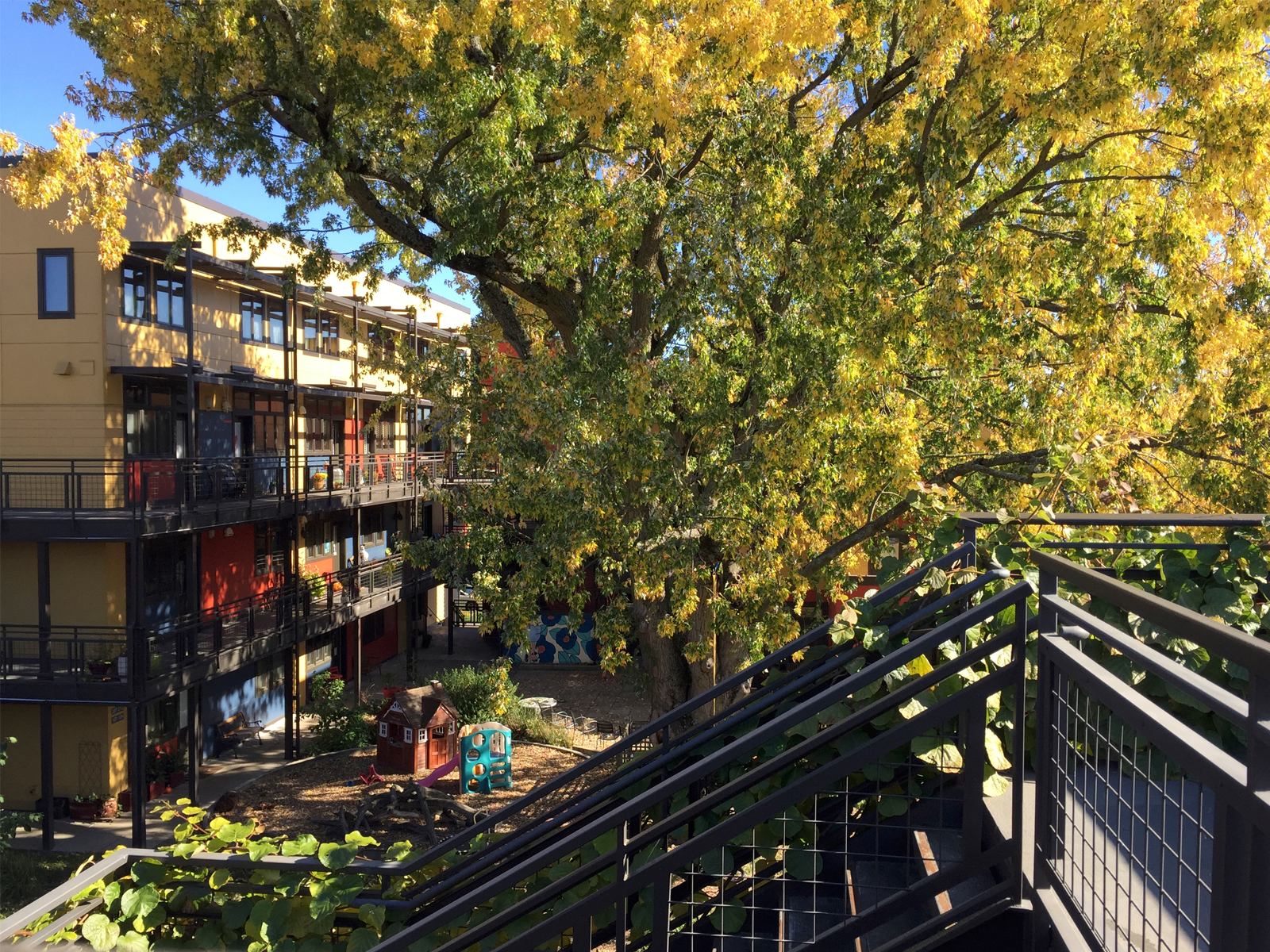
Colorful apartment complex with a large tree and playground in the courtyard.

Daybreak Cohousing

  • Communities

About the Communities

  • Established
  • Home-sharing
  • Urban

Founding year

  • 2005

What we do

Daybreak Cohousing is a multigenerational 30-unit development in the Overlook neighborhood of Portland, Oregon.
Daybreak’s homes are connected by an outside walkway that lets us interact easily. Daybreak’s campus is two-thirds of an acre centered around a fifty-year-old silver maple which serves as the community’s anchor.
Our complex consists of four multi-story buildings, three with residential units, and one large Common House with four residential units on top—all with maximum solar exposure. The condominium units are 1 to 3 bedrooms and range from 650 to 1,200 square feet. A circular lawn, gardens and children’s play area fills the central courtyard. Gardens and street trees on the east, south and west invite interaction with the neighborhood.
We develop warm connections by sharing meals, relaxing or celebrating events, participating in workdays and on teams, and making decisions together.

Our Mission

Multigenerational, Sustainable

  • Purpose
  • Home-sharing
  • Community type
  • Cohousing
  • Sustainability practices
  • Renewable energy systems
  • Activities
  • Property management

Commemorative dates

  • January 1, 2005
  • Started planning
  • January 1, 2009
  • Started living together
  • 37 Total members
  • Open to new members
  • Open to visitors
Total
46

How to join

The only way to become a member is by buying or renting one of our units. The responsibility to decide whether you are a good fit for Daybreak Cohousing is a personal one. We recommend that you visit Daybreak at least three times before you make an offer, or sign a rental agreement. If you are seriously interested in buying or renting at Daybreak, we’ll arrange a conversation circle with several community members, so you can ask questions and get to know us.

Basic expectations or agreements for members

Contact us. You are welcome to schedule a tour or attend a community event.

Primary decision-making authority

  • Small Leadership Group

A few people (not elected by the broader community) make the major decisions.

Decision-making process

  • Modified Consensus

Generally seek agreement, but have backup methods when consensus isn’t reached.

Governance structure

  • Collaborative/Horizontal

Power and responsibility are shared relatively equally among members.

Conflict resolution approach

We are reviewing our bylaws with the intention of updating them.

Economic model

  • Independent Finances

Members maintain separate personal finances with minimal sharing.

Economic scenarios for this community

  • Members need to pay fees, dues, or similar to live there on a per month or per year basis
  • There is a labor obligation
  • Members typically need to have their own job or other personal source of income to cover their expenses while living in the community?

Additional economic information

Regular fees: $750
Labor: Yes (4 hrs/week)
Members with pre-existing debt: allowed
HOA dues are based on square footage of condos.

Shared resources and amenities that are accessible to everyone in the community

Common House, Garden(s), Library, Workshop, Large Scale Kitchen, Swingsets & play areas, Internet

Frequency of communal meals

  • About once a week

Significant food acquisition practices

  • Locally sourced

Community activities and engagement

  • Neighborhood, Community Housing, or Homeowner's Association

Substance use culture

  • Substance use appears in public spaces but no pressure
  • Substance use is prohibited in the community

Gender composition

  • Majority cis (over 60%)

Age demographics

  • Family-focused (many children and parents)

Property status

  • Privately owned

Property owner

  • By a Land Trust, Home Owners Association, or corporation

Setting

  • Urban

Within city limits with access to urban amenities and infrastructure.

Community type

  • Cohousing

    Private homes with shared common facilities, designed for neighborly
    interaction while maintaining independence.

Sustainability approach

  • Renewable energy systems

Self-produced energy

  • Up to 33%

Energy sources used

Self-produced food

  • Up to 33%

Local, organic, or fair trade food

  • Up to 33%

Food systems

  • Community garden
  • Land area size
    0.7 acres

Guest Book

Written reviews are available for plus members. Click here to upgrade.

Location

  • Oregon, United States

Needs and Offers

Offer
  • Communities with Openings
2 months ago

Community House in SE Portland Seeks Membership!

Ellis Street Community House is seeking kind, present, and engaged new housemates with experience in community living. We are currently 3 adults, one baby, and two cats living in a 6 bedroom, 3 bath house on ¼ acre of land near Powell Butte nature park and the Springwater Corridor bike trail. We expect to be joined by a shy and sweet 2 year old in the next few months. For us, living in community is a collaborative process, one that helps improve our quality of life. We’re able to eat great food, keep the place clean, maintain a garden, and hold a space large enough to host guests and events by working together. We have an extensive community library and art/craft material collection, as well as a great tea selection, stocked pantry, and functional kitchens ready for feast-making, canning, and fermentation dreams. We make kombucha, ginger beer, sauerkraut, bone broth, natto, and apple/pear butter on a rotating basis. With two fridges and two deep freezers we can save blueberries and blackberries we harvested from close by and get meat directly from farmers. We hold potlucks and other events like bonfires and game nights about once a month, and make a house dinner together weekly. We maintain a home free from artificial fragrances and voice-activated technology. The larger downstairs room is available for $740 per month. The smaller downstairs room will be available for $600 per month starting on September 1rst. The main kitchen is on the second floor. We also have private outdoor space for someone sleeping in their home on wheels available for $200-500 per month depending on the size of the vehicle. This would include membership in the community and use of the common spaces. Guest space is available for friends and relatives of residents – upstairs there is an office/guest room for longer visits, and the couches/pads in the common areas are available for shorter stays. The home has heating and cooling through an efficient heat pump, and we ju

Information

Communities

A residential project: people live here as their primary home.

Organizations

An institution, business, network, or project that isn’t a residence (e.g. a learning center, farm, or network with no one living there full-time).

Plus Community Memberhsip

  • Find people with Profile Match
  • Access to your community listing statistics
  • Create Discussion Groups
  • 50% commission when your members purchase a Plus Membership
  • Access to our affiliate program
  • Member badge on your community profile
I am an official member of this community
Disclaimer
I affirm that my information is accurate and I am authorized to manage this listing
Foundation for Intentional Community FIC Member badge logo.

Free Plan

Free Membership
Free

Intentional Advertising

  • Subtotal

    {{ currencyFormat( pricing_summary.total_amount ) }}

Icon representing community connections and collaboration for intentional communities.

Plus Membership

  • Find communities with Profile Match
  • View detailed reviews about communities
  • Direct message and view contact information
  • Create free listings in Needs & Offers
  • Plus Member resources in CommUniversity
  • Plus Member badge on your profile