
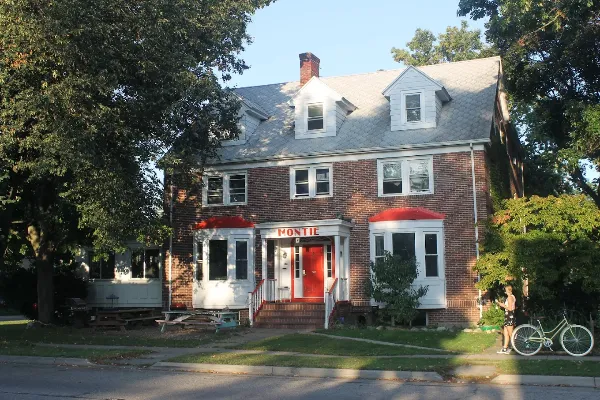
Historic brick building with red accents and a sign reading 'Montie' in a community setting.

Montie House Cooperative

  • Communities

About the Communities

  • Established
  • Home-sharing
  • Suburban

Founding year

  • 1964

What we do

**WE ARE LOOKING FOR NEW MEMBERS!**
The Montie House Cooperative is a cooperative housing organization. At its maximum, our house can fit 40 individuals. We aim to house about 20-30 at any given time. We have a large shared kitchen, several large common spaces, a TV room with double-decker couches, a projector, a workout room, and several small-to-large rooms. Sounds awesome, right? Unfortunately the house is super old and needs tons of work. Worsening effects of climate change are posing new threats like flash flooding. Our members pool our monthly membership fees to cover repair materials, and we pay our membership for conducting maintenance. We also use our pooled membership fees to cover utilities like electric, water, internet, and gas. We cover pantry staples like flour, dry beans, canned veggies, sugar, spices. We also cover toilet paper, toilet cleaner, kitchen cleaning products and more. Uhhhh we usually host at least one big event per month, lots of live music. We end by 11pm to avoid getting in trouble with the city. We are doing a bunch of garden and native planting projects on our relatively small lawn space! We also have our own compost!
We are completely independent – our membership votes to designate some members to serve on our executive board. That’s how we run the house!
We use Discord for our group chat.
There are a lot of student housing cooperatives in the area, but this one has a slightly older average age versus the nearby student communities. It’s a chiller environment which prioritizes strong communication as the basis of a strong community.
The house can get dirty – it’s definitely at 18+ community. Pets are not guaranteed to be let in and have to be voted on separately from new members.

Our Mission

A cooperative is an autonomous association of persons united voluntarily to meet their common economic, social, and cultural needs and aspirations through a jointly-owned and democratically-controlled enterprise. Cooperatives are based on the values of self-help, self-responsibility, democracy, equality, equity and solidarity. In the tradition of their founders, cooperative members believe in the ethical values of honesty, openness, social responsibility and caring for others. The cooperative principles are guidelines by which cooperatives put their values into practice.
1. Open & Voluntary Membership: Cooperatives are voluntary organizations, open to all persons able and willing to use their services to accept the responsibilities of membership, regardless of gender, social, racial, political, religious, disability, or national association.
2. Democratic Member Control: Cooperatives are democratic organizations in which members have the opportunity to take an active hand in the crafting and implementation of all policy changes and decision making. Individuals serving in elected e-board positions are accountable to the membership body, as well as to each other. All cooperative members, regardless of seniority, have equal voting rights within the house (1 person = 1 vote). Any changes made to the constitution, or any significant changes to the house dynamic such as membership, requires a 2/3 majority from the house.
3. Economic Participation from Members: Members contribute equitably to, and therefore democratically control, the capital of their cooperative. As members usually receive limited compensation, if any, on the capital they attribute as a condition of membership, at least a portion of the capital is considered common property of the cooperative. Membership will collectively allocate surpluses for purposes including: developing the cooperative, setting up reserves, benefitting members in proportion to their transactions with the cooperative, and supporting other activities approved by the membership body.
4. Autonomy & Independence: Cooperatives are independent and autonomous organizations governed by their membership body. If the organization chooses to enter into agreements with external entities or raise capital from external sources, they may only do so while ensuring the democratic control of the co-op by their members and the maintenance of said sovereignty.
5. Education, Training, and Information: Cooperatives provide education and training for their members, elected representatives, managers, and employees so they can contribute effectively to the development of their cooperatives. They inform the general public about the nature and benefits of cooperative living.
6. Cooperation Among Cooperatives: Cooperatives serve their members most effectively and strengthen the cooperative movement by working together through local, national, regional and international structures.
7. Community Preservation: Cooperatives work for the sustainable development of their communities through policies approved by their members.

  • Purpose
  • Home-sharing
  • Community type
  • Coliving
  • Sustainability practices
  • Regenerative agriculture or permaculture
  • Activities
  • Experiences
  • Networking

Commemorative dates

  • January 1, 1964
  • Started planning
  • January 1, 1964
  • Started living together
  • 18 Total members
  • Open to new members
  • Open to visitors
Total
18

How to join

Fill out this Google Form and our Membership Chair will reach out to you!
https://forms.gle/ks2GzJdU7K66RXx1A

Basic expectations or agreements for members

Fill out this Google Form if you’re interested in membership and a tour.
https://forms.gle/ks2GzJdU7K66RXx1A
For light inquiries, please send us a DM on instagram. Instagram.com/montiehaus

Primary decision-making authority

  • Small Leadership Group

A few people (not elected by the broader community) make the major decisions.

Decision-making process

  • Majority Vote

More than 50% agreement needed.

Governance structure

  • Representative/Democratic

Members elect leaders who make decisions within defined roles.

Economic model

  • Independent Finances

Members maintain separate personal finances with minimal sharing.

Economic scenarios for this community

  • There is a one-time fee, investment, or share purchase to join the community separate from accessing housing
  • Members need to pay fees, dues, or similar to live there on a per month or per year basis
  • There is a labor obligation
  • Members typically need to have their own job or other personal source of income to cover their expenses while living in the community?

Additional economic information

Join fee: $400
Regular fees: Yes
Labor: Yes
Members with pre-existing debt: allowed
Our house has a ledger which is visible to all cooperative members. So, if you don’t pay your membership fees, it can be seen by others and discussed in meetings. Community accountability.

Shared resources and amenities that are accessible to everyone in the community

Common House, Garden(s), Library, Workshop, Large Scale Kitchen, Internet

Frequency of communal meals

  • 2-5 times per week

Dietary restriction

  • People can cook and eat what they want in their own residence

Community activities and engagement

  • Organization, Resource, or Network
  • Festivals, Conferences, Events

Substance use culture

  • Substance use appears in public spaces but no pressure

Age demographics

  • Mixed adults (few or no children)

Property status

  • Privately owned

Property owner

  • By a Land Trust, Home Owners Association, or corporation

Setting

  • Suburban

Residential areas outside city centers but within metropolitan regions.

Community type

  • Coliving

    Shared living spaces with private bedrooms/bathrooms and communal
    kitchens, dining, and social areas.

Sustainability approach

  • Regenerative agriculture or permaculture

Self-produced energy

  • Up to 33%

Self-produced food

  • Up to 33%

Local, organic, or fair trade food

  • 33 - 66%

Food systems

  • Community garden
  • Shared kitchen or food co-op

Guest Book

Written reviews are available for plus members. Click here to upgrade.

Location

  • Michigan, United States

Montie House Cooperative

Needs and Offers

Connecting people and communities through an intentional online marketplace

  • Promoted
Offer
  • Promoted
  • Events
4 weeks ago

Healing Love Healing Money: Trust As The Foundation For A New Culture

Money, love and power are among the hardest things any community works with, and many of us carry the same fears into both: not having enough, losing what we have, and the sense that if someone else gets money or love, we won’t. Healing Love, Healing Money: Trust as the Foundation for a New Culture is taught by two intentional communities. Karen McAllister and Duncan Cryle are from Clear Sky Meditation and Retreat Center, a Buddhist-lineage community in the BC Rockies. Monika Alleweldt and Benjamin von Mendelssohn from Tamera Healing Biotope, a community of about 160 people in southern Portugal that has spent decades studying love, trust and relationship. Clear Sky has spent years working on its relationship with money, and our two communities found surprising parallels in the fears beneath both. Over four sessions we explore the roots of fear around money and belonging, love, possession and power, trust as infrastructure (community as a container for healing), and ethical livelihood. We use short meditations, body-based practices, reflection and small-group conversation. You do not need to be in a romantic relationship or live in community. When: October 27, Nov 3, 10, 17. All four sessions: 12–2pm Vancouver, 1–3pm Alberta, 7–9pm UK and Portugal, 8–10pm Central Europe. Note: US and some Canadian provinces change clocks on November 1, so the US west coast is 12–2pm on October 27, then 11am–1pm for the remaining sessions, and Eastern is 3–5pm on October 27, then 2–4pm for the rest. Cost: sliding scale Details and registration: https://www.clearskycenter.org/event/healing-love-healing-money-online/  
October 27, 2026 13:00 – November 17, 2026 15:00
  • Promoted
  • Events
13 hours ago

Coastal Regeneration Immersion: Permaculture Design Certification in Jalisco, Mexico

Tropical Dry Forest Permaculture Design & Regenerative Stewardship Certification (PDC)12-Day Intensive | 120 Hours | Costalegre, Jalisco, Mexico APPLY AT XOCHIRAIZ.COM Join us for an immersive Permaculture Design Certificate course set in the tropical dry forest bioregion of coastal Jalisco. This 120-hour intensive blends internationally recognized PDC curriculum with hands-on regenerative practice — combining ecological design, agroforestry, natural building, and community stewardship into one integrated learning experience. Lead Faculty Jorge Luis Gtz. Olarte (Arborescencia RedGenerativa) – Regenerative Design, Soil Biology & Agroforestry Ozzy Lusth (Survior & Xochiraíz) – Wilderness Resilience & Survival Skills Dave Collins (Capacha Coastal Conservation Center) – Bioarchitecture & Ecological Development What You’ll LearnThe course moves through six progressive phases: Permaculture & Ecological Literacy – ethics, principles, and reading the tropical dry forest landscape Water & Soil Systems – keyline design, water harvesting, living soils, and compost systems Horticulture – food garden design, propagation, and biological pest control Regenerative Food Systems – tropical agroforestry, food forest design, and guild planting Ecological Infrastructure – bamboo bioarchitecture, bioclimatic farm design, compost toilets, greywater, and rocket stoves Integrated Design Studio – team-based final design projects covering watershed strategy, agroforestry, food forest layout, infrastructure, and phased implementation Daily RhythmMornings begin with optional surf/yoga and journaling, followed by field practicums and hands-on workshops. Afternoons include design studio and construction lab work, with reflection circles, communal dinners, and evening talks, films, or campfire discussions rounding out the day. Final ProjectParticipants work in teams to produce a full regenerative design package — landscape analysis, water plan, agroforestry design, food forest plan, ecological infrastructure, and bioclimatic farm plan — presented to a faculty review panel on the final day, followed by a closing ceremony, certificate delivery, and community feast. CertificationGraduates receive the Tropical Dry Forest Permaculture Design & Regenerative Stewardship Certification (120 contact hours), hosted by Capacha Coastal Conservation Center and Tierralegre, A.C. Curriculum integrates international PDC standards with tropical ecology, agroforestry, ecological restoration, bamboo bioarchitecture, bioclimatic design, GIS/photogrammetry, and regenerative leadership. Highlights Hands-on bamboo construction (temazcal, bathhouses, sculpture) Tropical dry forest silviculture practicum Community mapping and design project for Ekoa Green Community Talent show and sea turtle release
January 10, 2027 00:00 – January 24, 2027 23:59

Update to a Public Profile

  • Log in
  • Go to your profile page
  • Toggle on the "Add my profile to the directory"
  • Save your profile

Information

Communities

A residential project: people live here as their primary home.

Organizations

An institution, business, network, or project that isn’t a residence (e.g. a learning center, farm, or network with no one living there full-time).

Plus Community Membership

  • Find people with Profile Match
  • Access to your community listing statistics
  • Create Discussion Groups
  • Access to our affiliate program
  • Member badge on your community profile
I am an official member of this community
Disclaimer
I affirm that my information is accurate and I am authorized to manage this listing
Foundation for Intentional Community FIC Member badge logo.

Free Plan

Free Membership
Free

Intentional Advertising

  • Subtotal

    {{ currencyFormat( pricing_summary.total_amount ) }}

Icon representing community connections and collaboration for intentional communities.

Plus Membership

  • Find communities with Profile Match
  • View detailed reviews about communities
  • Create free listings in Needs & Offers
  • Plus Member resources in CommUniversity
  • View communities detailed reviews
  • Plus Member badge on your profile