

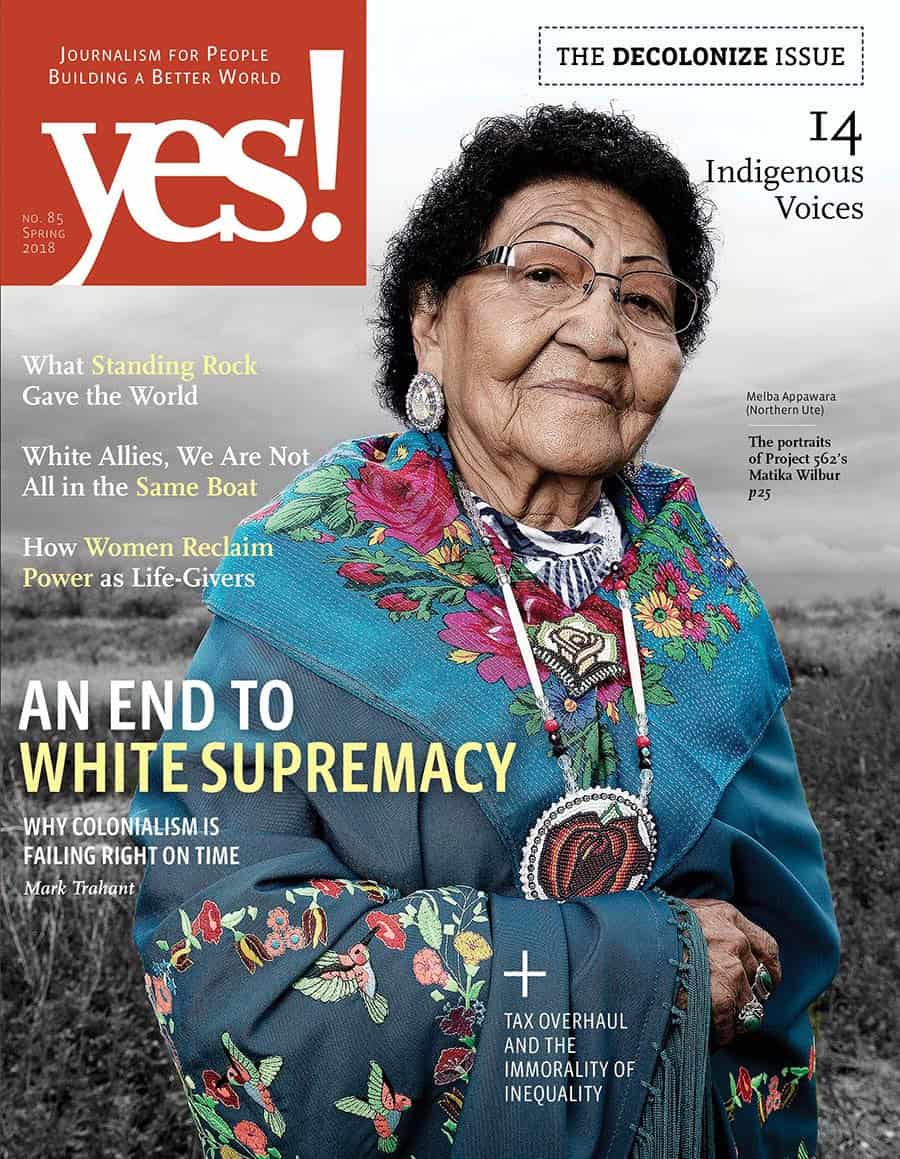
The FIC would like to express its support and enthusiasm to Yes! Magazine for its Spring 2018 edition- The Decolonize Issue. We encourage you all to check it out.
Just like our recent issue on class, race and privilege of Communities magazine, Yes! is experimenting with the gift economy model. The Decolonize Issue is available for free download. Please share the link widely.
Yes! is also going one step further, by offering people to register to receive free print magazines to distribute as widely as possible!
White supremacy didn’t sprout on American soil; it arrived here with European colonizers, and it came with the usual colonizer package: racial superiority, capitalist exploitation, patriarchy, oppression, hegemony.
After Standing Rock awakened so many to the idea of decolonization, the YES! editors decided to present an issue that explored the extent to which ending economic, cultural, and racial oppression is possible. What movements are countering the colonialist power structures? What’s working to support self-determination?
In the Spring 2018 issue YES! turns to Indigenous writers and photographers to tell those stories.
YES! Media is a nonprofit, independent publisher of solutions journalism. Through rigorous reporting on the positive ways communities are responding to social problems and insightful commentary that sparks constructive discourse, YES! Media inspires people to build a just and sustainable world. To learn more, visit YesMagazine.org.
Here’s a preview of the editor’s statement for the Decolonize Issue:
“How white allies can dismantle white supremacy is probably the crucial social issue of our current time. White people have the power and the privilege, and nothing will change until we change it.”
That was a recent message from a YES! reader (thank you!), and we couldn’t agree more. It points to why we decided to do an issue on decolonization. Because the idea of white supremacy didn’t sprout on American soil; it arrived here with European colonizers, and it came with the usual colonizer package:racial superiority, capitalist exploitation, patriarchy, oppression, hegemony. We cannot talk about ending white supremacy without talking about dismantling the entire power structure that is colonialism’s legacy.
After Standing Rock awakened so many to the idea of decolonization, YES! editors decided to present an issue that explored the extent to which ending economic, cultural, and racial oppression is possible. What movements are countering the colonialist power structures? What’s working to support self-determination? We turned to Indigenous writers and photographers to tell those stories.
Mark Trahant is guest editor for this special issue. He’s been a journalist for 40 years. He asks us to consider decolonization more in terms of disruptive forces. Colonialism is a framework that we think of as forever. It has many names: Pax Romana, the British Empire, Ancien Régime, Manifest Destiny, “Corporations are people, my friend,” hegemony, oligarchy, and white supremacy. These are forces of near absolute power (or so they seem at the time) that have been with us for much of human history. But history also shows how things can change quickly. Disruption is a force that redefines the norm and brings innovation. Exactly
what we need right now.
The best journalism explores “what if?” What would it take for humans to meet the challenges of justice and climate? A more inclusive, democratic path that recognizes global citizenship is the only reasonable answer. The United States is only 4 percent of the world’s population yet consumes so much more than its share, exerting colonial power as if only it matters. What if … that’s no longer the case? What if … the world governs itself as if the planet (and its future) matters? The systems of the past are incapable of bringing us together to solve the problems of today. We need to bury the rule of a few over the many. The stories in this issue describe what that could look like and how it might be accomplished—how it is being accomplished—and what justice and self-determination would mean not only for the world’s Indigenous people, but for all the people.
Please show your support for Yes! Magazine and Decolonization movements by downloading the issue from their digital editions page and sharing with your friends and fellow travelers.
And please let us know what you think about both the movement towards a gift economy model for our publications and ways in which we can further deconstruct our privilege and remediate our injustices.
Keep the conversation going with these pieces
There are no available blogs
Subscribe to our newsletter for fresh stories and community updates delivered to your inbox.
Get unlimited access to courses, exclusive member events, and a supportive network of community builders
Access all courses, books, and premium content
Member-only workshops and community builders
Member-only workshops and gatherings
We use cookies to improve your experience on our site. By using our site, you consent to cookies.
Manage your cookie preferences below:
Essential cookies enable basic functions and are necessary for the proper function of the website.
These cookies are needed for adding comments on this website.
Statistics cookies collect information anonymously. This information helps us understand how visitors use our website.
Service URL: policies.google.com (opens in a new window)
A residential project: people live here as their primary home.
An institution, business, network, or project that isn’t a residence (e.g. a learning center, farm, or network with no one living there full-time).

{{ item.label }}
{{ item.value ? item.value : currencyFormat( item.amount ) }}
Subtotal
{{ currencyFormat( pricing_summary.total_amount ) }}
There are no results matching your search

We’re introducing new Plus features — including community reviews, Profile Match, and unlimited Needs & Offers posts — while keeping most of FIC free for everyone. Membership costs less than two coffees a month.

