

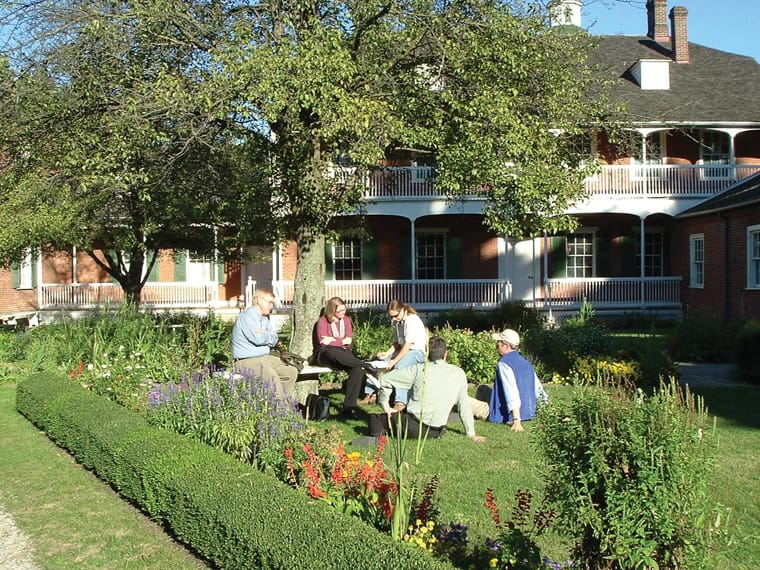
The Communal Studies Association is pleased to partner with the Foundation for Intentional Community for its Fall 2017 issue of Communities. For decades the two organizations have shared objectives, meetings, and members. The CSA, founded in 1975, and the FIC, founded in the 1940s and reorganized in the mid 1980s, also maintain cooperative ties with mutually kindred organizations in the causes of communal studies and communal living. In an unforgettable spirit of unity, members of the boards of directors of the CSA, FIC, International Communal Studies Association based in Israel, and Center for Communal Studies at the University of Southern Indiana met as one body in 1993. We sat together in a symbolic circle in the venerable Harmonist cooper shop in historic New Harmony, Indiana where our organizations were co-sponsoring a Communal Studies Conference.
It is in this same spirit of cooperation and support that the CSA and its members, some of whom have written articles for this Fall 2017 issue, are joining with the FIC to insure that Communities remains the standard of excellence in documenting the voluntary communal laboratories which offer the world experimental evidence of hopeful solutions to pressing global problems. The CSA’s journal Communal Societies and the FIC’s Communities are parallel publications helping make the world aware of the vital lessons to be learned from communal groups past and present. These lessons are now more urgent than ever to human survival itself—from conflict resolution, sustainability, and equality to the dangers of authoritarianism.
Just as communal living has a universal attraction to groups and movements seeking security, solidarity, and survival, the CSA was formed to attract and serve all who are interested in studying and learning from communal groups and their movements. Its founding constitution was written during a Communal Societies Conference at the Shaker Village of Pleasant Hill, Kentucky in 1975. The stated purpose was “to encourage the restoration, preservation, and public interpretation of America’s historic communal sites and the study of communal societies past and present” involving “preservationists from historic communal sites, residents of current communes, and scholars of communitarianism as active participants in its activities.” These activities included “publications, conferences, seminars, workshops, and exhibits” intended to “increase public awareness of the American communal tradition, to “act as a clearinghouse for information relevant to communal restoration, interpretation, funding and scholarship,” and to “provide a forum for the exchange of ideas to achieve an understanding of America’s communal heritage.”
The CSA (www.communalstudies.org) desires to be increasingly inclusive. It welcomes all who find interest and information, fascination and fun in the important social phenomenon of communal living into the fold of its meetings, networking, publications, and tours. Annual CSA conferences, conducted in a reunion-like atmosphere and spanning the spectrum of intellect and emotion, can be deadly serious as in a presentation by Jonestown survivor Laura Johnston Kohl, innovative as in a lecture on transformative utopianism by anthropologist Josh Lockyer, or just plain entertaining as in a folk dancing lesson directed by historian Larry Foster. Guided tours at conferences introduce attendees to those historic or current communal venues, such as Mormon sites in and around Temple Square during the conference in 2016. Pre- and post-conference tours have taken visitors to Hutterite bruderhofs in South Dakota, Daniel Wright’s Padanaram Settlement near Bedford, Indiana, Ma Jaya’s Kashi Ashram at Sebastian, Florida, and the Transcendental Meditation community and Maharishi Vedic University at Fairfield, Iowa.
The CSA, with headquarters at Amana, Iowa, fulfills its clearinghouse function by circulating contact information of those who come to conferences and by having its officers, including Executive Director Kathleen Fernandez, President Marc Rhorer, and its other board members, available to answer questions online or by phone. Those seeking research materials are often referred to two collections with which the CSA works in close collaboration. One is the Communal Studies Collection in the Special Collections Department of the University of Southern Indiana Archives (www.usi.edu/library/university-archives-and-special-collections), which now has information on some 6,000 historic and present communal groups, including about 25,000 images and partial online access. The other is the Special Collections and Archives at the Hamilton College Library in Clinton, New York (cgoodwillie [AT] hamilton.edu). It specializes in Shaker sources and publishes the American Communal Societies Quarterly that includes seminal articles on pertinent communal topics based on primary sources.
The CSA and FIC, their publications and outreach, are inseparably linked in the common cause for the communal, humanitarian, ecological, scholarly, and preservation activities they represent. The CSA invites all who are interested in its efforts to become members, apply for its Research Fellowship award (www.communalstudies.org/researchfellowship), participate in its conferences, and submit news to its newsletter Communiqué and articles to its journal Communal Societies. Especially, we welcome all to attend the 43rd annual CSA Conference this October 5-7, 2017, at the Zoar Village State Memorial in Zoar, Ohio, where we will celebrate the bicentennial of the founding of the Society of Separatists of Zoar (www.communalstudies.org/annualconference).
Don Pitzer was executive director of the Communal Studies Association from 1976 to 1993. He is now Professor Emeritus of History and Director Emeritus of the Center for Communal Studies at the University of Southern Indiana in Evansville, Indiana. His more complete history of the CSA appeared as “The Communal Studies Association at Forty: A Personal Retrospective” in Communal Societies: Journal of the Communal Studies Association (volume 35, number 1, 2015), pages 81-108.
Keep the conversation going with these pieces
There are no available blogs
Subscribe to our newsletter for fresh stories and community updates delivered to your inbox.
Get unlimited access to courses, exclusive member events, and a supportive network of community builders
Access all courses, books, and premium content
Member-only workshops and community builders
Member-only workshops and gatherings
We use cookies to improve your experience on our site. By using our site, you consent to cookies.
Manage your cookie preferences below:
Essential cookies enable basic functions and are necessary for the proper function of the website.
These cookies are needed for adding comments on this website.
Statistics cookies collect information anonymously. This information helps us understand how visitors use our website.
Service URL: policies.google.com (opens in a new window)
A residential project: people live here as their primary home.
An institution, business, network, or project that isn’t a residence (e.g. a learning center, farm, or network with no one living there full-time).

{{ item.label }}
{{ item.value ? item.value : currencyFormat( item.amount ) }}
Subtotal
{{ currencyFormat( pricing_summary.total_amount ) }}
There are no results matching your search


