

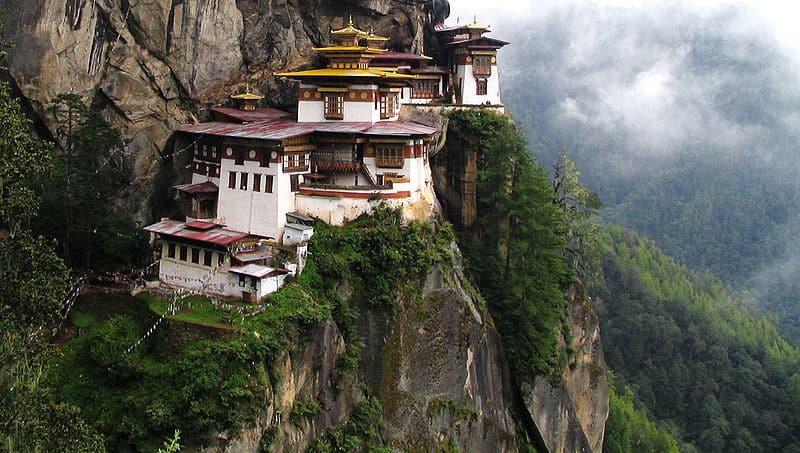
This post is an excerpt from Together Resilient: Building Community in the Age of Climate Disruption by Ma’ikwe Ludwig, published by The Foundation for Intentional Community. Visit our fundraising campaign to learn how you can support the publication of the book and get yourself a copy!
****
A group of researchers studying variations in per capita carbon emissions notes that, “Much of the U.S. resistance to ambitious global efforts to reduce carbon dioxide emissions reflects a fear common amongst Americans that high emissions are necessary to maintain high standards of living.” (1)
It’s worth questioning that assumption, and asking an even deeper question about how we define quality of life or a high standard of living, and to do so I’m going to invite you to take a look at this tiny Buddhist country squeezed between China, India and Bangladesh. Bhutan is the only nation in the world that has a negative carbon footprint. They also are the nation that pioneered the concept of measuring Gross National Happiness, instead of Gross National Product as their primary measure of cultural health.
But they aren’t measuring the “think positive thoughts” version of happiness that many Americans have become obsessed with, nor do they conflate shopping therapy with real personal growth.
They are measuring well-being … based on “a commitment to building an economy that would serve Bhutan’s culture based on Buddhist spiritual values, instead of western material development gauged by gross domestic product.” Bhutan is, in fact, a Buddhist country officially (though the constitution protects the right to freedom of religion).
I don’t think the constitutionally mandated attention on a non-material marker of well-being and the fact that Bhutan has the only negative carbon footprint in the world are coincidental, and neither does Pascale Aline Bertoli, a PhD candidate in psychology and practicing Buddhist who has made four trips to Bhutan in the past 14 years and who spoke to me about her impressions of the country.
What struck me most strongly during our conversation, was how many times I found myself thinking, “Wow… that’s really similar to how intentional communities do that.” Sufficiently intrigued, this organically emerged as the third “case study” for this book.
The Bhutanese constitution also mandate certain ecological values, and in fact states explicitly that 60% of the country (at a minimum) shall remain in forest cover in perpetuity. Both of these things represent a country with a strong world view that is explicitly anti-material, with both the ecological and well-being commitments arising from a strong spiritual basis.
In many ways, Bhutan is the large scale answer to that question I pose to my students in my workshops: if you started with a more caring world view, what social, economic and ecological systems would arise from that world view? In fact, GNH has four explicit pillars to it, and in them, you can hear the integration of the four dimensions of sustainability:
• Sustainable development
• Preservation and promotion of cultural values
• Conservation of the natural environment, and
• Establishment of good governance
Sustainable development is the bringing together of ecological and economic values, preservation of cultural values is where world view meets social, conservation of the natural environment brings together world view (conservation being a philosophy of management) and ecological, and good governance is social again. This echoes, remarkably well, the intersectionality of the four dimensions that inspired the Global Ecovillage Network to create the Gaia Education curriculum in the first place.
And like ecovillages who do a good job of bringing all four dimensions together, Bhutan displays remarkable ecological numbers.
They’ve also done well by some of the most common standards of quality of life. According to the United Nations, they’ve seen a steady rise in both life expectancy and a formula called the Human Development Index since 1990.
By my reading, Bhutan is basically just one ginormous ecovillage, and a successful one at that. It embodies the kinds of policies I am talking about in my policy reform platform, and is therefore worth studying in and of itself. And because of that, is also an answer to whether it is possible to scale up sustainability from the 50-100 adult scale that Dancing Rabbit and Twin Oaks are currently embodying.
****
1 Quote taken from: Why Do State Emissions Differ So Widely? Elizabeth A. Stanton, Frank Ackerman, and Kristen A. Sheeran. December 2010, Economics for equity and Environment www.e3network.org
Photo by Douglas J. McLaughlin (CCA-SA-3.0)
Keep the conversation going with these pieces
There are no available blogs
Subscribe to our newsletter for fresh stories and community updates delivered to your inbox.
Get unlimited access to courses, exclusive member events, and a supportive network of community builders
Access all courses, books, and premium content
Member-only workshops and community builders
Member-only workshops and gatherings
We use cookies to improve your experience on our site. By using our site, you consent to cookies.
Manage your cookie preferences below:
Essential cookies enable basic functions and are necessary for the proper function of the website.
These cookies are needed for adding comments on this website.
Statistics cookies collect information anonymously. This information helps us understand how visitors use our website.
Service URL: policies.google.com (opens in a new window)
A residential project: people live here as their primary home.
An institution, business, network, or project that isn’t a residence (e.g. a learning center, farm, or network with no one living there full-time).

{{ item.label }}
{{ item.value ? item.value : currencyFormat( item.amount ) }}
Subtotal
{{ currencyFormat( pricing_summary.total_amount ) }}
There are no results matching your search


