

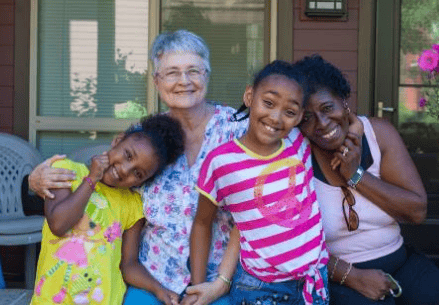
For many intentional communities and cohousing projects, being “intergenerational” is a core value and long-term goal. Parents envision themselves raising children with the support of other community members. Elderly residents want to share meals and social activities in their old age. But for some families – such as foster children and their adoptive parents – the stability that leads to a long-term intergenerational community can be a challenge.
That’s why Derenda Schubert is so passionate about Bridge Meadows, in intergenerational community in Portland, Oregon, that brings foster children, parents, and elders together into one place. Currently, around 70 residents live in apartments and townhouses in the complex, which was once an elementary school. There are just under 30 children and 30 elders, and around a dozen parents who have adopted children or are considering it.
For elderly residents, living at Bridge Meadows is no walk in the park. Besides a 22-page application and background check, senior citizens must be willing to volunteer at least 8 hours per week tutoring, running errands, or caring for the children. Each week, residents gather for “Happiness Hour” to share a meal and converse or play with other community members.
The eldest resident currently living at Bridge Meadows is 92. Some are retired, while others work outside the community. Residents come from many backgrounds, and over a third are from communities of color. Those who live at Bridge Meadows can’t shy away from the challenges that come from living in a multi-generational environment:
“[T]here is a counselor for families once a week, along with regular support groups—Wisdom Circle for elders only, Community Circle for parents and elders. There, adults can share what they’re experiencing with children or neighbors and seek feedback or advice. The revelations have led to workshops on understanding and appreciating diversity and on child development and trauma. Some elders have confronted their own biases or adjusted to new parenting styles; parents have learned how to accept help, to lose the fear of being judged.”
Bridge Meadows is just one of many similar housing communities around the country. Hope Meadows, in Rantoul, Illinois, has been around for over two decades and includes about 40 housing units for foster families and elders. The Genesis community launched in Washington, D.C. last year. In Portland, the Native American Youth and Family Center has begun work on a housing community for foster families called Generations.
In PDXMonthly, Derenda Schubert calls Bridge Meadows a “big family” and praises the “permanency and purpose” of the project. She has the stats to back it up:
“Since it opened, 100 percent of Bridge Meadows youth have remained with the same caregiver and attended the same school. Compared to the approximately five moves made by the average child in the foster care system, that permanency has led to improved academic performance for 73 percent of Bridge Meadows youth and a reduction in mental health issues for 63 percent of youth.”
Do you know anyone who lives in a multi-generational community? Learn more about Bridge Meadows in this in-depth profile in YES! Magazine, or visit their website or Twitter and Facebook pages for the latest updates.
Photo via Bridge Meadows FB page.
Keep the conversation going with these pieces
There are no available blogs
Subscribe to our newsletter for fresh stories and community updates delivered to your inbox.
Get unlimited access to courses, exclusive member events, and a supportive network of community builders
Access all courses, books, and premium content
Member-only workshops and community builders
Member-only workshops and gatherings
We use cookies to improve your experience on our site. By using our site, you consent to cookies.
Manage your cookie preferences below:
Essential cookies enable basic functions and are necessary for the proper function of the website.
These cookies are needed for adding comments on this website.
Statistics cookies collect information anonymously. This information helps us understand how visitors use our website.
Service URL: policies.google.com (opens in a new window)
A residential project: people live here as their primary home.
An institution, business, network, or project that isn’t a residence (e.g. a learning center, farm, or network with no one living there full-time).

{{ item.label }}
{{ item.value ? item.value : currencyFormat( item.amount ) }}
Subtotal
{{ currencyFormat( pricing_summary.total_amount ) }}
There are no results matching your search


