Although my husband and I don’t live in a “community” in the narrow sense, we do so in a wider sense, as our home is in a small midwestern college town, where people tend to know one another’s business. This has repercussions for both good and ill, we have learned. The day after we moved here over 20 years ago, we didn’t have enough cash for our purchase at a downtown shop and were told just to “bring the money in later.” When we related this incident to one of our new neighbors, she said, “Just face it: if you are not to be trusted, pretty soon everybody in town will know it.” On the other hand, when an acquaintance was divorced, there was no way for him to prevent the news from spreading that his former wife had written a book about the background of the estrangement, and before long people had borrowed all the library copies or else headed for one of the two bookstores in town.
People are very interested in one another, and also in one another’s business.
So it was a good place to erect a green building. A few years after our arrival here, a “building like a tree” named the Lewis Center arose on the college campus, the dream child of environmental studies professor David Orr. The goal was to teach through the building’s architecture itself what sustainability was all about, much as the great Gothic cathedrals of the middle ages taught theology and Scripture. Instead of a facade decorated with carved saints, its facade, facing south, let the light pour in. Instead of stained glass, it had solar panels; instead of a spire pointing heavenward, it reminded its occupants of earthly processes through its “living machine”: a series of ponds that processed sewage from the restrooms. And, instead of rows of votive candles, giving their fragile light and warmth to small chapels, it had geothermal heating and cooling that kept the entire building comfortable in all seasons. Like a tree, it wasted nothing and continuously gave back resources to the earth.
Fast forward to the day our gas furnace gave up the ghost, and we called in the local HVAC guru, Tom Monroe. He came, catalog in hand.
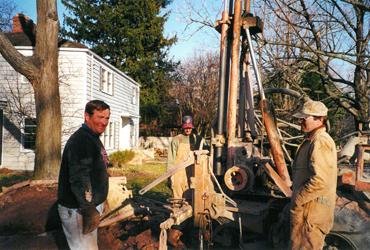
As he turned the pages slowly, he quietly asked if we were interested in efficiency. We nodded. “Well, maybe you would be interested in geothermal,” he said. My heart leapt. I remembered my enthusiasm (tinged with envy, I admit) about the Lewis Center. We would have to pay not only for the furnace and labor, but for the labor of the two local farmers who were free in their off-season to drill in our front yard four wells 150 feet deep. But this choice expressed our values so well! The Lewis Center had taught us that this technology was an investment in our planet’s future and, thinking about our children and grandchildren, we decided to go for it.
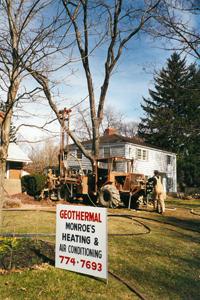
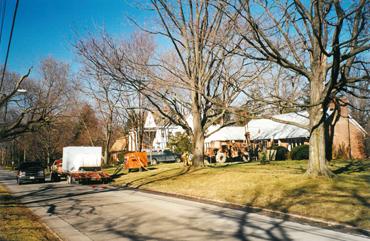
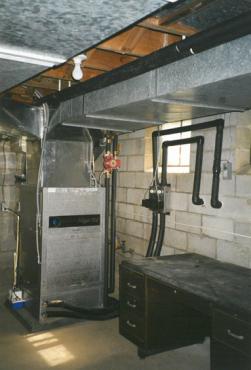
Soon the farmers arrived with their tall rigs, and drilled through the heavy clay which so often confounds local gardeners. After about 75 feet, they hit a vein of sand, and soon thereafter, some rocky material, reminding us that once this flat Ohio landscape was a mountain range, and later an inland ocean. Into these deep holes that were themselves a geology lesson, Tom and his crew placed pipes through which liquid would eventually circulate, bringing the 55-degree F temperatures 150 feet below the earth’s surface up into our home. A heat pump inside the basement wall would take care of the rest, compressing the air until it reached the temperature we’d set on our thermostat. Mercifully, the process could be reversed on the hottest summer days, so that when we turned the thermostat to the cooling mode, the hot air would travel back into the ground. Finally, the connection was made to our new hot water heater and furnace. “Furnace” however, is probably a misnomer, for nothing burns inside it: no wood, coal, oil, or gas. It is simply the largest computer in our house, in charge of supervising the whole process.
In the meantime, our property had become more distinctive, because our front yard was the only one in town that was decorated by four small mountains of mud. It would take a season or two before it would become its accustomed flat self, but in the meantime it became a source of local curiosity: “What on earth has happened in your yard?” Word got around about what we had done, so the question changed: “How do you like your geothermal system?” Our answer was that we loved it: in winter, the heat was steady and comfortable, and we finally had a refuge from sweltering Ohio heat in the summer. Soon after, similar mountains of mud sprouted around town in the yards of those who had asked us those questions. And some neighbors, who had the luxury of ponds on their property, used water to access the temperature for the heat pumps. Word gets around here.
We have lived happily with the geothermal system for 13 years now, with only one blip: a year ago, the board on which the computer chips are arranged malfunctioned and our repairman discovered its manufacturer was no longer in business. So we had to replace the “furnace” with a new one. This one is made locally, by a company financially stable enough that we can depend on parts, should we need them in the future. It is also quieter than our old apparatus.
We did not really mind the “whoosh” when the old one would turn on and off, though, for at the time it had been reassuring, like a heartbeat.
Because of the geology of northern Ohio, we caused no environmental damage, unless it was mental confusion to the earthworms confronted with temperature changes they had never expected. And people still ask us, “How do you like your geothermal system?” In a way, I suppose we are continuing to spread the message of the Lewis Center, like town gossips spreading some juicy news.
For we continue to answer, “We like it!”
Keep the conversation going with these pieces
There are no available blogs
Subscribe to our newsletter for fresh stories and community updates delivered to your inbox.
Get unlimited access to courses, exclusive member events, and a supportive network of community builders
Access all courses, books, and premium content
Member-only workshops and community builders
Member-only workshops and gatherings
We use cookies to improve your experience on our site. By using our site, you consent to cookies.
Manage your cookie preferences below:
Essential cookies enable basic functions and are necessary for the proper function of the website.
These cookies are needed for adding comments on this website.
Statistics cookies collect information anonymously. This information helps us understand how visitors use our website.
Service URL: policies.google.com (opens in a new window)
A residential project: people live here as their primary home.
An institution, business, network, or project that isn’t a residence (e.g. a learning center, farm, or network with no one living there full-time).

{{ item.label }}
{{ item.value ? item.value : currencyFormat( item.amount ) }}
Subtotal
{{ currencyFormat( pricing_summary.total_amount ) }}
There are no results matching your search