Author: Alyson Ewald
Published in Communities Magazine Issue #153
I’m a sheet-mulching, swale-digging, perennial-planting lunatic like most permies, but no matter what I do I can never seem to get enough organic matter down into our solid clay subsoil. So when I heard about hugelkultur—burying logs in the ground beneath your plants—I was instantly sold.
I began shopping around our homestead at Red Earth Farms in rural Missouri as if it were a vast open-air hugelkultur store. My partner was thrilled with my sudden interest in all his piles of wooden detritus, too rotten to become firewood or construction materials. It seemed like every bit of degraded slope on our place was crying out for trenches filled with old sticks. I roamed around with a shovel and a deranged glint in my eye until I found two perfect spots. My only question was what to plant.
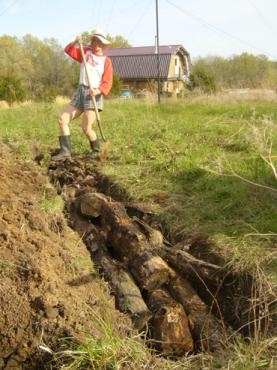
Hugelkultur, German for “mound culture,” may have roots in an ancient form of Eastern European sheet mulching. It has come to refer to a practice used by Austrian farmer Sepp Holzer and spread across the internet by permaculture maven Paul Wheaton and other bloggers. The idea is to build a raised bed by first digging a deep trench or pit and then filling it with woody stuff, adding some nitrogen-rich compost materials like grass clippings or manure if you have them, piling the soil back on top, mulching, and leaving it to break down. You can plant into it immediately or wait a while. You can also do it without the pit—just pile any soil or compost on top of a stack of logs.
The wood acts like a sponge, holding a tremendous amount of water and nutrients and feeding them slowly to your plants. The decomposing wood attracts earthworms deep into your subsoil, extends your growing season by adding warmth, creates air pockets for your plants’ roots to enter, and encourages mycelia to join the party. Sounded like a win-win-win to me.
I’d read that potatoes and cucurbits had been shown to do well in hugelkultur beds, but I had already planted those in other places. I’d also heard that the moist, decomposing logs could tie up nitrogen and lower soil pH, like a bog. I wanted to experiment with hugelkultur on a crop that I knew would enjoy the low pH. Like…blueberries!
Shockingly, the internet turned up exactly zero people who had tried blueberries in a hugelkultur bed. Clearly someone would have to launch this experiment. Then I received two things: a strong-armed intern, and a phone call from a neighbor offering me as many mature blueberry plants as I wanted. The universe was sending me a message. So we began to dig.
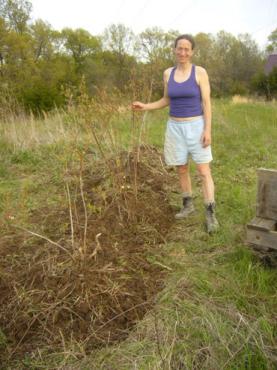
In the sites I had chosen, the soil was already quite acidic (pH 5.1). We dug a trench a few feet wide and about a foot and a half deep and laid the sodden, already crumbling logs and sticks in the bottom. Then we piled the subsoil and topsoil around the logs, stuck in some 10-year-old blueberry plants that were still holding soil around their roots, and mulched them like crazy with mown hay from our fields.
The plants initially thrived in our moist springtime. Although they had been completely neglected and unpruned in their old home, they stood proudly atop their hugels and set a fair amount of large, sweet fruit. Our daughter rejoiced in the berries and we celebrated our success.
Then came the drought. Two of the seven plants suddenly blackened and turned brittle. And I realized I had failed to heed fully two great tenets of permaculture: that we must put things in the right place, and that important functions should be performed by multiple elements.
“Place the elements of your design in ways that create useful relationships and time-saving connections among all parts,” says Toby Hemenway, author of Gaia’s Garden. Well, of course I was aiming for a placement that would create those connections. That’s why I’d planted them along a frequently traveled path, where my community members and I could observe and tend (and harvest) easily. And that’s why I had chosen them to extend the “edge” of our orchard, where scything and leaf-fall would generate sufficient mulch nearby. I had placed them uphill of the rest of the orchard, so that any excess nutrients would run down to the fruit trees, and so that liming the orchard would not raise the pH of the blueberry bed. I was stacking functions—the logs would hold water and build organic matter and soil health, the perennial plants would hold soil and provide food, wildlife cover, beauty, and mulch, and the mound and hedge as a whole would help buffer the orchard against prevailing winds. I was turning a problem (acidic soil, unsightly log piles) into a solution (tasty berries). I had even placed the mounds along a slope so they would catch and store water, reducing runoff and protecting against erosion. What had I done wrong?
As the hot, dry July days continued, the answer became painfully clear: I had placed them far uphill from the only source of water—our pond. This was not a useful relationship or a time-saving connection. There was no element serving the all-important function of providing adequate water to saturate the logs, encourage them to compost, and fill the cavities between them and the soil. The poor plants were left literally high and dry, and I had little patience for hauling buckets of water up the hill in a cart.
The saving grace at this juncture turned out to be community. Thank God I do not live alone out here on the prairie. Family, friends, and neighbors have all helped me get adequate water and more mulch to the blueberries, and despite a continuing drought we have managed collectively to stave off the death of the five remaining plants. Spring will tell whether the hugelkultur experiment has succeeded.
Interestingly, the blueberries closest to our house have shown no difficulty at all. I suspect they have received more attention, mulch, urine, and water than those farther away. Which reminds me of another principle I forgot—start close to home and work slowly outward. A friend just gave me a couple more young blueberry plants, which I’m planning to put near the surviving ones closest to the house (and pond).
Sometimes I think I learn more from my failures than from my successes. Hey, guess what? That’s Toby Hemenway’s Permaculture Principle #14: “Mistakes are tools for learning.” At least there’s one principle I’m following. I’m considering building my next hugelkultur beds right here below the house, downhill from the pond. I think I’ll put in potatoes.
Keep the conversation going with these pieces
There are no available blogs
Subscribe to our newsletter for fresh stories and community updates delivered to your inbox.
Get unlimited access to courses, exclusive member events, and a supportive network of community builders
Access all courses, books, and premium content
Member-only workshops and community builders
Member-only workshops and gatherings
We use cookies to improve your experience on our site. By using our site, you consent to cookies.
Manage your cookie preferences below:
Essential cookies enable basic functions and are necessary for the proper function of the website.
These cookies are needed for adding comments on this website.
Statistics cookies collect information anonymously. This information helps us understand how visitors use our website.
Service URL: policies.google.com (opens in a new window)
A residential project: people live here as their primary home.
An institution, business, network, or project that isn’t a residence (e.g. a learning center, farm, or network with no one living there full-time).

{{ item.label }}
{{ item.value ? item.value : currencyFormat( item.amount ) }}
Subtotal
{{ currencyFormat( pricing_summary.total_amount ) }}
There are no results matching your search